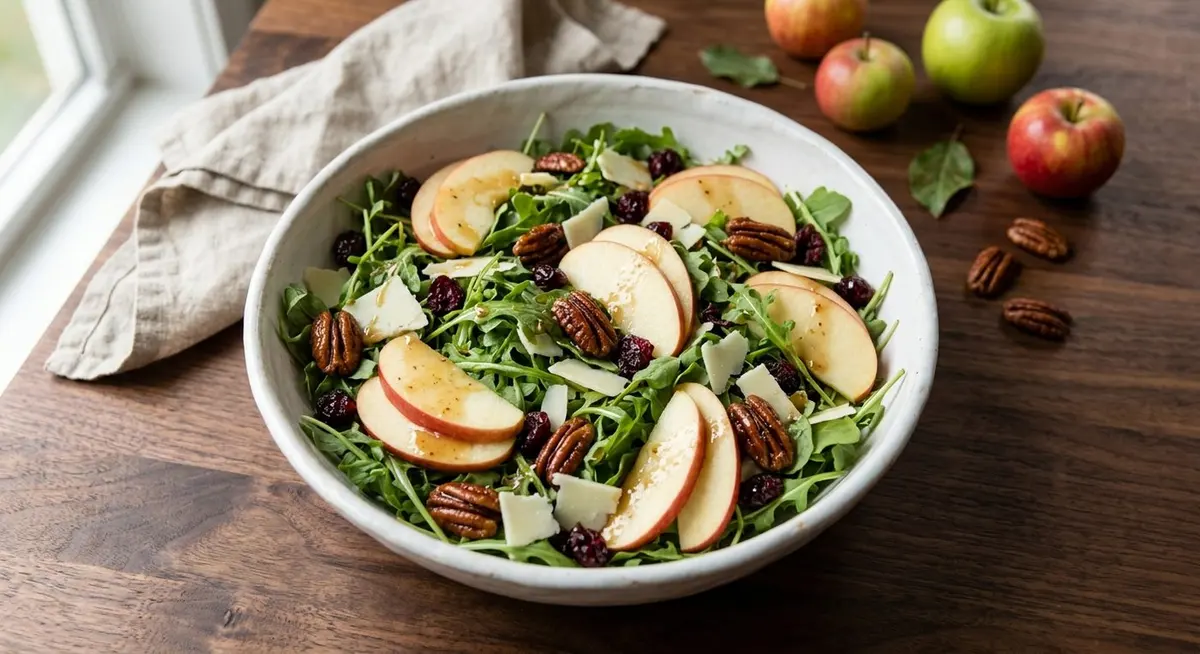
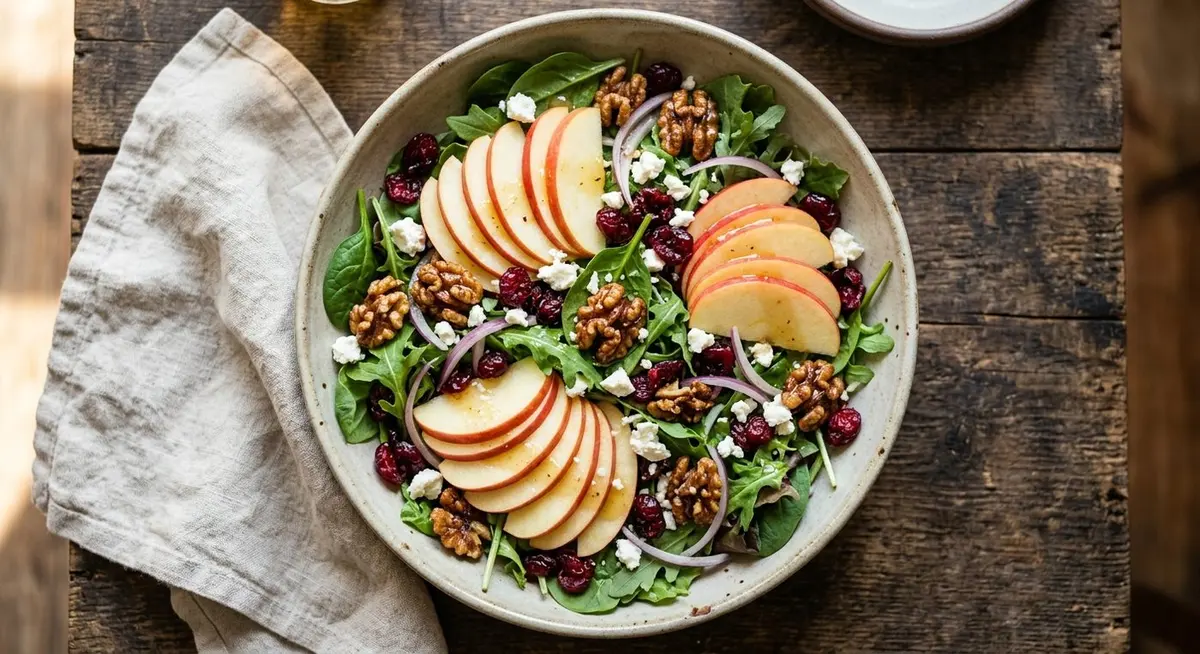
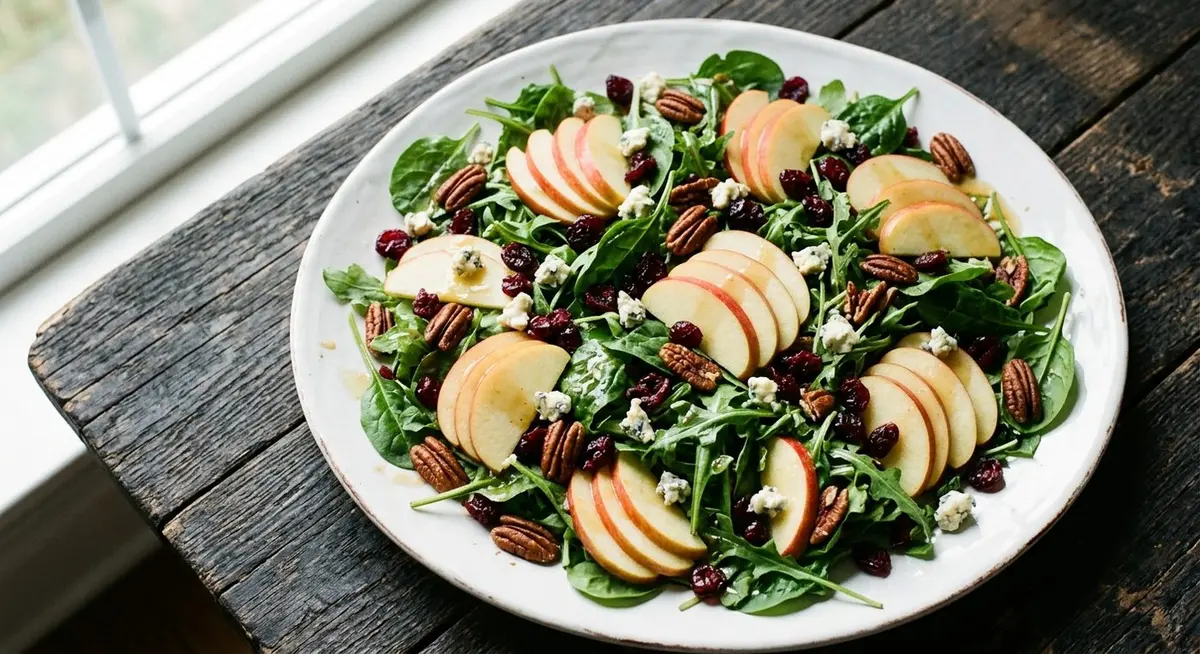
Crisp apples, peppery greens, a snowfall of sharp white cheddar and a handful of crackly candied pecans, all pulled together with a maple balsamic vinaigrette that tastes like the whole season in one spoonful. This is the salad that shows up on my table from the first cool week of September straight through to the holidays — and it takes about fifteen minutes from fridge to serving bowl.
Most autumn salads have one good idea and a lot of padding. This one has a structure I come back to every year: something crisp, something peppery, something salty and something sweet, with a dressing that carries a little acidity to keep it all from turning heavy.
The balance is deliberate. Arugula brings a peppery bite that keeps the sweet apples in check. Sharp white cheddar cuts through the maple. Dried cranberries add a tart chew that contrasts with the crackling sugar glaze on the pecans. Nothing in the bowl is doing the same job as anything else, which is why it never feels like a pile of ingredients — it reads as one composed dish.
It is also genuinely fast, and it scales without fuss. I have made a single bowl for two and a triple batch in a roasting pan for a crowd, and the only thing that changed was how long the apples took to slice.
Short on time? Make the candied pecans and the vinaigrette on Sunday, keep the greens washed and dry in the fridge, and this becomes a five-minute assembly job on a weeknight.
What Goes Into It, and Why
Every component is here for a reason. Swap anything and you are making a different salad, which is fine — just know which dial you are turning.
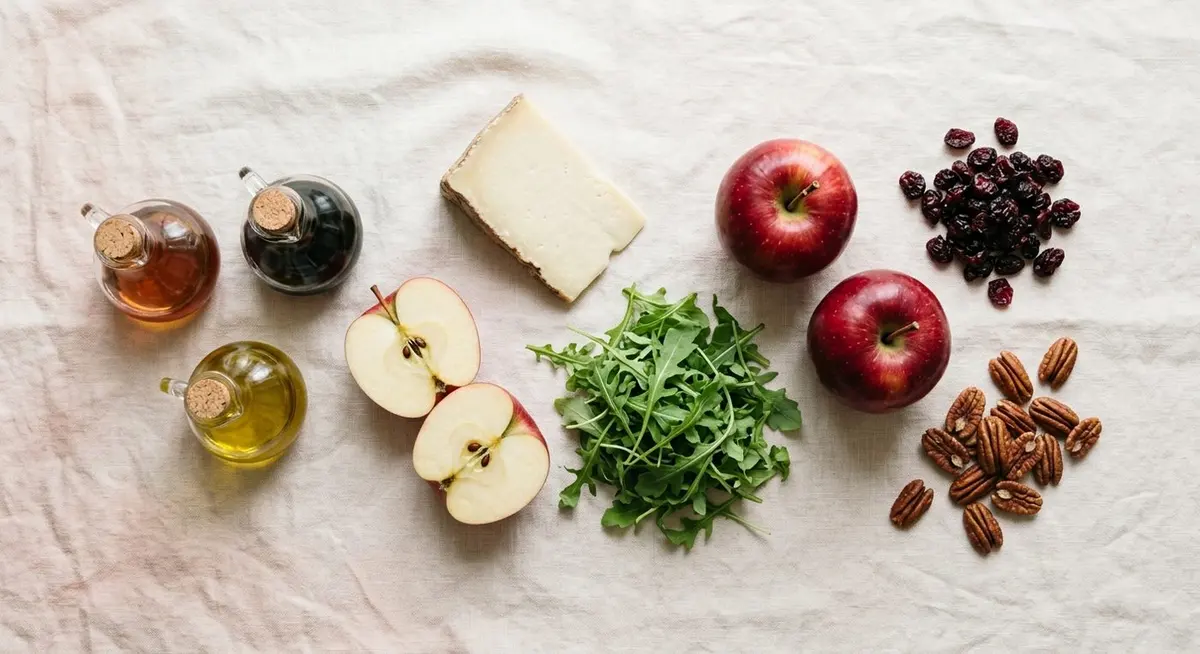
Everything the salad needs, laid out. Two apples, a wedge of sharp cheddar, a bag of peppery greens and a handful of pantry staples.
Ingredients at a glance
Component
What to look for
Why it matters
Greens
Arugula, or a 50/50 mix of arugula and butter lettuce
Peppery bite balances the sweet fruit; sturdy enough not to collapse under toppings
Apples
One sweet, one tart — see the section below
Two varieties give you depth instead of a single flat note
Cheddar
A block of aged white cheddar, sharp or extra-sharp
Salty, tangy and firm; pre-shredded cheese is coated in starch and tastes dusty
Pecans
Raw pecan halves, not pieces
Halves candy evenly and look deliberate in the bowl
Dried cranberries
Unsweetened or lightly sweetened
Tart chew that cuts the glaze on the nuts
Maple syrup
Pure, grade A, amber or dark
Pancake syrup is corn syrup with flavoring and will taste thin
Balsamic vinegar
Everyday balsamic, not a $40 aged bottle
You want acidity and depth here, not a syrup you would sip
One shopping note that saves dinner: buy the cheddar as a block and shave it yourself with a vegetable peeler. Pre-crumbled or pre-shredded cheese is coated in cellulose and potato starch to stop it clumping, and those same coatings keep it from melting on the tongue. On a salad where the cheese is a main texture, it shows.
Pick the Right Apples
The single biggest upgrade you can make to this salad is buying two kinds of apples instead of one. A sweet apple alone disappears into the maple dressing. A tart apple alone can make the whole bowl taste sharp. Together they give you the sweet-tart tension that makes people go back for seconds.
For sweetness and aroma
Honeycrisp — explosive crunch, honeyed juice, and it holds up for a whole meal without browning. My first choice if you only buy one.
Fuji — reliably sweet, dense and crisp, and cheaper than Honeycrisp almost everywhere.
Gala — mild and forgiving, good for a crowd where you do not know preferences.
For acidity and structure
Granny Smith — the classic baking apple and the classic salad apple. Firm, bracingly tart, barely browns.
Braeburn — sharper than it looks, with a spiced finish that flatters the maple dressing.
Pink Lady — bright, winey acidity and a very firm bite; excellent sliced thin.
How to slice them so they do not wilt the greens
Cut around the core into four cheeks, then slice each cheek crosswise into thin half-moons about an eighth of an inch thick. Thin slices read as elegant and they take the dressing evenly; thick wedges sit on top of the greens like boulders and taste raw.
Toss the slices in a teaspoon of lemon juice the moment they are cut. Not for flavor — for the polyphenol oxidase, the enzyme that turns cut apple brown. A little acid disables it, and your salad still looks fresh forty minutes later.
Peel or not? Leave the peel on. It carries most of the apple’s fiber and almost all of its colour, and on a salad the deep red rim around each pale slice is the visual hook that makes the bowl look like autumn.
The Cheddar Question
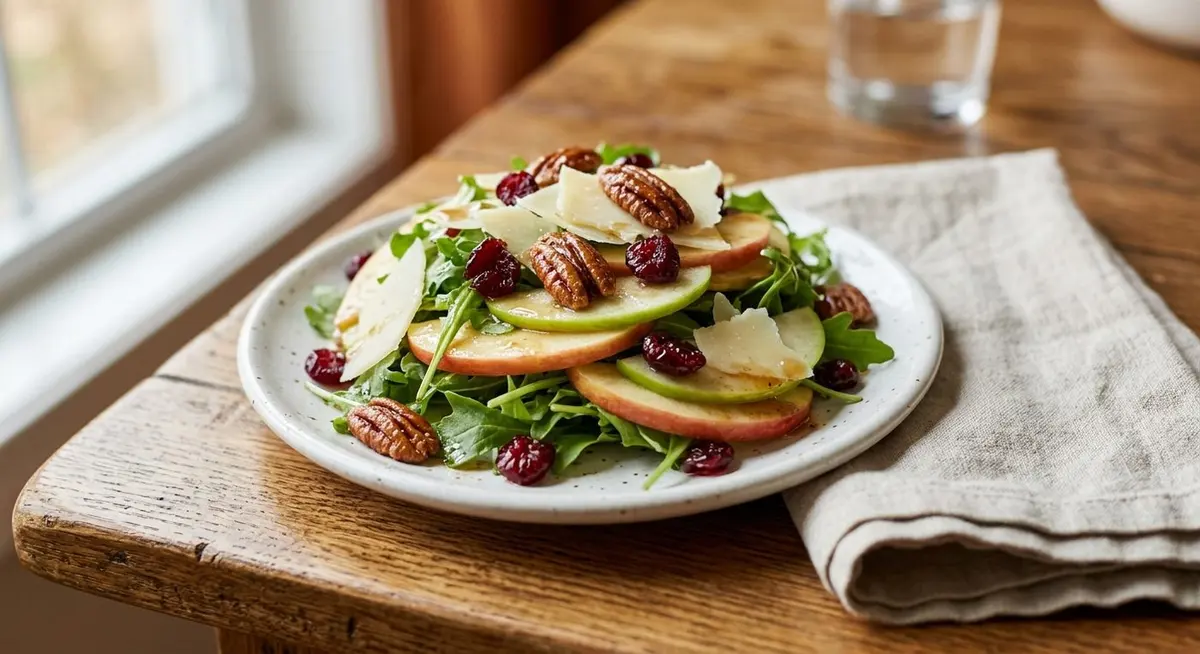
Sweet apple, salty cheddar, tart cranberry, crackly pecan — four textures doing four different jobs.
Sharp white cheddar is the right cheese here for a specific reason: it is salty and acidic enough to stand up to maple syrup without turning cloying, and it shaves into thin petals that drape over the greens instead of sitting on them like croutons.
Use a vegetable peeler to shave ribbons off the block, then break the ribbons into rough petals with your fingers. You get far more surface area than cubes would give you, so a small amount of cheese seasons mouthfuls all over the bowl.
If you want to change the cheese
Feta — sharper, saltier, more crumbly. Crumbles everywhere; use a little less and skip added salt.
Blue cheese — a bigger swing. Excellent with the apples and pecans, but it will dominate. Start with a third of the amount.
Parmesan or pecorino — nuttier, drier, closer to a Caesar energy. Shave it just as thin.
Goat cheese — creamier and tangier, and it makes the salad feel more like a plated restaurant dish. Crumble it cold so it does not smear.
Make it vegetarian by default. Everything in this recipe as written is naturally meat-free — the salt comes from the cheese and the candied pecans. That means you can serve it alongside a roast without it reading as a side dish built for meat.
Candied Pecans in Five Minutes
You can buy candied pecans, and on a rushed week I sometimes do. But the stovetop version is genuinely five minutes of work, needs no candy thermometer, and the pecans come out with a thin, crackling shell rather than the thick candy coating you get in a bag. It is also the single component that makes people ask what is in the salad.
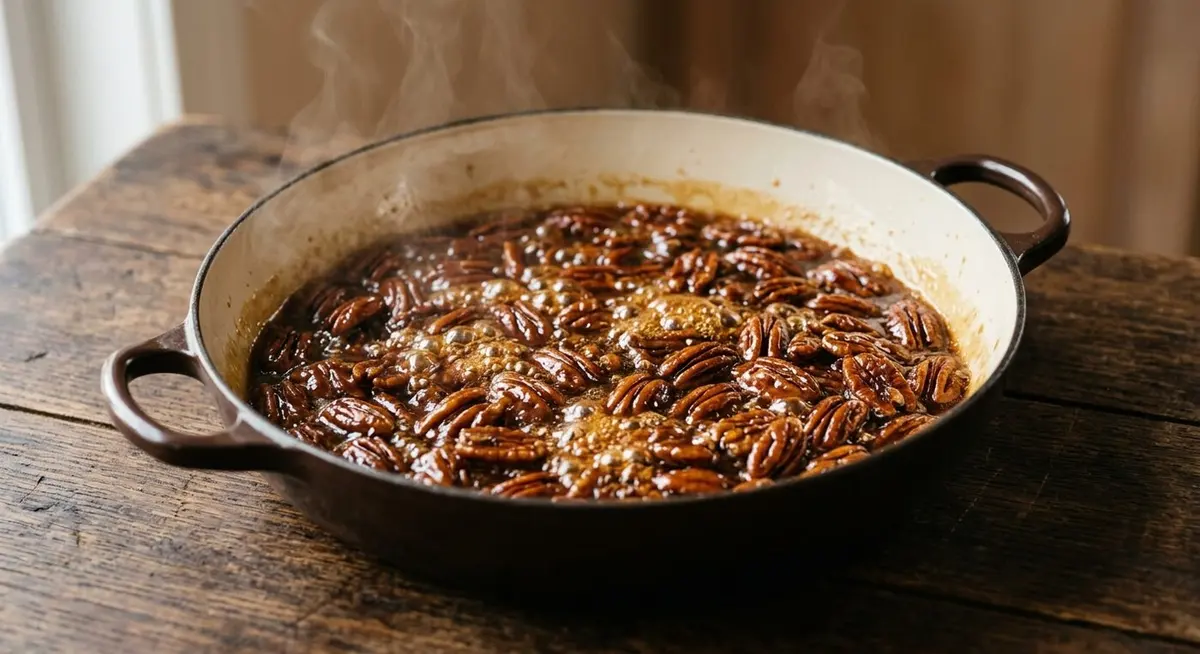
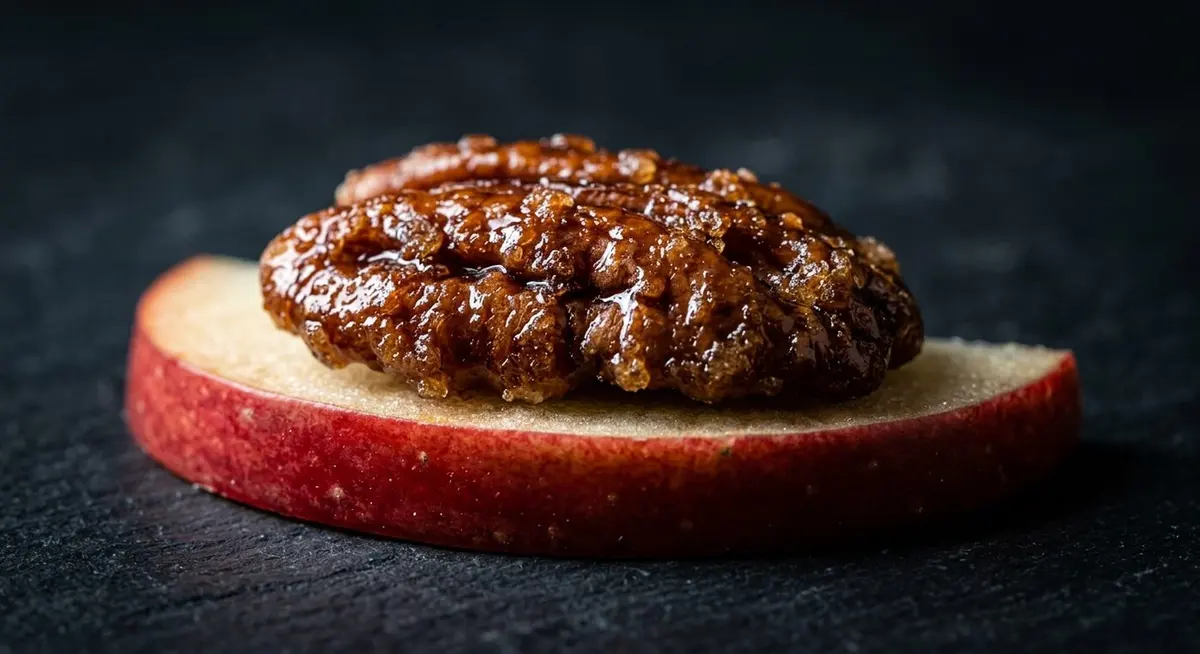
Sugar, a splash of water and a little cinnamon. The glaze tightens around the nuts in about three minutes.
The method
Set a dry skillet over medium heat. Add the pecan halves and toast them for two minutes, stirring, until they smell nutty. Toasting first is what gives you depth; skipping it is why homemade candied nuts sometimes taste flatly sweet.
Push the pecans to one side and add the brown sugar, water, cinnamon and a pinch of salt to the empty side of the pan.
Stir the sugar mixture until it dissolves into a loose syrup, about 45 seconds, then pull the pecans through it and stir constantly.
Keep stirring for two to three minutes. The syrup will bubble, then thicken, then suddenly coat the nuts in a shiny amber shell. That moment is your cue to take the pan off the heat.
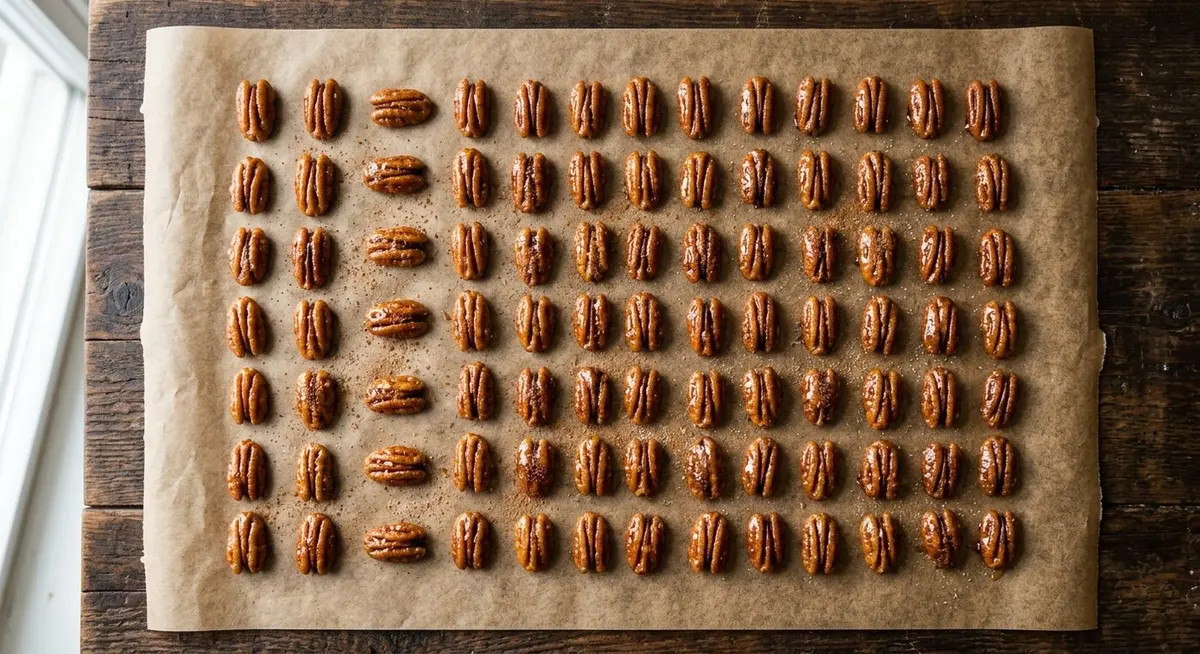
Tip the pecans onto parchment in a single layer and leave them alone for ten minutes. They crisp as they cool — eating one hot will taste soft and you will think you failed.
Spread them out in one layer on parchment. A pile will steam itself soft and you will lose the crunch you just built.That thin, glassy shell is what separates stovetop candying from the thick, tooth-sticking kind.
The one way this goes wrong: walking away. The window between “glossy and perfect” and “burnt and bitter” is roughly thirty seconds. Stay at the pan once the syrup starts to thicken.
If you would rather use the oven
Toss the pecan halves with a beaten egg white, a tablespoon of water, then a half cup of brown sugar mixed with cinnamon and salt. Bake at 300°F for about 45 minutes, stirring every 15, and cool completely on the tray. The coating is thicker and more candy-like, and it makes a bigger batch with less attention.
The Maple Balsamic Vinaigrette
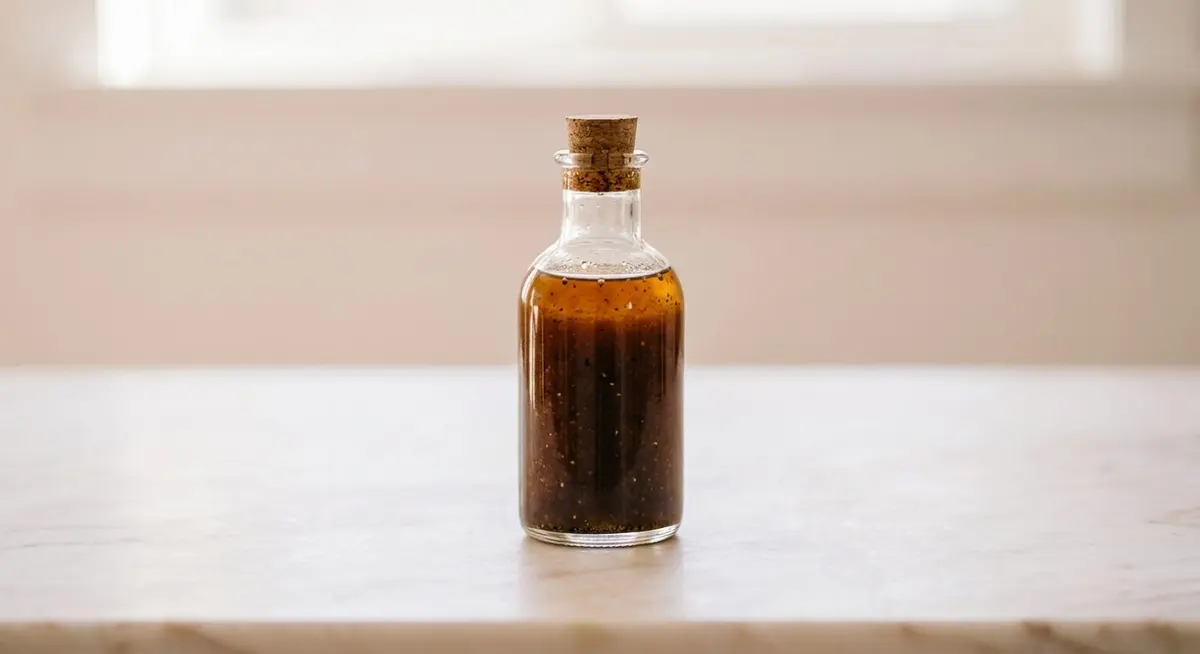
This dressing is a ratio more than a recipe, and once you have it in your head you can make it without measuring. Three parts balsamic to one part maple to one part mustard to ten parts olive oil, plus garlic and seasoning. The mustard is not there for flavour so much as for chemistry — it is an emulsifier, and it is the reason your dressing stays creamy instead of splitting on the greens.
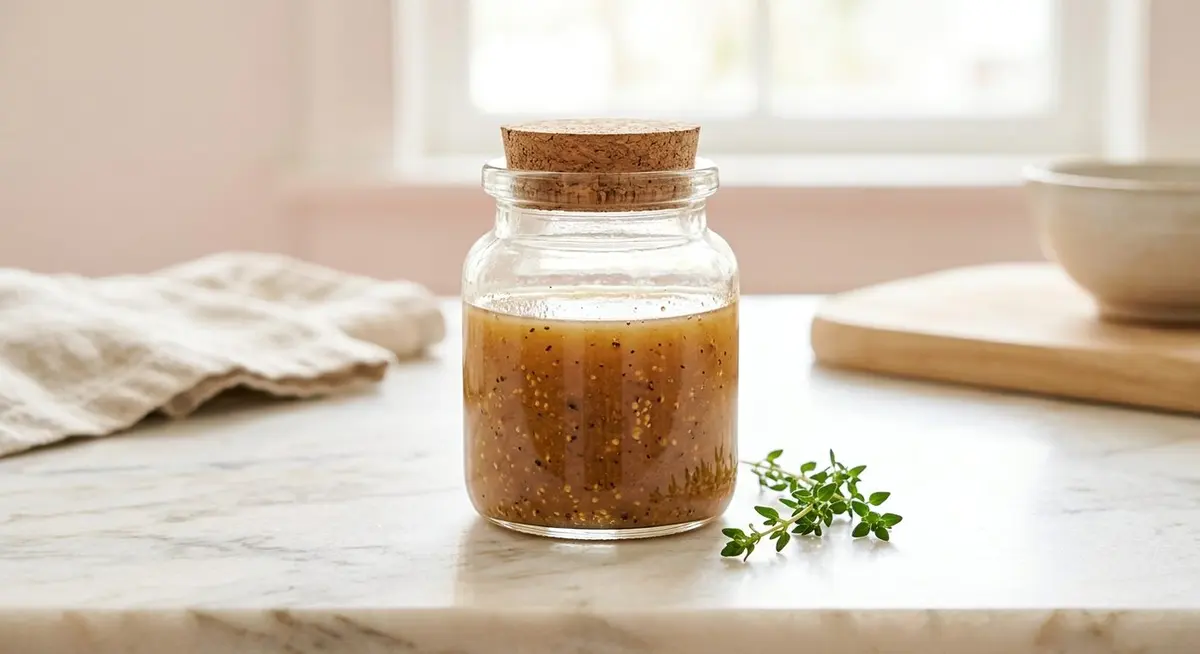
Make it in a jar. Shake, dress, refrigerate the rest — no whisking, no bowl to wash.
Maple balsamic vinaigrette, single batch and doubled
Ingredient
Single
Doubled
Balsamic vinegar
3 tbsp
1/2 cup + 2 tbsp
Pure maple syrup
1 tbsp
2 tbsp + 2 tsp
Dijon mustard
1 tsp
2 tsp
Garlic, finely grated
1 small clove
2 cloves
Olive oil, extra virgin
1/3 cup
3/4 cup + 1 tbsp
Salt and black pepper
to taste
to taste
Put everything except the oil in a lidded jar. Shake hard for fifteen seconds, then add the oil and shake again for another twenty. The dressing will go glossy and slightly thick. Taste it on a leaf of arugula, not on a spoon — the greens change how much salt you need, and every batch of arugula is a little different.
Grate the garlic on a microplane rather than chopping it — grated garlic dissolves into the dressing and never lands as a raw chunk on someone’s fork.
Too sharp? Too sweet? Balsamic varies wildly between brands. If the dressing tastes harsh, add another half teaspoon of maple. If it tastes flat, a teaspoon more vinegar and a pinch more salt will wake it up.
How to Assemble Without Wilted Greens
Assembly is where a good salad becomes a great one, and it comes down to one principle: dress the greens, then stack everything else on top. If you toss the whole bowl together with all the dressing, the pecans go soft, the cheese disappears and the dried fruit sinks to the bottom where nobody finds it.
Dry the greens properly. Spin them, then lay them on a clean towel and blot. Water on the leaves dilutes the dressing and is the fastest route to a limp salad.
Put the arugula in a wide, shallow bowl and add roughly a third of the vinaigrette. Toss with your hands until every leaf has a light sheen and nothing pools at the bottom.
Scatter the apple slices over the top in a loose, even layer. Do not toss them in.
Add the cheddar petals, the dried cranberries and the candied pecans in that order, so the nuts stay proud on the surface.
Drizzle the remaining dressing over the top in a thin ribbon, then finish with flaky salt and a few grinds of black pepper.
Leave it alone for two minutes before serving. The salt on top pulls a little moisture from the apples and cheese down into the greens, which is exactly the seasoning you want.
Dress the greens first, then build upward. Everything on top keeps its texture, and the bowl still looks composed at the table.
The Make-Ahead Plan
This is one of the better salads for entertaining precisely because almost all of it can be done in advance. The only thing that cannot be prepped is the sliced apple, and even that holds for a few hours with lemon juice.
What to prep when
When
Do this
Keeps
Up to 7 days ahead
Candy the pecans; store in an airtight jar at room temperature
1 week
Up to 5 days ahead
Whisk the vinaigrette in a jar and refrigerate
1 week
Up to 3 days ahead
Wash, dry and refrigerate the greens in a lidded container lined with paper towel
4 days
Up to 3 days ahead
Shave the cheddar and store it in a zip bag with the air pressed out
5 days
Morning of
Slice the apples and toss with lemon juice
6 to 8 hours, chilled
Just before serving
Toss greens with a third of the dressing and build the bowl
Serve immediately
The paper-towel trick: line your greens container with a clean, dry paper towel before adding the leaves and put a second one on top. The towels soak up the condensation that would otherwise collect on the lid and drip back onto the leaves. Your greens will still be crisp on day four.
Variations and Add-Ins
Once you know the formula — crisp, peppery, salty, sweet, acidic — you can move it around the map without losing the plot.
Swap the fruit
Pears — Bosc or Anjou, sliced thin. Softer and more floral than apple; use them the same day.
Fuyu persimmon — orange discs with a honeyed, almost melon-like sweetness. Stunning in November.
Grapes — halve red grapes for a juicier, more kid-friendly bowl.
Pomegranate arils — keep the apple and add a scattering of pomegranate for jewel-like crunch.
Swap the crunch
Walnuts — candy them exactly the same way; they are softer and slightly more bitter, which suits the cider-sweet version of this salad.
Pumpkin seeds — toast them in a dry pan and skip the sugar for a lighter, everyday version.
Toasted sourdough croutons — tear rather than cut, toss in olive oil and bake until golden.
Make it a main
Roast chicken — shredded warm or cold, straight from a simple roast, is the most obvious and probably the best.
Crisp bacon — crumbled, and reduce the salt in the dressing to compensate.
White beans or chickpeas — a can, rinsed and dried, turns this into a sturdy lunch that travels well.
Cooked farro or wild rice — add a half cup per serving and slightly increase the dressing.
Seasonal pivot: in place of the dried cranberries, use halved red grapes in early autumn and pomegranate arils from November. Both give you the same tart sweetness with better texture at their peak — the same logic behind pairing seasonal produce properly in a butternut squash soup.
What to Serve It With
This is a side that behaves like a starter. It is bright enough to open a heavy autumn meal and sturdy enough to sit beside roasted meat without being lost.
Alongside a main
Roast chicken, roast pork or a simple Sunday roast — the acidity cuts through the fat.
Sheet pan chicken fajitas on a weeknight, when you want something quick that still feels like a real dinner.
For Thanksgiving or Christmas, this salad does something the usual green bean casserole cannot: it brings colour and acidity to a plate that is otherwise beige and heavy. Build it in a wide, shallow platter rather than a deep bowl so it reads as a generous, deliberate dish among the roasts. If you are planning the whole meal, the four-week meal plan system is where I lay out holiday-week timing so nothing lands at the same moment.
As a starter
Serve a smaller portion on a chilled plate with the pecans scattered last, and it works beautifully as a first course. Add a slice of warm, crusty bread and you have a lunch that needs nothing else.
Storage, Safety and Leftovers
Dressed salad does not keep. Once the vinaigrette is on the greens, you have a window of an hour or so before the leaves soften — which is why the advice to dress at the last minute is not fussiness but the actual difference between crisp and soggy.
If you have leftovers
Pick the leftovers apart rather than storing the tossed salad as it is. Lift out any whole pecans, cheese petals and apple slices and keep them separately; the greens that were dressed are best eaten cold the next day as a sort of chopped salad, or blitzed into a green dressing. Store everything in the refrigerator, in airtight containers, and eat it within a day.
How long each part keeps
Component
Refrigerator
Room temperature
Candied pecans
2 weeks
1 week in an airtight jar
Maple balsamic vinaigrette
2 weeks
Not recommended
Washed, dried greens
4 days
—
Sliced apples, lemon-tossed
6 to 8 hours
—
Fully tossed salad
Eat the same day
Not past 2 hours
Undressed assembled salad
1 day
—
The two-hour rule, plainly. Perishable food left out at room temperature should be refrigerated within two hours — one hour if the room is above 90°F. A dressed salad on a buffet is exactly the kind of dish that sits out longer than anyone intends, so if you are entertaining, keep the serving bowl in a cool spot and top up from the fridge rather than putting the whole batch out at once.
Transporting it to a gathering? Carry the components separately — greens in one container, toppings in another, dressing in a jar — and build the salad in the host’s bowl when you arrive. It takes four minutes and the difference is enormous.
Troubleshooting and Questions
These are the things that come up most often when people make this salad for the first time.
My pecans came out sticky instead of crunchy. What went wrong?
Almost always the cooling step. Sugar coatings stay soft while warm and set as they cool, so if you tasted one straight from the pan it will seem sticky when it is actually fine. If they are still tacky after fifteen minutes on parchment, they were undercooked — return them to the pan with a teaspoon of water and cook another minute. Generally to make candied nuts crisp, spread them in a single layer and never pile them.
The salad went limp before we sat down. How do I stop that?
Two causes: wet greens, or dressing too early. Dry the leaves thoroughly after washing, and dress only the greens rather than the whole bowl. If you need to hold it, keep the dressing on the side and pour it at the table — it looks intentional and it solves the problem completely.
Can I make this salad dairy-free or vegan?
Yes, and it is a small change. Shave the cheese out entirely and add an extra handful of candied pecans plus a tablespoon of toasted pumpkin seeds for the salty crunch. Use maple syrup in place of honey if your recipe calls for it, and check that your balsamic has no added honey. Nothing else in the bowl needs changing.
Which apples are best for a fall salad?
Use two varieties whenever you can. A sweet, crunchy apple such as Honeycrisp or Fuji paired with a sharp one such as Granny Smith or Pink Lady gives you the sweet-tart contrast the dressing is built for. Cut them into thin half-moons and toss with a squeeze of lemon so they stay pale and crisp.
How far in advance can I assemble this?
Prep every component up to three days ahead and keep the apples sliced the morning of. Assemble the bowl about ten minutes before serving — that short rest lets the salt on top season the greens without softening them.
Can I use bottled dressing instead?
You can, but a bottled balsamic is usually much sweeter and thinner than a fresh vinaigrette, and it will flatten the balance. If you are short on time, a squeeze of lemon, a drizzle of olive oil and a pinch of salt is closer to what the salad wants than anything from a shelf.
Free Printable: The Fall Salad Planner
A two-page printable companion to this salad — the shopping list, the do-ahead timeline, the vinaigrette ratio card and a blank builder so you can invent your own autumn combinations all season.
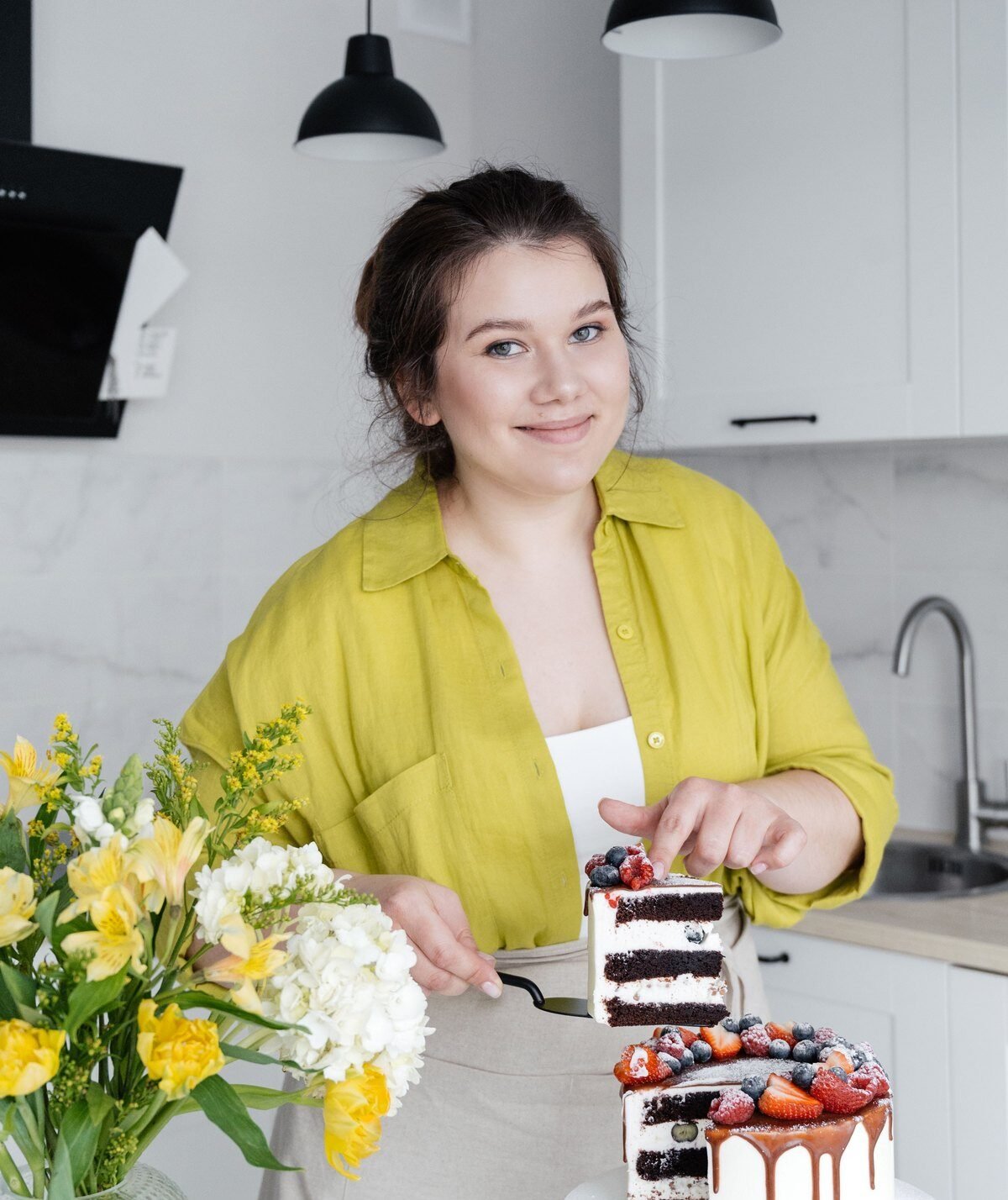
Elowen Thorn I cook, photograph and re-test every recipe in an ordinary home kitchen before it goes up, so what you make matches what you see. Savory Discovery is where simple weeknight cooking, seasonal ideas and the odd bit of kitchen craft sit side by side — written plainly, and worth cooking twice.