By Elowen Thorn · Savorydiscovery.com · about 14 minutes
The eight o’clock standoff almost never starts at eight. It starts at 6:40, when a small person announces that tonight is not a bath night. It ends at 9:15, with you sitting on the floor beside the bed, negotiating exactly how many sips of water legally count as a drink.
If that is your evening, here is the thing worth knowing before you try anything else: bedtime asks a child to make something like fifteen decisions in a row, at the precise hour their brain has the least capacity to make any of them. Pajamas or no pajamas. Which pajamas. Teeth before the story or after. Which story. One more story. Water. Which cup. Light on or off. Door open or closed. And then, at the very end, the biggest decision of all: whether to let go of the day.
Night routine cards fix that by moving the decisions out of the moment. Instead of fifteen questions fired at a tired child, the evening becomes a short, visible sequence they can run themselves. You stop being the one who says no, because the cards say what happens next.
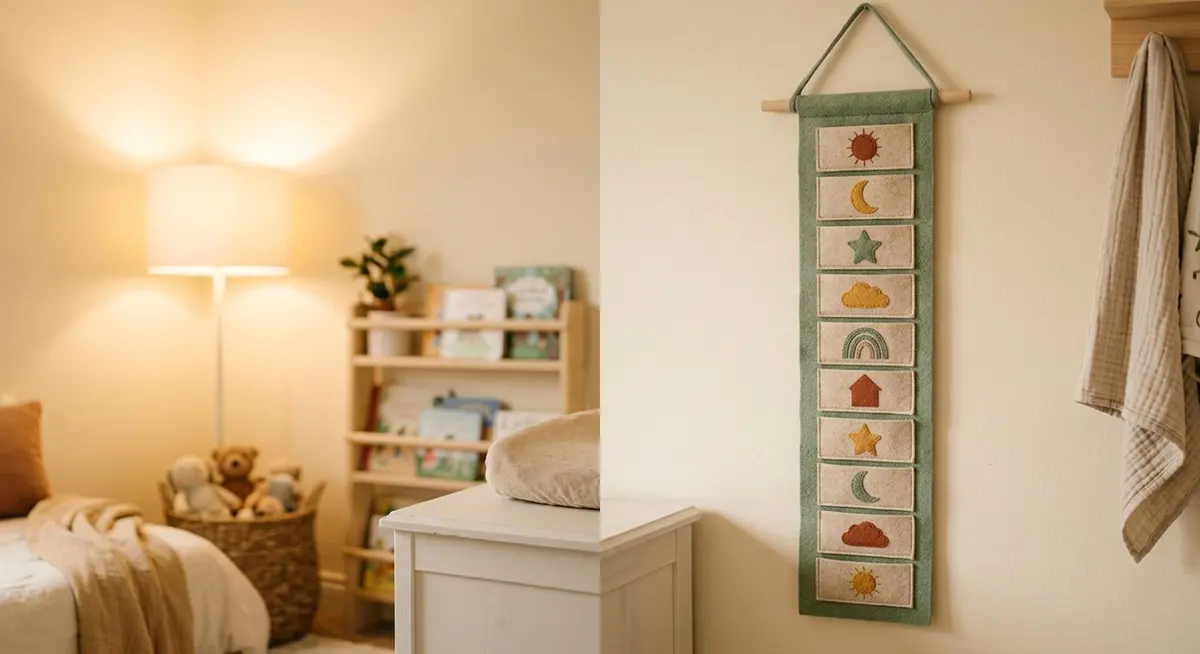
Simple picture cards on the wall take the decisions out of the moment. That is most of why they work.
What follows is the whole system. Why bedtime unravels the way it does, what the sleep research actually supports, how to set the cards up in five minutes, how to choose the right four to six steps, what to say on the first three nights, an age-by-age guide from toddlers to ten-year-olds, and what to do on the nights it all collapses anyway.
I have also put the cards themselves into a printable pack — illustrated cards, a blank set, a weekly planner and a star chart — so you can start tonight rather than after a trip to the shops.
Why bedtime unravels at the same time every night
There is a reason the resistance clusters around bedtime rather than, say, lunch. Two forces collide there, and neither of them is a discipline problem.
The first is decision fatigue. A child who has spent the day holding it together at nursery or school arrives home with a finite budget for choosing things. By evening, that budget is spent. Ask them to pick between two pairs of pyjamas and you are asking for a decision they genuinely no longer have the resources to make. What looks like defiance is often depletion.
The second is transition. Bedtime is the sharpest transition of a child’s day. It moves them from company, light and activity to solitude, dark and stillness — in one go, on command. Adults rarely tolerate that kind of gear change without a run-up. We need the desk tidied, the lights down, a last look at the phone, a shower. Children are asked to do it cold.
Add a third ingredient and you get the loop most of us know by heart: autonomy. Around the age of two, children work out that they are separate people with opinions, and bedtime is the single richest seam of leverage they have all day. You are tired. They can tell. Every request they make — water, a hug, the door a crack wider — is a bid for one more minute of connection and one more unit of control.
By evening a child’s capacity for choosing things is largely spent. Every decision you hand over lands on a nearly empty tank.
The fifteen-decision problem
Count the choices in a typical bedtime. I have watched parents do this on paper, and the number is consistently between twelve and twenty. Each one is small. Collectively they are the whole evening.
A routine that is written down and visible collapses that list into a single instruction — follow the cards — and hands the choices back to the child in a form they can manage: not what happens next, but the order it happens in, and whether they get there themselves.
Why a picture beats a reminder
Spoken instructions have a short shelf life. Ask a five-year-old to remember five things you just said and you have set them up to fail, and failing feels awful, and feeling awful is not a state anyone falls asleep easily from.
A picture does something different. It sits outside both of you. When your child wanders off mid-routine, you are not the one issuing a correction — you are pointing at the wall. The message becomes the chart says teeth next rather than I say teeth next, and that small grammatical shift removes an enormous amount of friction, because there is nothing to argue with.
The cards do not need to be obeyed. They need to be consulted. That is a much smaller ask, and it is why children so often go along with them.
What makes it worse — and it is not the child
A few things reliably sabotage an otherwise decent routine, and all of them are in the adult’s control.
Screen light in the final hour. Bright screens push the body’s sleep signal later. Blue-white light is the worst offender; amber light the least disruptive.
A bright bedroom. A room that looks gently dim to you can still read as daytime to a child, because children’s eyes let in proportionally more light than adult eyes do.
Rough-and-tumble play right up to lights out. It is lovely, and it is the opposite of a wind-down. Give it its own slot earlier in the evening.
A routine that runs on your memory. If it only exists in your head, it changes shape every night, and the whole point is that it does not.
A start time that drifts by forty minutes. The sequence matters, but so does the consistency of the start. The body reads the clock as much as the order.
The short version: bedtime is hard because it combines a depleted decision budget, the sharpest transition of the day, and a child’s most reliable source of leverage. Cards work on all three at once — they remove the decisions, structure the transition, and hand back a form of control that costs you nothing.
What the research actually supports
Bedtime advice is everywhere and most of it is vibes. It is worth separating the claims with real evidence behind them from the ones that merely sound authoritative, because you only have so much energy to spend on an evening.
The strongest finding: consistency is the active ingredient
The best-known work here is a large study of young children across several countries, published in the journal Sleep in 2015. It found a clear dose-response relationship: children with a nightly bedtime routine fell asleep faster, slept longer, and woke less often overnight than children whose routine was inconsistent or absent. Crucially, the benefit scaled with frequency. It was not a yes-or-no thing. Every additional night the routine was followed added a little more.
That single detail should shape how you set this up. A four-step routine you actually do beats a nine-step routine you manage twice a week. If you take one thing from this whole guide, take that.
The American Academy of Sleep Medicine builds on the same line of research and recommends a short routine of roughly 20 to 30 minutes, made from the same three or four calming activities, in the same order, every night. Notice what is not in that sentence: complexity, duration, or novelty. The recommendation is deliberately boring.
Worth knowing too: sleep difficulties are common rather than a sign of a broken family. Around half of children experience them at some point, often around schedule changes and stressful periods. You are not an outlier.
The evidence favours a short, identical sequence over a long, impressive one. Fewer steps, done nightly.
Why visual supports earn their place
Cards are not just a cute craft. Visual supports — pictures that show what is happening and in what order — are among the better-evidenced tools in child development practice for reducing anxiety, reducing challenging behaviour, and building independence. They are used routinely with autistic and ADHD children precisely because they work, and the same mechanisms apply to every child: an unpredictable moment becomes something you can see, understand, and act on.
The useful reframe is this: a visual schedule does not tell a child what to do. It tells them what is already going to happen. That is a much more comfortable thing to be shown.
What the evidence does not support
Being honest about the limits of the research is part of using it well. These are the claims that outrun their evidence:
Claim
What the evidence actually shows
The routine must be exactly 20 minutes
The 20–30 minute band is a recommendation, not a threshold. What matters most is that the sequence is the same and happens nightly.
Lavender, warm milk or a specific bath product fixes sleep
These may help a child relax, and a relaxed child sleeps more easily, but they are not sleep treatments. The routine itself is doing the work.
One technique works for every child
Not established. Studies compare routine versus no routine, not method versus method. There is no single best way to run the sequence.
Melatonin supplements are a first-line answer
Guidance supports short-term use in specific circumstances and under medical advice for children. It is not a substitute for a routine, and not a do-it-yourself decision.
If it is not fixed in a week, it will not work
Behaviour change takes repetition. Expect the first three or four nights to be the worst, not the benchmark.
Two more findings worth stealing
Reading lowers arousal. Reading before bed is associated with a lower heart rate and lower anxiety than most alternatives — which is why it earns a permanent card in the sequence rather than being the thing you cut when you are running late. If you have to trim the routine on a late night, trim the bath, not the story.
Light colour matters. If your child needs a night light, an amber or red lamp is markedly less disruptive to the body’s sleep signal than a blue-white one. Same for screens: if a screen has to be part of the evening, put it in the early part, not the last twenty minutes.
What this adds up to: same steps, same order, most nights, short enough to survive a bad evening. Everything else in this guide is in service of making that possible.
The five-minute setup
You do not need laminating pouches, a cutting machine or a laminator. You need a printer, something to cut with, and five minutes. Here is the whole thing.
Print at 100%. Choose actual size in the print dialogue, not fit to page. Fit-to-page shrinks the cards by a few percent, which is harmless on the sheet and maddening once they are cut and stacked unevenly in a ring.
Go heavier if you can. Card stock around 200–250 gsm survives being dropped, sat on and chewed. Plain paper is fine if you slide the cards into plastic sleeves or run clear tape along the edges.
Cut generously, then round the corners. Straight cuts are fine; sharp corners are not, especially with younger children. Two snips per corner with any pair of scissors removes the risk.
Punch one hole in the top-left of each card. A single hole is enough and keeps the deck hanging neatly. A metal ring is the simplest binding; hook-and-loop tape on the back works if you would rather build a chart on the wall.
Put them where bedtime happens. Not in a drawer, not on the kitchen table. The chart only works if a child can point at it without leaving the room.
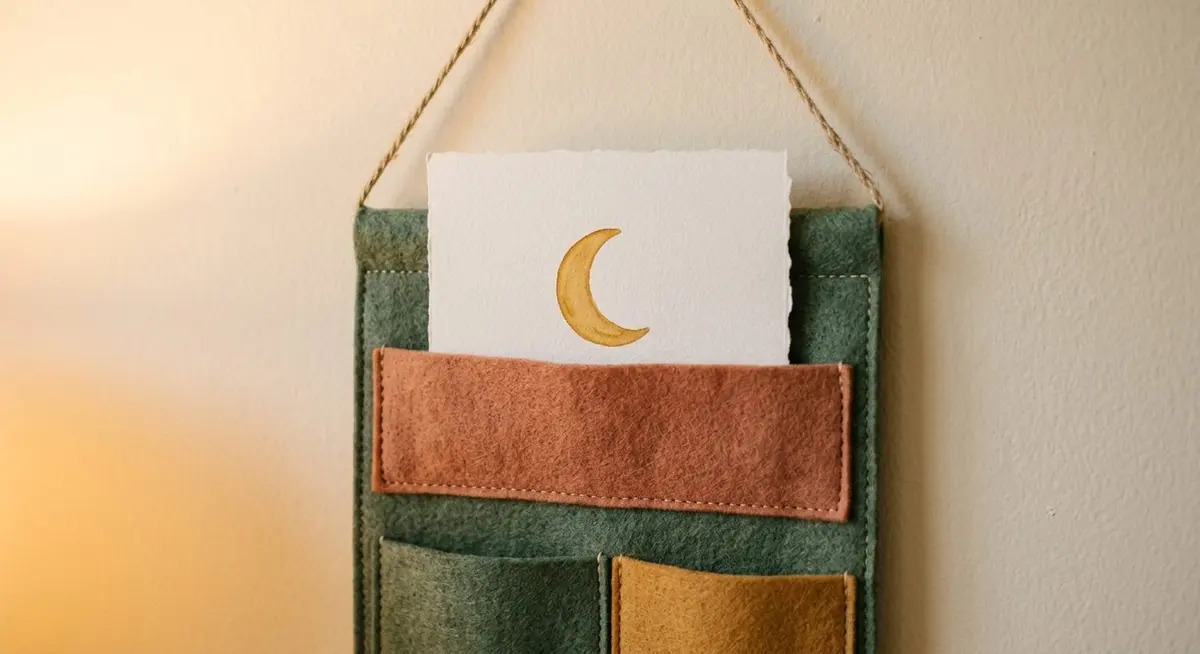
A pocket chart on the bedroom wall beats a card ring in a drawer, because it can be consulted without leaving the room.
If you have no printer tonight: draw five squares on a sheet of paper and sketch the steps in stick figures. It will look nothing like a designed card and it will work about ninety percent as well. The format is not what does the work — the visibility is.
Choosing the four to six cards that fit your child
The single most common mistake is using every card in the pack. A wall with eighteen steps on it is not a routine, it is a project plan, and nobody completes a project plan at eight in the evening.
Four to six steps is the working range. For a three-year-old, four. For a seven-year-old, five or six. If the sequence runs past ten minutes of actual activity, you have built something that only works on good nights, and good nights are not the ones you need help with.
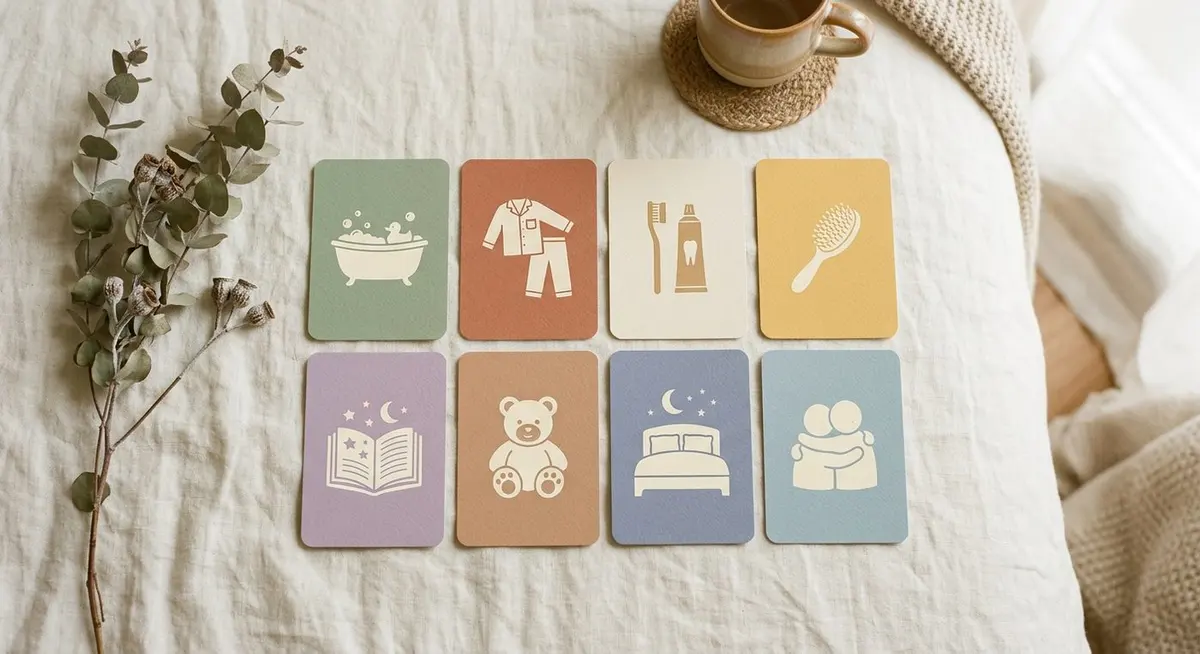
A reliable core looks like this. It starts with something physical, moves to something calming, and ends with something connecting.
Slot
Example card
Why it sits here
1 · Body
Bath or shower
Warm water drops body temperature afterwards, which nudges the sleep signal along. It is also the step most often skipped on late nights, and the most forgivable one to skip.
2 · Care
Brush teeth
Non-negotiable, so it belongs in the middle where energy is highest — not last, where it becomes a fight you have to win at the worst possible moment.
3 · Comfort
Pajamas on
A sensory signal in itself. Clothes change, body understands the day is closing.
4 · Calm
Story time
Reading lowers heart rate and anxiety more reliably than almost any other bedtime activity. Protect this step.
5 · Connection
Goodnight hug
Fills the connection bid that otherwise comes back as a sixth request for water.
6 · Signal
Lights down
Always the final card. It should never be ambiguous which card is last.
What to leave out
Some cards earn their place and some quietly cost you the evening. The ones to consider dropping:
Anything with a screen. A screen step at the end of the routine undoes the twenty minutes before it.
Two versions of the same thing. If both quiet book time and story time are on the wall, you have handed over a choice that exists only to be litigated.
Long, open-ended steps. “Tidy your room” is not a card. “Put one toy away” is a card.
Anything you will not enforce. A card you let slide teaches a child that cards are negotiable. Two fewer cards and a rule that holds is worth more than six and a maybe.
One more thing, and it matters more than it sounds: include one step your child owns completely. Choosing the story, turning on the lamp, deciding which teddy is on duty. Not because it is efficient — it usually is not — but because a routine that contains one genuine act of ownership is a routine a child defends rather than resists.
Let your child set the order
This is the step parents skip, and it is the one that changes the most. Once you have chosen the cards together, hand over the sequencing. Let them decide what comes first and what comes last.
The reasoning is not sentimental. Order is the one part of bedtime where a child can exercise real control without costing you anything. Teeth before or after pyjamas? Genuinely does not matter to you. Enormously matters to them. Trade it.
So the deal is: the steps are negotiable before you start, and fixed once you begin. Choosing happens in daylight, or at least before the routine starts. During the routine, the cards decide. If your child wants to reorder mid-flow, the answer is a warm, boring “we can change it tomorrow” — and then actually change it tomorrow, so the promise is real.
Two options is a choice. Four is a decision. At bedtime you want the former.
The two-option rule
Where you do offer a choice during the routine, cap it at two. “Red pyjamas or blue pyjamas.” “You turn the lamp on, or I do.” Anything beyond two becomes a research task, and a research task at bedtime ends in tears about twelve percent of the time and a small existential crisis the rest.
And be careful which questions you ask. “Do you want to go to bed?” is not a question, it is an invitation to negotiate. “It is bedtime. Do you want to walk, or do you want me to carry you?” is a real choice with two acceptable outcomes. Same effort, completely different evening.
The first week, night by night
Set your expectations properly and this goes far more smoothly. The first three or four nights are usually the worst — not because the cards are failing, but because you have changed a system and a small person is testing whether the change is real. Hold the line through the wobble and it settles fast.
Night one: do it with them, narrating
Walk the routine beside your child and say the steps out loud as you go. “Pyjamas is next, the chart says so.” You are teaching the sequence and, just as importantly, teaching that the chart is the authority. Aim for warmth, not efficiency. It will take longer than usual. That is fine and expected.
Night two: narrate, then step back
Same sequence, but you stay at arm’s length. When your child stalls, point at the card rather than saying the instruction. “What does the chart say next?” This one sentence does more work than any other line in this guide — it hands the routine back to them while keeping you fully present.
Night three: they lead, you follow
Let them run it and only step in if the sequence stalls completely. Expect backwards pyjamas and a truly perfunctory tooth-brushing. Resist. Correcting the quality of the performance is the fastest way to return ownership to you.
Night four and beyond: quiet presence
By now, most children are checking the cards instead of checking with you. This is the moment the payoff arrives: you are no longer the enforcer, you are the company. Bedtime gets calmer because there is nothing left to push against.
What to say when it stalls — three lines that do most of the work:
“What does the chart say next?” — hands the routine back without a correction.
“That is not on the list tonight.” — warm, final, no negotiation offered.
“You can choose that tomorrow.” — protects tomorrow’s autonomy so tonight’s refusal has somewhere to go.
One caution about praise. “You did it!” is cheerful and it also tells a child that finishing was in doubt, which makes the next night’s struggle more likely. Name the specific thing instead: “You went straight to the bathroom on your own.” Belonging beats applause.
The twenty-minute wind-down clock
Routines fail on timing more often than on content. Start too late and every step becomes a rush, rushes are stressful, and a stressed child does not fall asleep quickly. The fix is not to run faster. It is to start earlier.
Here is a shape that fits the 20–30 minute band most sleep guidance recommends, built so the calm steps get the most generous slices and the busy steps are kept tight.
Clock
Step
What you are actually doing
0–6 min
Bath or shower
Warm, quick, unhurried. This is the last loud-ish part of the evening. Keep the bathroom dim rather than floodlit.
6–10 min
Pyjamas and teeth
The functional block. Grouped together because both are non-negotiable and both are easier to do while momentum exists.
10–15 min
One story
The heart of the wind-down. Read slowly, in a low voice, and finish the book you started. Rushing the ending undoes the calm you just built.
15–20 min
Lights down, hug, one good thing
The closing sequence. Lamp to amber, curtains closed, one sentence each about something good from the day.
20–25 min
Quiet presence
You stay nearby but stop talking. This is the part most parents cut, and it is usually the part that decides how long the whole thing takes.
Where to put the light
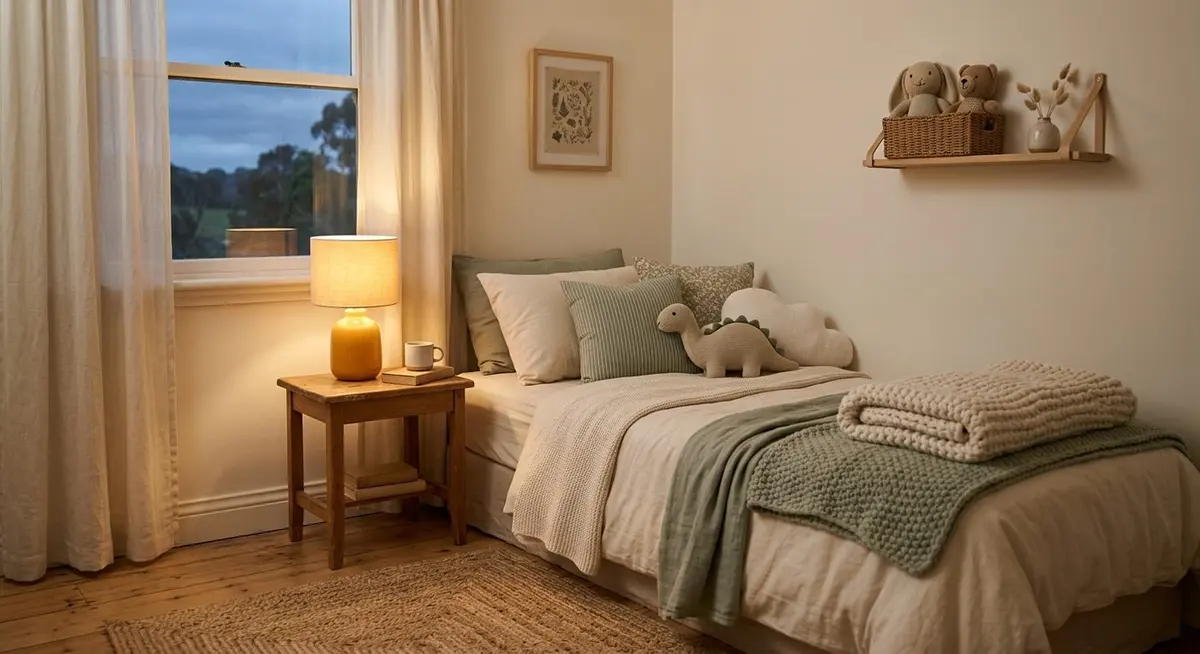
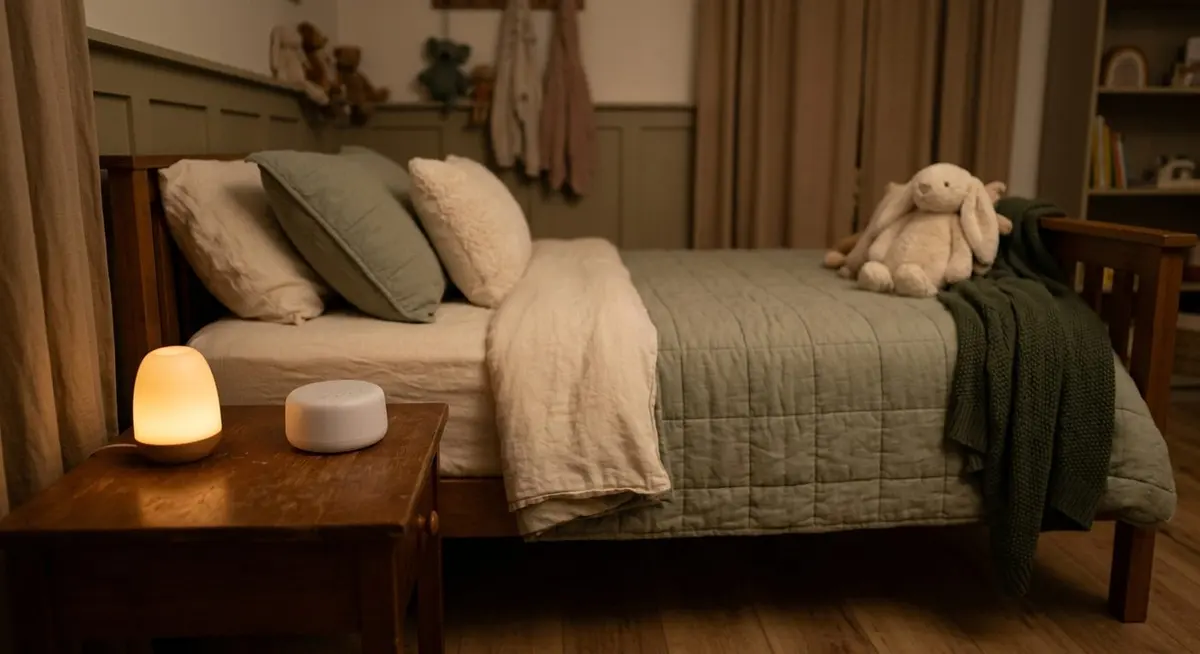
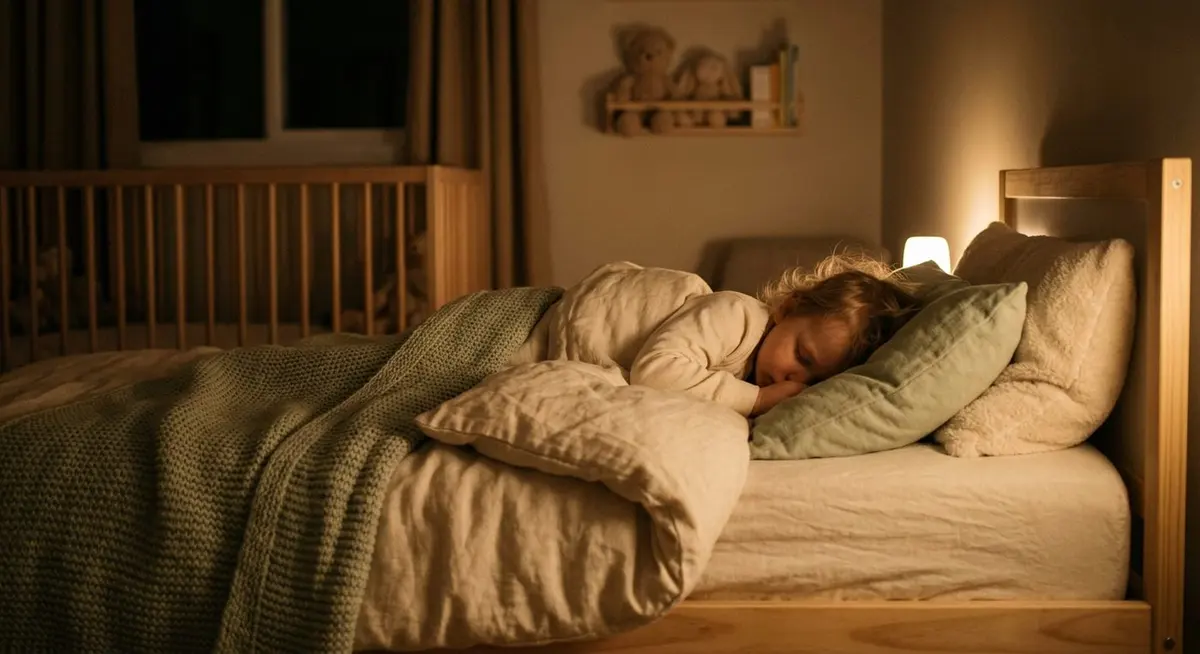
Work backwards from the room. In the final twenty minutes, aim for one warm light source — a lamp rather than a ceiling light, with an amber or red bulb if you have one. Bright blue-white light is the most disruptive to the body’s sleep signal; warm amber light is the least. If there are screens in the evening, they belong in the early half, before the routine starts, not woven through it.
One warm lamp and a steady source of white noise do more for settling than a brightly lit room and perfect silence.
Why white noise works, and when to turn it down
A steady, low-level sound masks the small noises that pull a child back to full alertness — a door, a conversation downstairs, the washing machine finishing. Keep the volume low enough to talk over comfortably from the doorway, and if you are choosing a setting, a low rumble beats a hiss.
On late nights, compress — do not delete
Some evenings you genuinely cannot start on time. The instinct is to skip ahead and cut steps, which changes the sequence and undoes the predictability you have been building. Better to compress each step than to remove one: the bath becomes three minutes, the story becomes three pages, quiet presence becomes one minute. The order is what your child is relying on. Protect the order, shrink the clock.
The one step never to cut: the story. Reading is associated with a lower heart rate and lower anxiety more consistently than any other bedtime activity, and it is the cheapest calm you will buy all evening.
Age-by-age adjustments
The same system works from toddler to ten-year-old. What changes is how much you do for them, how many steps they can hold, and how much choice is genuinely useful rather than overwhelming.
Before the table, one broad rule that saves a lot of trial and error: choose the step count by what your child can remember, not by what they can physically do. A capable four-year-old may still only hold four steps in their head, and handing over six will produce a routine that collapses halfway through — which looks like non-compliance and is actually overload.
Age
Steps
What to adjust
18–24 months
3
You run every step and they tag along. Use cards as pictures you point at, not as a sequence they follow. Say the step names the same way every night — the words are doing the work.
2–3 years
3–4
The peak of the leverage phase. Offer two choices per step, never more. Expect to carry them through the last card most nights, and consider that a success rather than a failure.
4–5 years
4–5
The sweet spot for a card ring. They can own teeth, pyjamas and choosing the story. Keep one physically tiring step early so the calm steps have something to calm down from.
6–7 years
5–6
They can run the whole sequence and will likely start reminding you. Add reading time as an independent step. Expect the negotiation to shift from whether to how long.
8–10 years
5–6
Move to a written list rather than pictures, and negotiate the whole thing once a month rather than nightly. Their wind-down is usually about screens and social time, not hygiene — build the transition around that.
If your child is autistic or has ADHD
Visual schedules are a standard, well-evidenced support in this context, so the cards are not a workaround here — they are the recommended tool. Three adjustments tend to make them land better:
Add a “finished” pocket. A physical place a card goes once it is done. Knowing when something is over matters more than knowing what comes next.
Never change the order without warning. If a step must move, change it before the routine starts, not during. Mid-sequence changes are the most common cause of a full shutdown.
Build in a transition card. A card that only says five minutes until bath gives a nervous system time to prepare. Two minutes is often not enough.
A dedicated reading corner earns its floor space. It is the step that does the most work for the least effort.
Sharing bedtime between two adults
If two adults run bedtime on different nights, the cards quietly solve a problem you may not have named: consistency stops depending on memory. Both adults follow the same wall. Children adapt to which parent is on duty remarkably fast — as long as the sequence does not change with the shift.
The printable Night Routine Card Pack
Everything above works with a sheet of paper and a pen. But if you would rather start tonight with something that already looks good on the wall, I have put the whole thing together as a printable pack you can download and print in one go.
It is built to be used, not admired. The cards are illustrated so a pre-reader can follow them, the icons are drawn without brand names or clutter so nothing on the page competes for attention, and the whole thing prints in plain black-on-cream if you are out of colour ink.
Free printable · 13 pages The Night Routine Card Pack
18 illustrated routine cards and 4 blanks to write your own, a 7-night planner, a 20-star wind-down chart, plus the two tools for hard nights: the three-breath card and four printable “one extra pass” tokens.
Download the card pack →
PDF · prints on A4 or US Letter at 100% · no email required · cut, punch and hang
Print once, use for years. The pack is designed to survive being handled by children every night.
What is in it, page by page
Section
What it gives you
Routine cards
18 illustrated cards covering the full sequence, from bath and teeth through to lights down and eyes closed. Dotted cut guides so you can trim them cleanly.
Blank cards
Four empty cards for the steps your family has that nobody else does — medicine, a specific toy, a call to a grandparent.
Weekly planner
A seven-night grid for start time, lights out, which steps you used, and how it went. Useful for spotting the pattern when something is not working.
20-star chart
A wind-down chart with room for one star per night, plus a reward menu to agree on before you start.
Hard-night tools
The three-breath card and four printable “one extra pass” tokens for the nights your child calls you back.
How to print it so it lasts
Set the printer to 100% or actual size. Do not use fit-to-page.
Card stock around 200–250 gsm is ideal. Plain paper plus plastic sleeves works just as well.
Cut along the dotted guides, then clip the corners so younger children do not catch themselves.
Punch one hole in the top-left corner of each card and thread them onto a metal ring.
The planner and star chart are designed as one-per-week sheets. Print a fresh batch at the start of each month.
If you use only two pages of the whole pack, make it the card sheet and the star chart. Those two do about eighty percent of the work.
When it starts to slide
Every routine drifts. A week of late finishes, a growth spurt, a new baby, a school holiday that wrecked the clock — something shifts and bedtime goes back to being a negotiation. This is normal, not a relapse, and it is usually fixable with one adjustment rather than a rebuild.
Find your symptom in the table below. The third column is the part people get wrong.
What you are seeing
Most likely cause
What actually helps
The routine runs past 30 minutes
Too many steps, or each step has quietly grown
Cut one step rather than speeding up. If you trim time, the whole sequence feels rushed and the calm steps stop working.
They add a new request every night
The routine has a gap where a need is not being met
Add a permanent card for whatever keeps coming up. If it is a hug, make it an official step instead of a nightly argument.
Lights out triggers tears
You are asking them to go from company to alone in one move
Add a bridge step: one minute of quiet presence with no talking. Do not switch the light off and leave in the same second.
It works at home, not at the grandparents’.
The environment changed and the cues went with it
Travel with the cards. Same order, shorter steps. Five minutes per step is plenty when you are away from home.
One specific card causes a fight
That step is hard, boring or was chosen for them
Ask where it should go. Reordering often dissolves the standoff without you conceding anything that matters.
It worked for a fortnight and stopped
Novelty has worn off and the novelty was doing the work
Change exactly one thing: a new card, a new reward, or a slightly later start. Do not redesign it.
They are awake long after lights out
The start time is too early for their current sleep need
Push lights out back by fifteen minutes for a week and hold it steady. Fighting an unready body is a losing position.
The one-week rule for changing anything
Give every change seven nights before you judge it. Behaviour that looks like a failure on night two frequently looks like a habit by night eight — and parents who redesign the routine every forty-eight hours are, without meaning to, running the least predictable bedtime in the street.
Keep the bathroom dim and uncluttered during the routine. A calm room does part of the job for you.
When to get help rather than keep tweaking. Persistent snoring, long pauses in breathing, extreme daytime sleepiness, or a child who cannot settle at all night after night are worth a conversation with your doctor or health visitor. Some sleep problems have a physical cause, and no chart on a bedroom wall will fix those. Snoring with breathing pauses in particular is worth mentioning rather than watching.
The toolkit for hard nights
Some evenings the cards are not enough. Not because the system is wrong, but because a tired child has run out of capacity and no amount of structure will talk them back. These are the nights you want two or three tools that work in under two minutes, without anything to assemble.
Three breaths: the two-minute reset
Breathing out for longer than you breathe in is one of the fastest routes to settling a nervous system, in children and adults alike. It is not mystical — a slow exhale directly nudges the body toward its calmer branch — and it is invisible, which means it works in a dark room with no equipment.
Teach it as a game, not a technique. Smell the flower for four counts, blow out the candle for six. Three rounds. Then stop. Doing it to your child — breathing loudly beside them so they can follow — works better than telling them to do it alone.
The pass system: one visit, and it is spent
The single most effective tool we ever used for the “one more thing” loop was a physical token. Hand your child one cardboard pass at lights out. If they need you, they hand it back and you come once — a proper visit, no lecture, no sigh. Then it is gone until tomorrow.
What makes it work is that it converts an unlimited resource into a limited one. There is no rule to break and nothing to argue about, because the limit is visible and it is their choice when to spend it. Most children hold on to it and never use it, which is the point. It is not a reward for calling you — it is proof that one call is always available.
Solve the predictable requests in advance. Water on the nightstand removes one negotiation before it starts.
Pre-empt the requests you know are coming
Almost every child has two or three recurring requests. Instead of batting them away nightly, solve them before lights out and take them off the table entirely.
Water: a small cup on the nightstand. Not a bottle that can be emptied, spilled and refilled.
The door: decide in advance and keep it constant — open two fingers wide, or closed with a light on in the hallway. Changing it nightly creates a bargaining chip.
Toilet: make it an official card, placed last before lights down. Requests that have a home stop wandering.
One more story: agree the number before you open the book, and count down out loud so the ending is never a surprise.
What not to do on a hard night. Do not add steps, do not speed up the sequence, and do not start negotiating rules at 8:45pm. A hard night is not the moment to improve the system. Run the same list, warmly and slightly faster, and change something tomorrow when everyone is rested.
Off-script nights: travel, grandparents, late dinners
The routine earns its keep on ordinary nights. It proves itself on the unusual ones. Whether it survives a change of scene depends almost entirely on what you take with you — and the answer is the cards, not the whole apparatus.
Travelling
Pack the card ring and nothing else. Same order, shorter steps: five minutes each is plenty. The environment has changed, so hold everything else steady. If you are crossing time zones, shift the routine in fifteen-minute increments over a couple of days rather than forcing it straight to the new clock.
Staying at grandparents’
Two things go wrong here. First, the sequence quietly changes because someone else is running it — and children notice a changed sequence far more than a changed room. Second, well-meaning adults add a step, usually a treat at exactly the wrong moment.
Hand over the ring and say the two things that matter: this order, every night. Most grandparents are delighted to have a script rather than an argument.
Late dinners and special evenings
On genuinely late nights, run a compressed routine rather than a shortened one. Every step still happens, in order, just faster: three-minute bath, teeth, one short book, lamp, hug. What you are protecting is not the duration, it is the pattern — and a child who gets the pattern on a chaotic night is a child who comes back to it easily the next evening.
A familiar object in an unfamiliar room does real work. Pack a blanket and the cards, and most children settle fine.
The nights you are away
If you are out and someone else is running bedtime, resist the urge to leave detailed verbal instructions. Leave the cards. A visible sequence is followed more reliably by a babysitter or a partner than any amount of explanation, and it keeps the routine identical even when the person is not.
A one-line handover note that covers most of it:
“Cards in order on the hook. Teeth before story. Lamp on, then I read one book, then lights down. One pass each. That’s it — thank you!”
Making it stick past week two
Most routines do not fail at the start. They fail at week three, when the novelty has gone, the parent is tired, and the small daily compromises have quietly added up to a bedtime that looks nothing like the one you designed. Here is how to keep the shape.
Protect the start time, not the end time
If you can hold only one thing steady, make it the start. A routine that begins at the same time every night can absorb a slow story and a long bath. A routine that begins anywhere between 6:45 and 7:40 will end in chaos regardless of how good the steps are, because the body never gets a reliable cue.
Review once a month, not nightly
Nightly tinkering destroys the predictability that makes the whole thing work. Put one review in the calendar: once a month, lay the cards out again and ask what should change. Then leave it alone for another month. If you keep the weekly planner from the printable pack, this takes four minutes.
Give the routine a name
It sounds trivial and it is not. “Time for the night list” is a shorter, softer instruction than “go and get ready for bed”, and it carries the whole sequence inside it. A named routine travels: to a grandparent’s house, to a babysitter, to a hotel room.
Let the reward system retire gracefully
Star charts are scaffolding, and scaffolding comes down. Use them to get through the first three or four weeks, then thin them out: a star every night becomes a star every other night, then weekly. If you keep the chart running indefinitely, the routine becomes a transaction and you will eventually lose the negotiation over price.
The goal is quiet independence. You are not managing bedtime — you are handing it over, one card at a time.
Signs it is genuinely working
The wins are quieter than you expect, which is why they are easy to miss. Look for these instead of a perfect evening:
Your child checks the cards before asking you what is next.
Bedtime stops being the moment of the day you dread.
The same request stops repeating every single night.
They start running the sequence on nights you are running late.
A disrupted evening no longer means a disrupted week.
That last one is the real prize. A routine is not valuable because it works on the good nights. It is valuable because it gives you a shape to come back to after the bad ones.
Questions parents ask
What age are night routine cards suitable for?
They work from around eighteen months to about ten years. What changes is how much you do for your child rather than whether the cards help. Under two, you run every step and use the pictures as something to point at. From four, children can own most of the sequence. By eight or nine, swap the pictures for a written list and renegotiate it monthly.
How many cards should we actually use?
Four to six for most families. Three or four for a toddler, five or six for a seven-year-old. A sequence you complete every night beats a longer one you manage twice a week — that is the single most important finding in the research on bedtime routines.
Should the routine be the same every night?
The order should be. The research on bedtime routines found the benefits scaled with how often the routine was followed, so frequency matters more than length or sophistication. Keep the same steps in the same sequence, and keep the start time within about fifteen minutes either way, including at weekends.
How long should the routine take?
Around twenty to thirty minutes is the band most sleep guidance points to, built from the same few calming activities. If yours runs longer, cut a step rather than speeding up the ones you keep. If it runs shorter and everyone is settling well, there is nothing to fix.
What if my child refuses to follow the cards?
Usually the sequence is too long or a specific card is the problem. Ask which card should come first — reordering very often dissolves the standoff without you conceding anything that matters. Make sure the cards are in the room where bedtime happens; a chart in a drawer is not a routine.
What do I do about the endless “one more thing” requests?
Give the recurring request a permanent home. Water becomes a card. A hug becomes a card. Then, for the rest, use one physical pass: one visit, handed back when needed, spent for the night. It converts an unlimited resource into a limited one, and most children never spend it.
Should I use a reward chart?
Yes for the first few weeks, then retire it. Stars are scaffolding for building the habit, not a permanent payment system. Thin them out over time — nightly, then every other night, then weekly — and keep praise specific to what your child actually did rather than general applause.
Can I use these cards for a morning routine too?
The same format works very well in the morning, and the two routines reinforce each other. The only real difference is that mornings have a hard deadline, so keep the morning sequence even shorter — three or four steps — and put the non-negotiable ones first.
Do I need to laminate them?
No. Card stock around 200–250 gsm is enough for most households, and plain paper in a plastic sleeve works just as well. Laminate only if the cards will be handled daily by a very young child or kept somewhere damp.
What if bedtime is still hard after a fortnight?
Change one thing, not everything, and give it seven more nights. If nothing shifts after a month of a consistent, short routine, it is worth a conversation with your doctor or health visitor — especially if there is snoring, long pauses in breathing, or extreme daytime sleepiness. Some sleep problems have a physical cause that no bedroom chart will address.
One last thing. The evening you get this right will probably not feel dramatic. There will be no breakthrough night where bedtime becomes effortless. What happens is quieter: the argument gets shorter, then it stops starting at all, and one day you notice you are reading a book instead of refereeing a negotiation.
Where to start tonight
If you are reading this at 7:40pm with the evening already going sideways, do not build the whole system. Do one thing. Pour a glass of water, put it on the nightstand, and sit down with your child to write four steps on a piece of paper. That is enough for tonight, and it is genuinely most of the mechanism.
Tomorrow, print the cards, cut them out and let your child choose the order. By the end of the week you will have a bedtime that runs itself — not perfectly, and not every night, but reliably enough that the bad evenings stop setting the tone for the whole week.
Start tonight Print the Night Routine Card Pack
18 illustrated routine cards, 4 blanks, a weekly planner, a 20-star wind-down chart and four “one extra pass” tokens — on 13 printable pages.
Elowen Thorn I cook, photograph and re-test every recipe in an ordinary home kitchen before it goes up, so what you make matches what you see. Savory Discovery is where simple weeknight cooking, seasonal ideas and the odd bit of kitchen craft sit side by side — written plainly, and worth cooking twice.