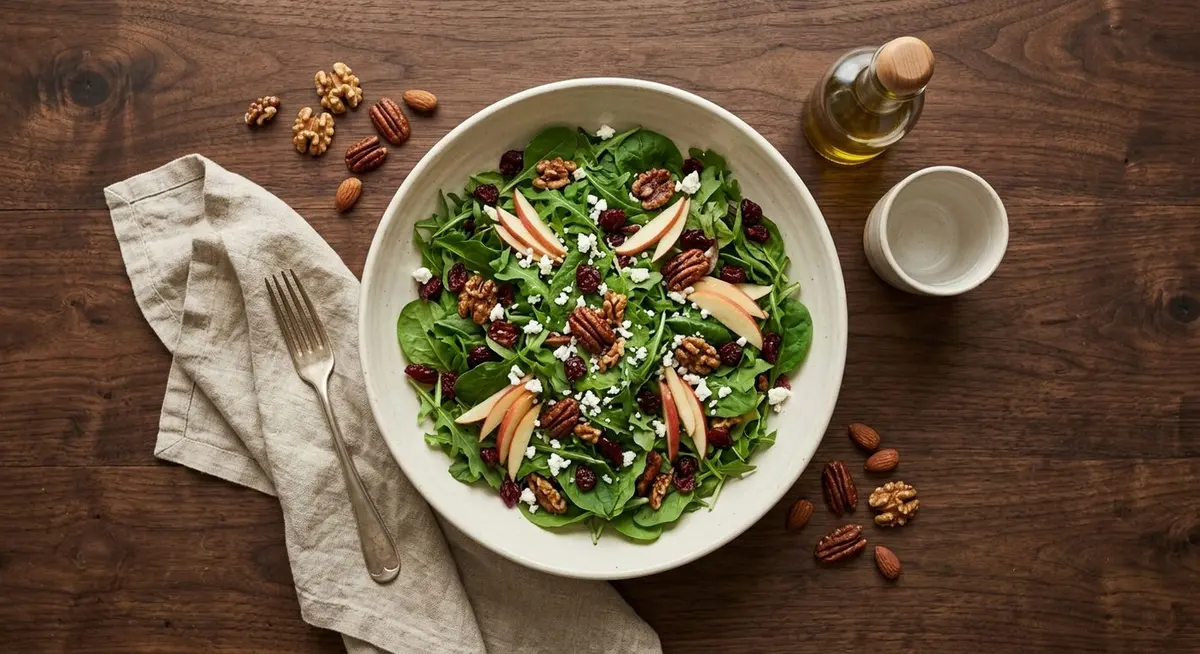
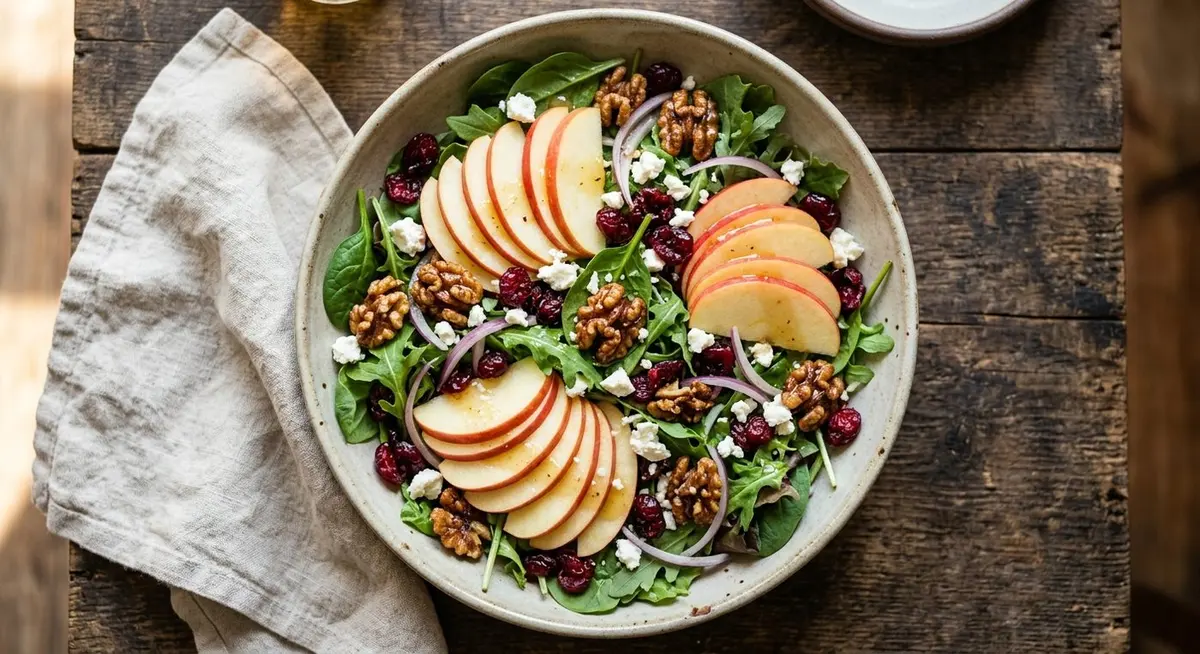
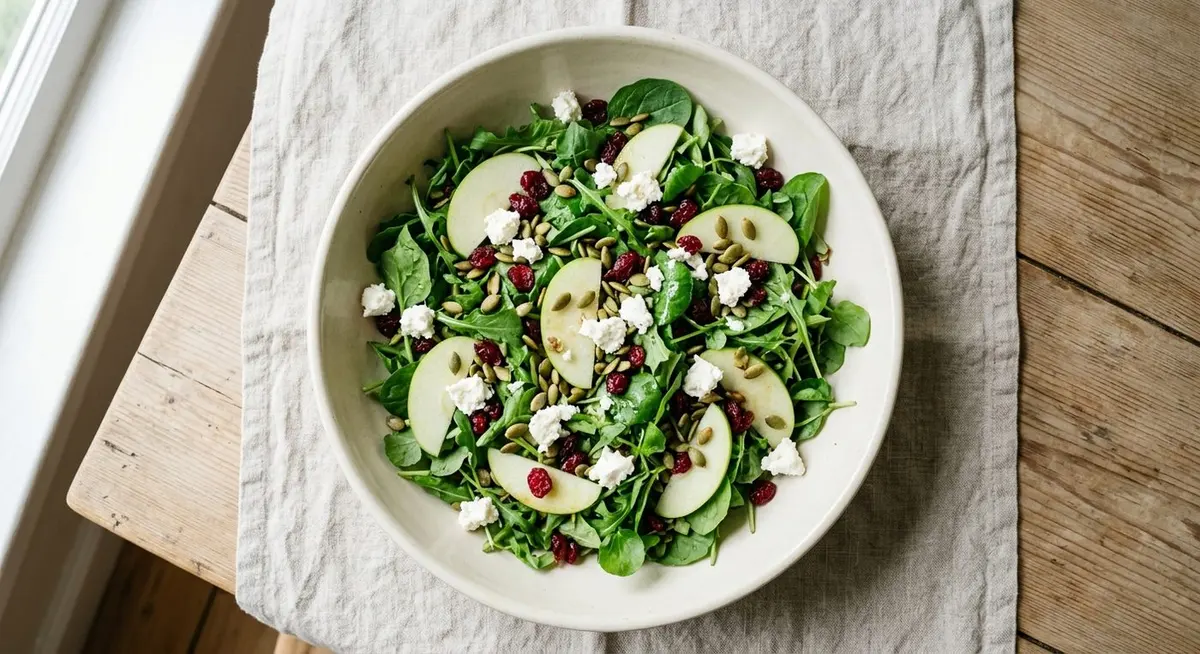
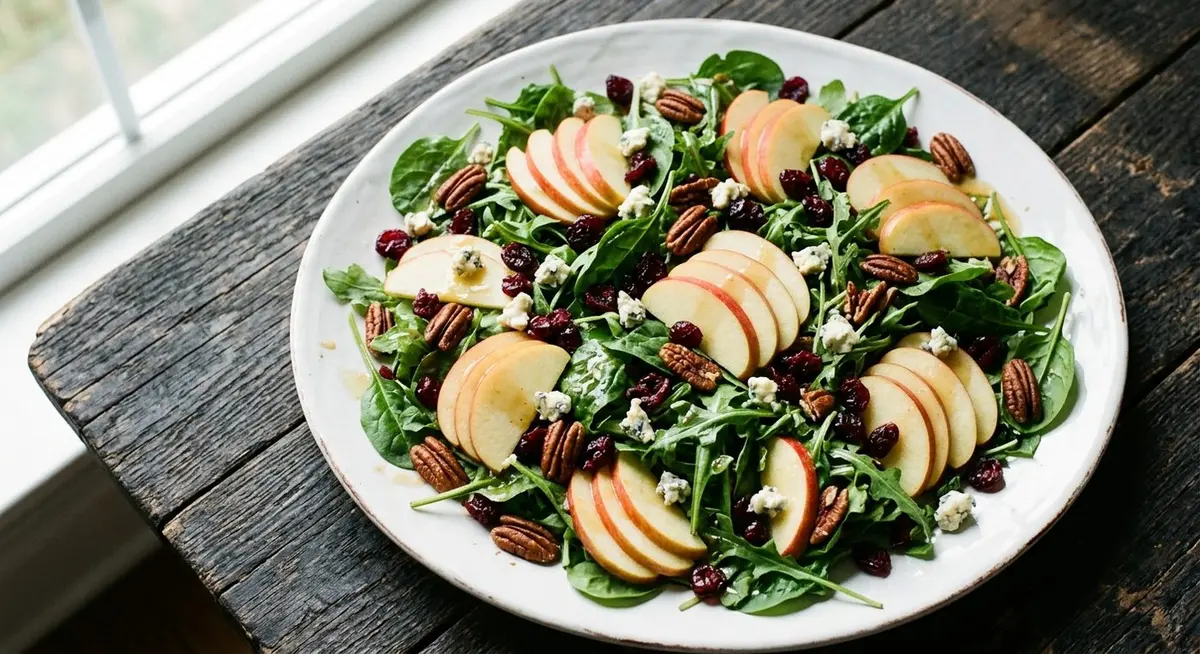
This is the salad I take to every gathering between October and December, and it is the only one anyone ever asks me to bring back. Crisp apple, leaves that still snap, candied walnuts with a glassy amber shell, and cranberries plumped until they burst when you bite them. It looks like an enormous amount of work and it is honestly about twenty minutes.
Most apple salads fail for the same reason: everything in the bowl is soft. Soft leaves, soft cheese, soft fruit, and a dressing that has already soaked in by the time the bowl reaches the table. What you get is pleasant and forgettable.
This one is built on four distinct textures that stay distinct. The apple stays crisp because it is cut thin and dressed at the last minute. The leaves stay upright because they are dried properly and dressed lightly. The walnuts stay crunchy because the sugar shell seals them off from the vinaigrette. And the cranberries stay plump and juicy because they have been rehydrated first instead of being scattered in like gravel.
Get those four things right and the salad holds its shape on a buffet table for a full hour, which is more than most leafy salads manage for ten minutes. Get them wrong and you have made a bowl of wet leaves with apple in it.
Four textures, four jobs. The nuts stay crunchy because the sugar shell keeps the dressing out.
The one rule that decides whether this works. Dress it at the table, not in the kitchen. Five minutes of contact is plenty. Twenty minutes turns the whole bowl soft, and there is no way back from that.
What Goes In, and What Each Thing Does
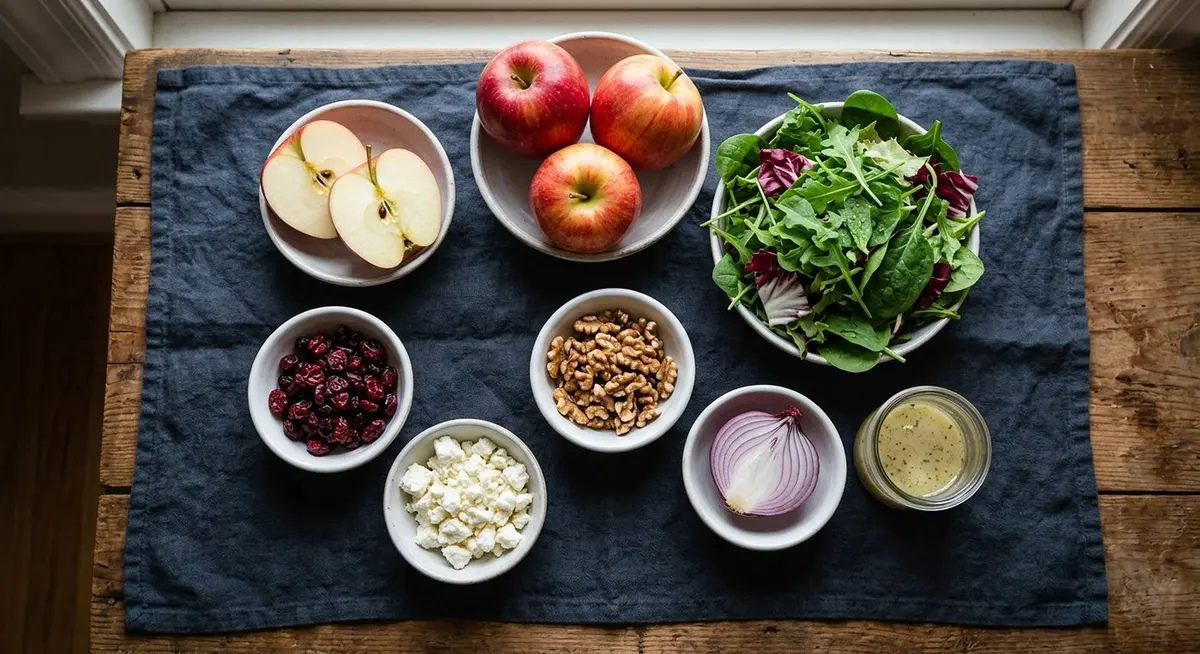
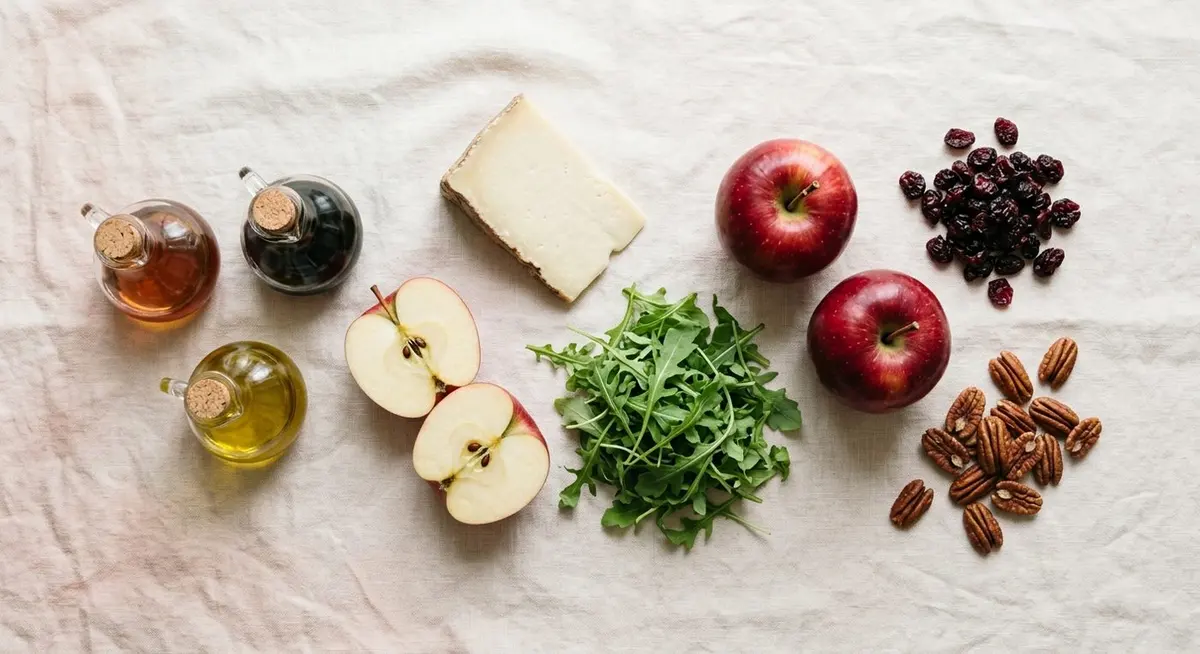
Everything laid out before you start. A salad is assembled, not cooked, so the whole job is done in one pass.
Ingredients and their job
Ingredient
Amount
What it is doing
Red apple
1 large, quartered and cut paper-thin
Crisp sweetness and the structural backbone of the bowl
Mixed baby leaves
5 generous handfuls (about 5 oz)
Volume and a fresh, slightly bitter counterweight to the sweet nuts
Dried cranberries
3/4 cup
Sweet-tart pops of colour and juice, once plumped
Walnut halves
1 cup
Crunch, and a bitter edge that keeps the salad from tasting sugary
Red onion
1/2, sliced into thin wedges
Sharpness that cuts through the sweetness of the apple and the candy shell
Feta or soft goat cheese
2 tbsp, crumbled
Salt and creaminess, used sparingly so the salad stays light
Salted butter
1 tbsp
Carries the sugar and keeps the candy shell from tasting flat
White sugar
1/4 cup
The candy shell itself
Cider vinegar
2 tbsp
The acid backbone of the dressing
Olive oil
4 tbsp
Body and roundness, and it carries the aromatics
Dijon mustard
1 1/2 tsp
Emulsifies the dressing so it clings instead of pooling
Sugar
1 1/2 tsp
Takes the hard edge off the vinegar
Fine salt and black pepper
1/2 tsp / 1/4 tsp
Without salt the whole bowl tastes sweet and dull
The cheese is a seasoning, not an ingredient. Two tablespoons, crumbled small, scattered over the top so you get a little salt and cream in some bites rather than a lot in all of them. If you add half a cup because it looks generous in the bowl, the salad turns heavy.
Choosing and Cutting the Apple
One large apple goes further than you would think once it is cut paper-thin, and one is genuinely all this salad needs. The variety matters less than the cut, but it does change the character of the bowl.
You want an apple that is crisp enough to snap when you bite it and sweet enough to eat raw. A soft, mealy apple will go limp the moment the dressing hits it, and there is nothing you can do about that afterwards.
Which apple to reach for
Apple
Character
How it behaves here
Honeycrisp
Explosively crisp, honeyed
The best of the lot if the price does not offend you
Fuji
Very sweet, dense, long-keeping
Reliable; holds its cut shape longest
Braeburn
Sweet-tart, firm
Adds a bright edge that balances the candy shell
Pink Lady
Tart, very crisp
Excellent if you like the salad on the sharper side
Gala
Sweet, mild, softer
Works, but slice it thicker so it does not collapse
Granny Smith
Very tart, very firm
Only if you want real bite; can overpower the dressing
Red Delicious
Sweet and often mealy
Skip it. It goes limp faster than any other apple here
The cut that matters more than the variety
Quarter the apple, cut away the core, then slice each quarter as thin as you can manage \u2014 a millimetre or two at most. Thin slices bend rather than snap, which is what lets them tuck between leaves and hold dressing on their surface instead of shedding it. Thick wedges sink to the bottom of the bowl and stay there.
Stopping the apple from browning
If you are serving within half an hour, do nothing at all \u2014 cut it and add it. If you need to prepare ahead, drop the slices into cold water with a good pinch of salt for five minutes, then dry them well. Salted water slows the browning without the sourness that lemon juice leaves behind, and this salad already has plenty of tartness from the vinegar and the cranberries.
Dry the slices. Apple straight out of a water bath carries surface water into the bowl, and that water dilutes the dressing and wilts the leaves from underneath. Pat them dry on a clean cloth, or spin them with the leaves and dry the whole lot together.
Candied Walnuts That Actually Stay Crisp
This takes five minutes on the stove and it is the single step that makes the salad look like something from a restaurant. The sugar melts, coats the nuts in a thin glassy shell, and then hardens as it cools into a crunch that survives being tossed with dressing.
Line a tray with parchment paper before you turn on the heat. Sugar waits for nobody, and by the time it is ready you will not have a free hand.
Melt 1 tbsp salted butter in a small non-stick pan over medium heat.
Add 1/4 cup white sugar. Stir once, then leave it alone until it has mostly melted and begun to bubble at the edges.
Tip in 1 cup walnut halves and stir continuously for about two minutes. Every nut should end up coated and glossy.
Pour the whole lot straight onto the parchment and spread the nuts out with a fork while they are still hot. If you leave them in a heap they cool into a single lump you will have to break apart.
Let them cool completely, about ten minutes. Chop roughly half and leave the rest whole \u2014 the mix of sizes is what gives the salad its texture.
Break up any stray shards of caramel and scatter them over too. They are the best bits.
When the sugar seizes or scorches
Two things go wrong with candied nuts, and both are recoverable. If the sugar turns grainy and clumpy instead of smooth and liquid, you have stirred it during the melting stage \u2014 just keep going on a slightly lower heat and it will smooth out. If it darkens past amber toward brown, you have gone too far and it will taste bitter; tip it out anyway, let it cool, and pick out the least-dark nuts rather than throwing the batch away.
Safety note. Melted sugar is hotter than boiling water and it sticks to skin. Keep the pan handle turned away from the front of the stove, keep children and pets clear of that burner, and never touch a coated nut until it has cooled completely. If you do get sugar on your hand, run it under cool water rather than pulling at it.
Making more than you need
It is genuinely hard to make a smaller batch than this, and the leftovers are a gift. Cooled candied walnuts keep for two weeks in an airtight jar at room temperature and for three months in the freezer. They are excellent chopped over a bowl of slow-cooked apple butter or scattered over a tray of brown butter chocolate chip cookies.
Nut-free and other nuts
Pecans \u2014 the classic substitute, slightly sweeter and softer than walnuts.
Almonds \u2014 firmer and louder in the bowl; give them an extra thirty seconds in the pan.
Pepitas and sunflower seeds \u2014 a seed-free version that works beautifully and candies in under two minutes.
No nuts at all \u2014 toast the seeds dry in a pan, skip the sugar entirely, and add a handful of broken crispbread for crunch instead.
Plumping Cranberries So They Burst
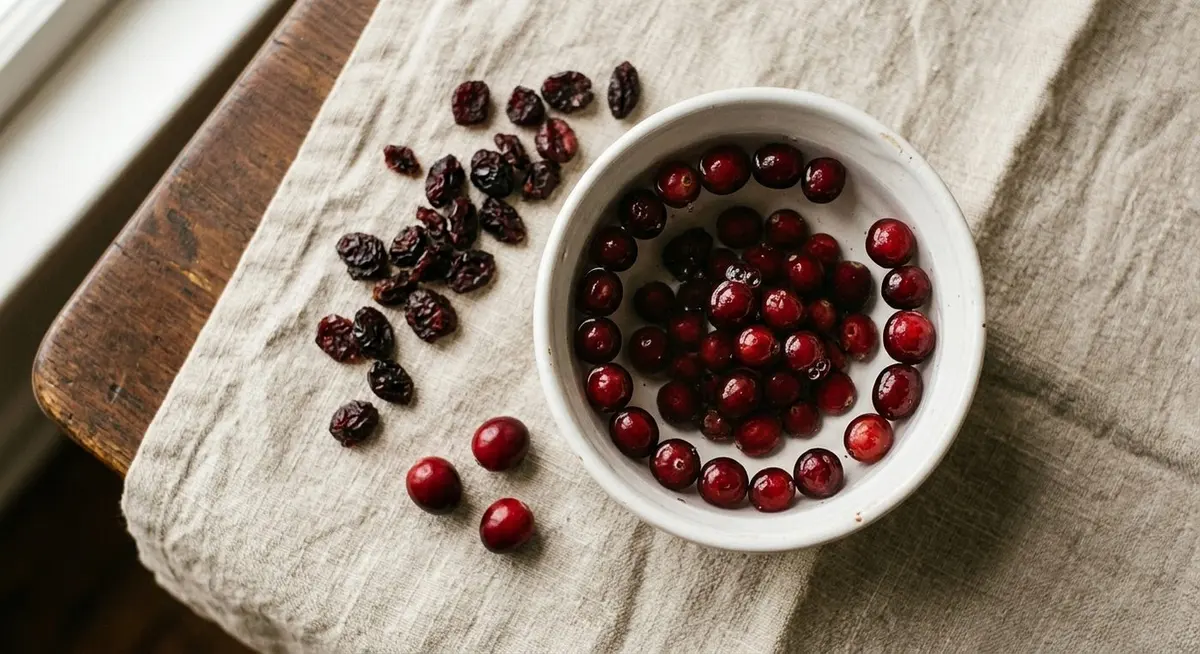
Dried cranberries straight from the bag are shrivelled, leathery and slightly hostile. Ten minutes in hot liquid turns them into fat, soft, juicy berries that pop when you bite them \u2014 and they stop stealing moisture from the rest of the bowl.
Plain boiling water does the job. Warm apple cider does it better, and it is worth the extra step here because the cider reinforces the apple flavour already running through the salad instead of diluting it.
Left: what comes out of the bag. Right: what ten minutes of hot liquid does to it.
Put 3/4 cup dried cranberries in a heatproof bowl.
Pour over enough warm apple cider \u2014 or just-boiled water \u2014 to cover them by about an inch.
Leave them for ten minutes. They will visibly swell and the liquid will take on colour.
Drain them well and pat them dry. Wet cranberries bleed juice into the dressing and turn the leaves pink.
The cider upgrade. Warm the cider with a strip of orange peel and a single clove, strain it, then pour it over the berries. It takes two extra minutes and gives the cranberries a faint spiced-orange note that makes the whole salad taste more deliberate.
The Vinaigrette, by Ratio Not by Recipe
A dressing for this salad has one job: to be bright enough to cut through the candied nuts without competing with them. That means more acid than you might expect and no strong flavours \u2014 no garlic, no herbs, no honey. Learn the ratio and you can make it from memory forever.
The ratio, and how it scales
Component
Ratio
For this salad
Job
Cider vinegar
2 parts
2 tbsp
The brightness; it is what keeps the salad from tasting sweet
Olive oil
4 parts
4 tbsp
Body and richness
Dijon mustard
3/4 part
1 1/2 tsp
Emulsifier \u2014 holds oil and vinegar together so it clings
Sugar
3/4 part
1 1/2 tsp
Softens the vinegar’s edge
Fine salt
1/4 part
1/2 tsp
Makes every other flavour louder
Black pepper
1/8 part
1/4 tsp
Warmth in the background
Put everything in a jar with a lid and shake it hard for fifteen seconds. That is the whole method. Shaking emulsifies far better than whisking and you can do it with one hand while you deal with the apples.
Tuning it once it is made
Too sharp? Another half teaspoon of sugar, shake, taste again.
Too soft or flat? Another teaspoon of vinegar. This is the most common fix.
Want it creamier? Add oil a tablespoon at a time; the dressing thickens as the ratio shifts.
Want it lighter? Replace one tablespoon of the oil with cold water. It stays emulsified and coats more thinly.
Broken or separated? Shake it again with a teaspoon of mustard. It will come back together.
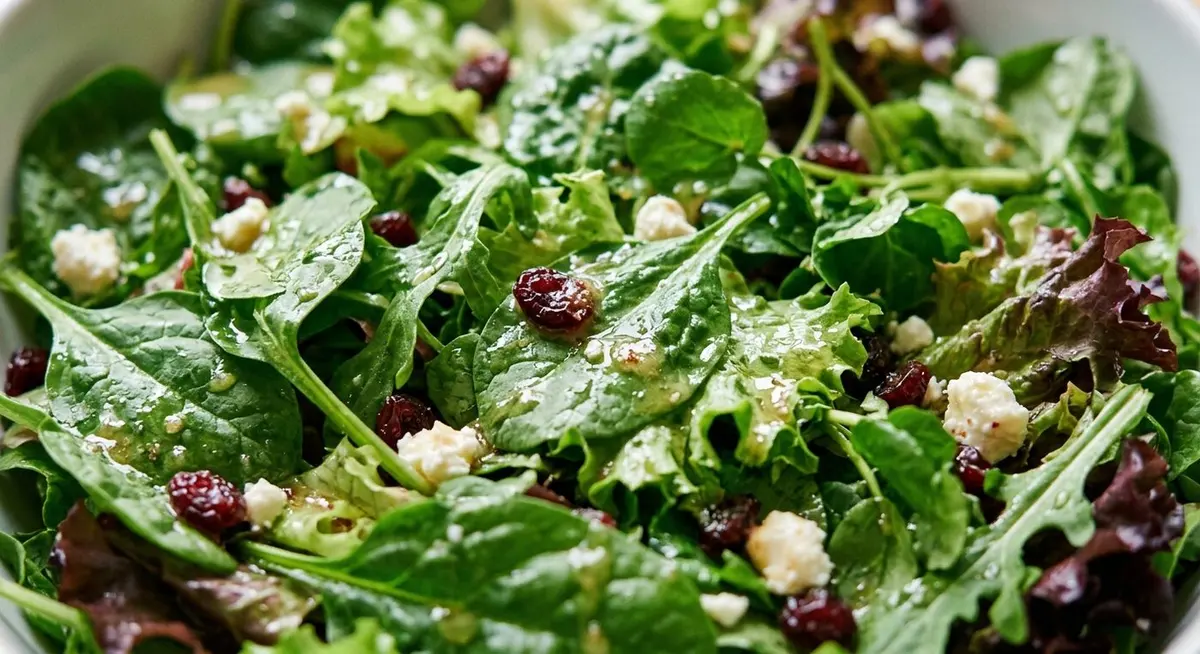
Lightly dressed, not drowned. Every leaf should glisten; none should be sitting in liquid.
Dress the leaves, not the bowl. Pour the dressing around the inside rim of the bowl and toss from the bottom up. Pouring it straight onto the middle of the pile crushes the leaves at the centre and leaves the outside dry.
Assembly, in the Order That Matters
The order is not fussiness. Each step exists so that the ingredients that must stay crisp never sit in dressing and the ones that must be distributed evenly get a chance to move.
Wash and dry the leaves thoroughly. Dry leaves are the difference between a bright salad and a soggy one \u2014 use a salad spinner, or roll them in a clean tea towel and pat gently.
Put the leaves in a large bowl with half the apple slices and all of the onion wedges. Tossing the onion through now distributes its sharpness evenly instead of leaving it in clumps.
Drizzle over half the dressing and toss gently from the bottom up, lifting rather than stirring.
Scatter over the cranberries, then the walnuts, then the remaining apple slices. Keep them near the surface where they can be seen.
Crumble the cheese over the top and finish with the rest of the dressing.
Serve immediately. If it must wait, leave the dressing off entirely and add it at the table.
The plating version
For a table where the salad is the centrepiece, build it on a wide flat platter rather than in a deep bowl. Spread the dressed leaves out in a single loose layer, then lay the apple slices over them in overlapping rows and cluster the walnuts and cranberries in three or four separate groups rather than scattering them evenly. A slightly uneven, clustered look reads as deliberate, and it lets people take the parts they want.
Warm plates, cold salad. If the rest of the meal is coming out of the oven, do not plate the salad onto hot dishes. Ten minutes on a warm plate is enough to wilt the leaves and soften the apple.
The Make-Ahead Timeline
Almost all of this salad can be done in advance, and it is the kind of thing worth preparing in stages on a day when you are already cooking. The only component that cannot be prepped is the apple itself.
What to do, and how far ahead
When
What to do
Keep it in
Up to 2 weeks ahead
Candy the walnuts; cool and store
Airtight jar, room temperature
Up to 1 week ahead
Shake the vinaigrette
A lidded jar in the fridge; bring to room temperature and re-shake
Up to 3 days ahead
Wash and dry the leaves
A tea towel in the fridge drawer
Up to 1 day ahead
Plump the cranberries and drain them well
A covered bowl in the fridge
Up to 1 day ahead
Slice the onion; keep it in cold water
A covered bowl in the fridge; drain and pat dry before use
1 hour ahead
Cut the apple, hold the slices in salted water, then dry them
Salted water, then a dry cloth
At the table
Toss with dressing and scatter the toppings
\u2014
If you are transporting it. Carry the leaves, the toppings and the dressing in three separate containers and assemble at the other end. A dressed salad that spends twenty minutes in a car arrives as a warm, limp pile, and there is no fixing that once it has happened.
Scaling It for 4 or for 40
The salad scales cleanly because nothing in it depends on a chemical reaction \u2014 but the candied nuts do not scale as neatly as the rest, and the dressing needs to be a little more generous per head as the bowl gets bigger.
Quantities by crowd size
Serves
Leaves
Apple
Cranberries
Walnuts (candied)
Dressing
4 as a side
4 handfuls
1 apple
1/2 cup
3/4 cup
3/4 of the batch
6 as a side
5 handfuls
1 large apple
3/4 cup
1 cup
full batch
10 \u2013 12
10 handfuls
2 large apples
1 1/4 cups
double batch
1 3/4 batches
20 \u2013 24
20 handfuls
4 large apples
2 1/2 cups
triple batch
3 1/2 batches
40 (buffet)
40 handfuls
7 large apples
5 cups
five batches
7 batches
How to serve a big batch without wrecking it
Do not make one enormous bowl. Build two or three smaller bowls and dress them one at a time as each is needed, or keep the second bowl undressed and swap it in when the first runs low. One giant bowl means the bottom half sits in dressing while people work through the top half, and by the time anyone reaches it the leaves have given up.
The candied-nut exception
You cannot candy nuts in proportion to everything else \u2014 the pan gets crowded and they steam instead of caramelising. Make the batches one after another in the same pan rather than doubling the quantity in a single pan, and wipe the pan out between batches if the sugar has started to darken.
Variations and Swaps
The skeleton \u2014 crisp fruit, bitter leaves, crunchy nuts, something sharp, something salty \u2014 will take almost any substitution you throw at it as long as you keep those five roles filled.
Fruit swaps
Pear \u2014 sweeter and softer than apple; cut it a little thicker and use it the same day.
Grapes, halved \u2014 a good winter substitute when apples are tired.
Pomegranate arils \u2014 swap half the cranberries for them; they add a jewel-bright look and a sharper pop.
Fresh figs, quartered \u2014 spectacular with goat cheese instead of feta, but assemble at the very last moment.
Greens and cheese
Kale \u2014 massage the leaves with a pinch of salt and a teaspoon of oil first, then dress as normal; it holds up far longer than soft leaves.
Arugula or watercress \u2014 peppery and excellent here, but wilt quickly, so dress at the table.
Shaved Parmesan \u2014 a harder, saltier alternative to feta that keeps its shape in the bowl.
Blue cheese \u2014 a quarter of the amount of feta; it is far more assertive.
Making it a main course
Add shredded roast chicken, a handful of cooked lentils, or a couple of soft-boiled eggs cut in half, and double the dressing. The salad is sturdy enough to carry protein without collapsing, which is more than most leafy bowls can claim. It also works well alongside a heavier baked side such as sweet potato casserole or a bowl of fresh corn salad on a holiday table.
Storage, Leftovers and What Not to Do
Dressed salad does not keep. It will hold for about an hour on a table and that is the end of its useful life. What you can do is store the components and rebuild a fresh bowl later, which is a much better use of any leftovers.
What keeps and for how long
Component
Room temperature
Fridge
Freezer
Candied walnuts
2 weeks, airtight
3 weeks
3 months
Vinaigrette
1 day
2 weeks, re-shake before use
Not recommended
Plumped cranberries
Same day only
3 days, drain well
Not recommended
Washed dried leaves
Same day
3 days in a cloth
No
Cut apple
1 hour
1 day in salted water
No
Dressed salad
1 hour
Do not
Do not
Rescuing an overdressed bowl
If it has gone limp, you can sometimes bring it back by tipping the whole bowl into a colander, letting it drain for a minute, then spreading the leaves on a tray lined with a clean towel and adding a fresh handful of dry leaves and a handful of the candied nuts to restore crunch. It will not be as good as it was, but it will be perfectly presentable \u2014 and this is exactly why making extra walnuts is worth it.
Food safety. Anything with a dressing, cheese or cooked protein should not sit out for more than two hours in total. If the day is warm or the bowl has been on a sunny table, cut that to one hour and refrigerate or discard what is left. When in doubt, throw it out \u2014 a rescued salad is not worth an evening you will regret.
Troubleshooting and Questions
Nearly every problem with this salad traces back to one of four things: wet leaves, an early dress, a pan that was too hot, or sugar measured by eye. Here are the ones that come up most.
My salad went soggy almost immediately. What went wrong?
Almost certainly the leaves were still wet when they went into the bowl, or the salad was dressed more than five minutes before serving. Water on the leaves dilutes the dressing and starts wilting them from underneath. Dry the leaves properly, dress at the table, and if you are prepping ahead keep the dressing in a separate jar until the last moment.
The candied walnuts turned into a solid lump. Can I save them?
Yes. Let the lump cool completely, put it in a zip bag, and break it with the back of a spoon or a rolling pin. You will get irregular shards rather than whole nuts, which actually works well scattered over the top. Next time, spread the nuts out on the parchment while they are still hot instead of leaving them in a pile.
My candied nuts taste bitter. Why?
The sugar went past amber and started to burn. Sugar goes from perfect to bitter in a matter of seconds at high heat, so work at medium rather than high and pull the pan off the heat a moment before you think the colour is right. If the batch is only lightly bitter, the dressing will mask a lot of it.
Can I make this without the sugar on the nuts?
Yes. Toast the walnuts in a dry pan for three to four minutes until fragrant, then use them plain. You lose the glassy candy shell and some of the drama, but you keep the crunch, and the salad becomes a much lighter thing.
How far ahead can I make the vinaigrette?
It keeps for two weeks in a lidded jar in the fridge. It will solidify slightly when cold, so take it out twenty minutes before you need it and shake hard. Mustard-based dressings like this one separate a little as they sit; that is normal and shaking fixes it.
Is this salad safe for someone with a nut allergy?
Not as written. The candied walnuts are central. Swap them for candied pepitas made in exactly the same way, and check that your dried cranberries and cheese were produced in a nut-free facility, since cross-contamination is the real risk rather than the recipe itself.
My apple slices went brown before I served them. What should I do?
Hold them in cold salted water and drain and pat them dry right before assembling. Lemon juice works too but leaves a sour note this salad does not need. Browned apple is harmless, just less pretty \u2014 if it is only faint, the dressing will disguise most of it.
Can I use bottled dressing?
You can, but choose carefully. Look for something thin and sharp, like a simple vinaigrette, rather than anything creamy, sweet or herby. A thick ranch or a sweet poppy-seed dressing will bury the apple and the cranberries completely.
Free Printable: The Apple Salad Party Planner
A printable companion to this salad \u2014 the market list, the vinaigrette ratio card, an apple variety card, the candied walnut method, a make-ahead timeline, an assembly checklist and a scaling table up to 40 guests.
PDF \u00b7 4 pages \u00b7 prints on letter or A4 \u00b7 no email required
Savory Discovery · By Elowen Thorn · Last updated September 2026. Nutrition figures are estimates and vary with brand and portion. Serve dressed salads within an hour and refrigerate anything held longer.
Elowen Thorn I cook, photograph and re-test every recipe in an ordinary home kitchen before it goes up, so what you make matches what you see. Savory Discovery is where simple weeknight cooking, seasonal ideas and the odd bit of kitchen craft sit side by side — written plainly, and worth cooking twice.