By Elowen Thorn · Autumn Activities · Ages 2 to 12
A fall nature walk is the cheapest, easiest, highest-return activity of the whole season. You need a basket, an hour and somewhere with trees. But there is a difference between a walk that ends in twenty minutes with everyone cold and complaining, and one the kids are still talking about at dinner. That difference is almost entirely in the setup.
Most autumn activities need something bought, prepared or booked. A nature walk needs none of that. The season does the decorating for you: every path is covered in colour, every tree has dropped something worth picking up, and the light from late September through October is the softest you will get all year. It is also the rare activity that works for a two-year-old and a ten-year-old at the same time, which is the real reason it earns a permanent place in our October.
What makes it stick, though, is not the walk. It is the collecting. A child who has been handed a basket and a short list stops being a passenger on a boring adult walk and becomes the person in charge of finding things. That single shift is what turns a fifteen-minute trudge into an hour and a half.
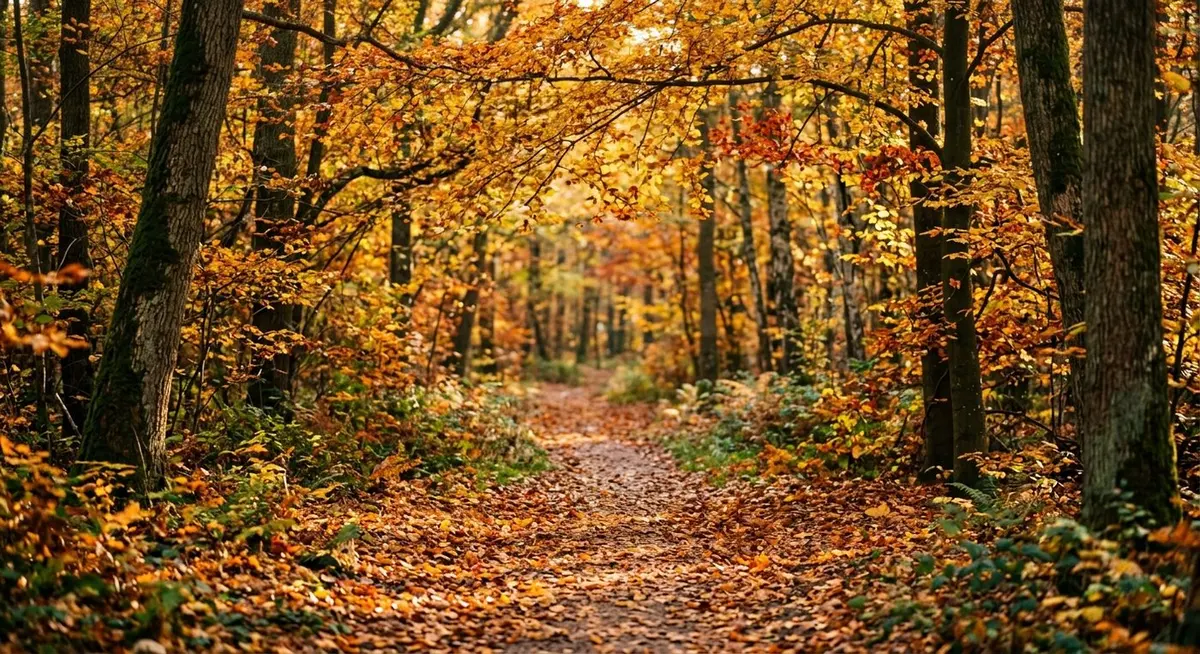
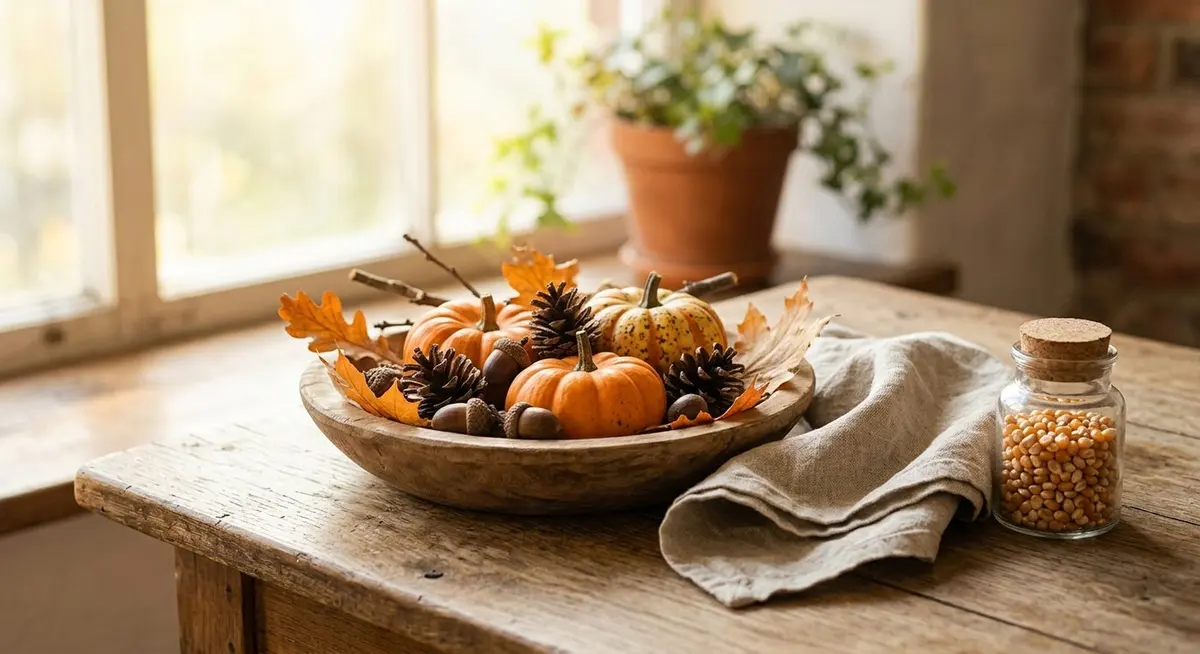
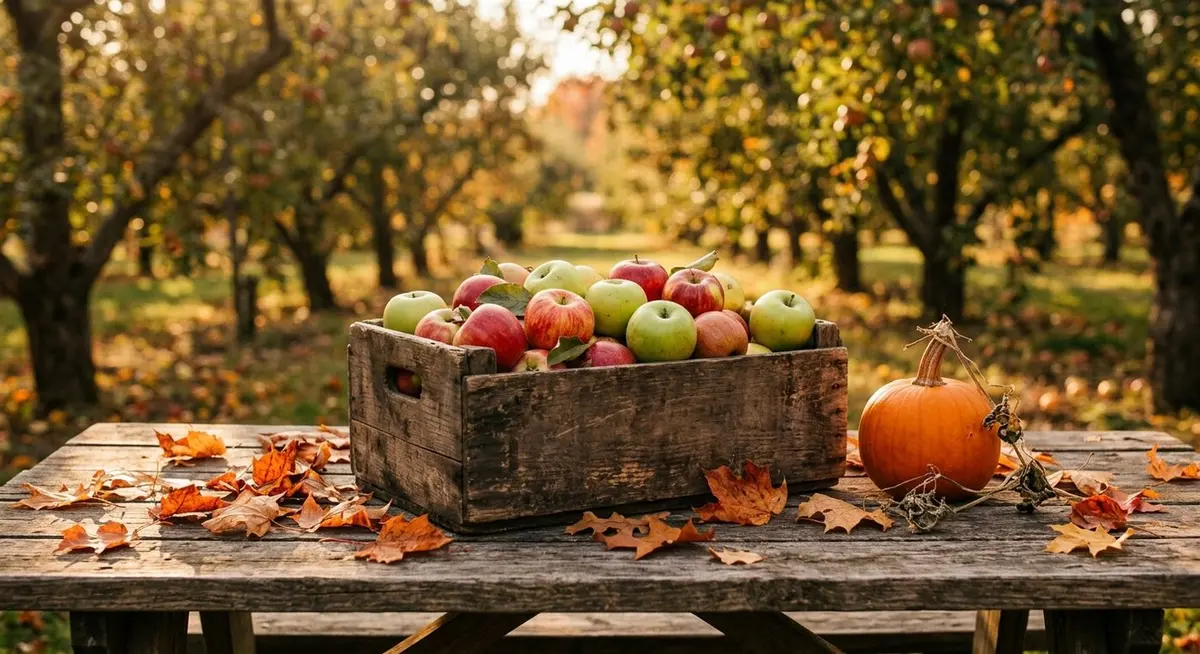
Late September and October give you the softest light of the year, which is why the photographs from these walks always look better than they have any right to.
The rule that saves the afternoon: say the boundary out loud before anyone moves. “We stay where you can still see me.” A boundary announced in advance is a rule. A boundary shouted across a field is a fight.
If you want the printable version to carry with you, the fall scavenger hunt sheet is built for exactly this walk, and there is a shorter version for the anyone who wants the classic twelve-item hunt instead.
What to Bring, and What to Leave Home
The kit matters more than the route. Get this right and the walk runs itself; get it wrong and you spend the whole time carrying things. The goal is one small bag per adult, one basket per child, and nothing else.
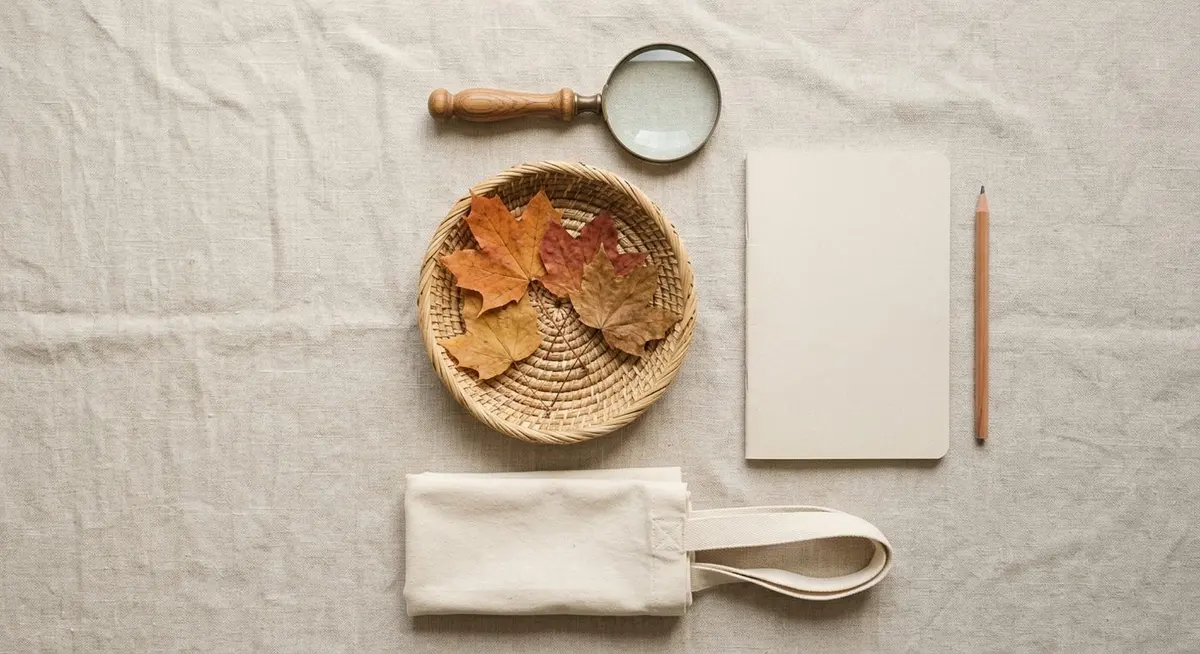
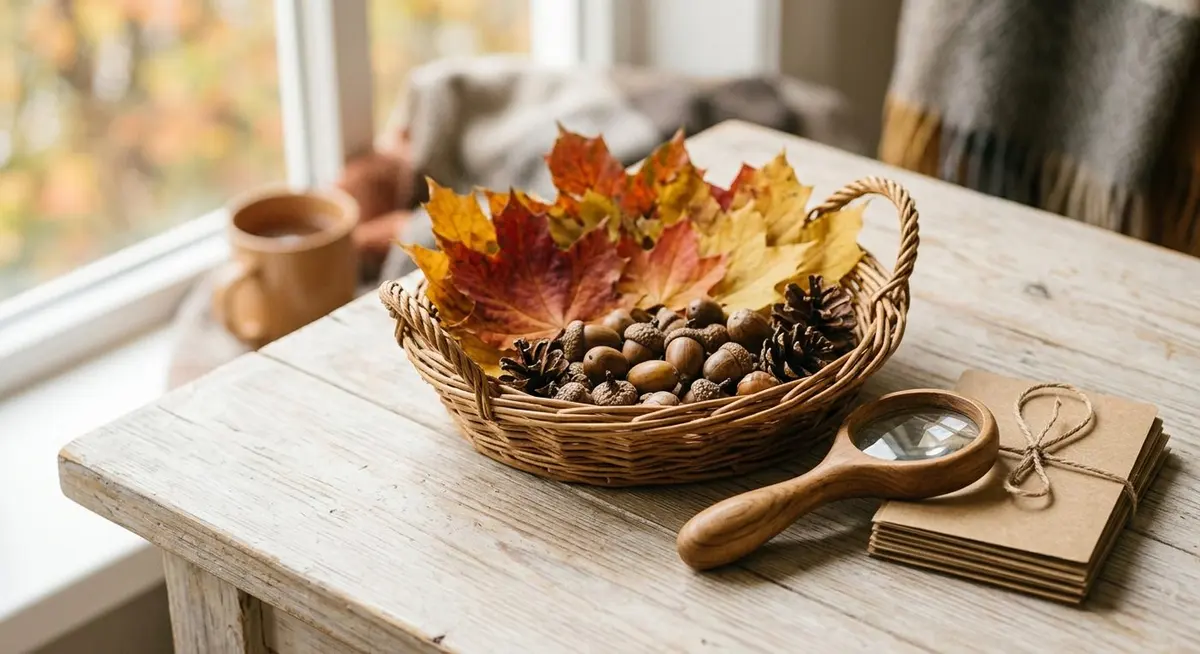
One basket, one lens, one notebook. Everything past this point gets carried by an adult rather than used by a child.
The kit, and what each thing is actually for
Bring
Why it earns its place
A shallow basket or a canvas tote, one per child
Deep bags hide the finds and make children dig instead of look. A shallow basket shows the collection off as it grows, which is the whole reward loop.
A magnifying glass
The single highest-value item in the bag. It converts a five-second pickup into a five-minute examination, and it is what makes the walk last.
A plain notebook and a pencil
For drawing one thing rather than writing about it. Do not bring a printed worksheet with blanks to fill in, it turns a walk into homework.
A phone in a pocket, not a hand
For a photo of the best find and for the time. Not for checking anything else.
Water and one small snack
The single most common cause of a walk ending early is a hungry child, not a bored one.
A second thin layer and a spare pair of socks
Socks in a bag solve the puddle problem in thirty seconds without ending the outing.
Leave these at home
Leave behind
Because
The buggy
If the walk is chosen for the buggy, the walking child rides and nobody looks at anything.
Anything with a screen
A tablet in the bag is a standing invitation to end the walk early.
A printed list of thirty items
Too long to finish, and a list you cannot finish stops being a game.
Bags for “proper” collecting
A child filling a bin bag is gathering, not noticing. A basket that fills up in an hour is the right size.
New expensive shoes
They will come home muddy. This is not a design flaw, it is the point.
Ten minutes of packing beats an hour of walking. Fill the basket, the water and the spare socks before anyone puts a coat on. A group standing in a hallway while an adult hunts for a lens has already lost its momentum.
How to Run the Walk, Step by Step
The order here is what makes the difference between a walk that works and a walk that dissolves. Read it once before you go and it will run itself.
Walk the route alone first, or pick one you already know. Ten minutes of scouting tells you whether there are acorns, whether the path has a road along one side, and where the natural turning-back point is.
Set the boundary out loud at the car or the gate, before anyone starts moving. Point at the far edge so it is a place and not a concept.
Hand out the baskets and the list, and let the children choose the order. Ownership of the order is what makes them keep going.
Start slow. The first hundred metres will produce more finds than the rest of the walk, because everything is new. Let it take as long as it takes.
When interest dips, change the goal rather than the place. Ask for the smallest thing, the reddest thing, the thing that is not a leaf.
Run one quiet minute about halfway through. Everyone stands still, listens, and reports one sound. It resets a group better than a snack does.
Turn back while everyone still wants more, not after. The walk that ends at the moment of peak interest is the one that gets asked for again next week.
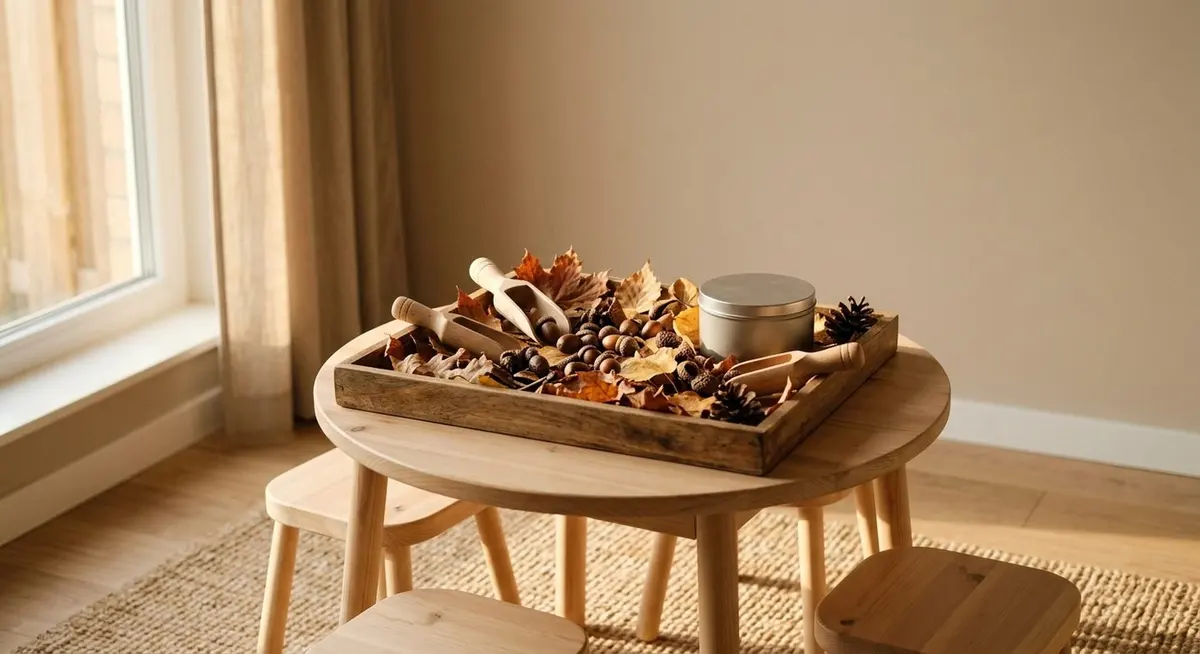
Do the sorting at home, on a tray, with the shoes off. The sorting is half the activity and it happens after the walk, not during it.
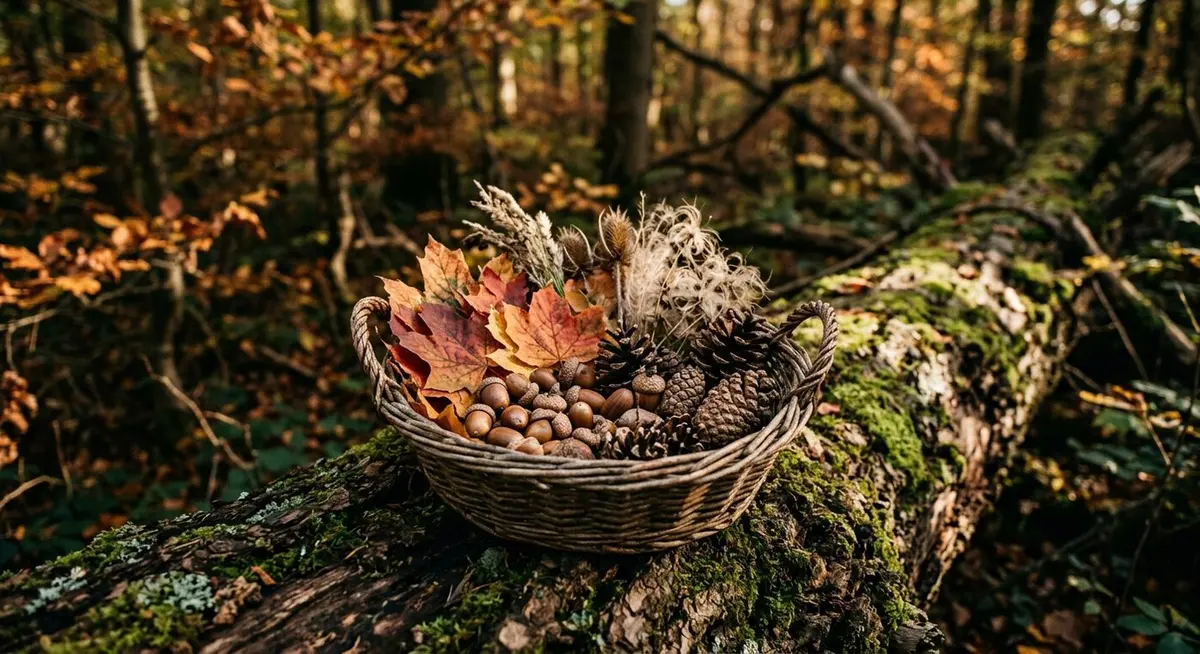
A shallow basket is the whole trick. It shows the collection off as it grows, so the reward arrives during the walk rather than after it.
The ten-minute rule. End the walk ten minutes before you think you should. Fatigue is what children remember, not the leaves they saw. Finishing early is what buys you the next four walks.
The Scavenger List, and Why Each Item Is on It
A good list is not a list of rare things. It is a list of things that are almost certainly there, because the point is to keep a child looking rather than to test them. Twelve items is the sweet spot: long enough to fill an hour, short enough to finish.
The twelve, and where to look
Find
Where to look
Why it is on the list
A leaf with three colours on it
Anywhere under trees
Impossible to rush. A child has to stop and compare to answer it, which is the entire goal.
An acorn or an oak leaf
Under oak trees, along the path edge
The classic autumn find, and the one that photographs best on the sorting tray at home.
A pinecone
Under conifers, often in the grass margin
Available almost all autumn, which means every child gets one and nobody is left out.
Something red
Shrubs, berries, rose hips, a single bright leaf
Colour hunts work for children too young to read the rest of the list.
Something that is not a leaf
Stones, twigs, feathers, seed pods
The item that breaks the fixation on leaves and opens the walk back up.
A seed you can shake
Grasses, ash keys, poppy heads, dry pods
It makes a sound, and a find that makes a sound gets shown to everyone.
The smoothest stone you can find
Path edges, stream beds, gravel
A superlative task. Children will test stone after stone, which buys you a lot of walking.
Bark you can rub
Any tree trunk at child height
Encourages touching and looking up, and it needs no collecting at all.
A feather
Grass margins, under hedges, along fences
Rare enough to feel like a win, common enough to be findable.
Something an animal made or left
Chewed leaves, a nibbled cone, a hole in a trunk
Turns a walk about objects into a walk about noticing. No touching required.
The biggest leaf you can carry
Beneath maples, sycamores and horse chestnuts
A size hunt is the best way to start a walk, because the first find arrives in seconds.
Something the wind moved
Anywhere at all
The closing item. It sends everyone back to the car watching the trees instead of their feet.
Write the list for the ground you actually have. If your route has no oaks, an acorn hunt is a list of failures. Walk the route first and swap in what is really there, then the list becomes a certainty rather than a hope.
What Changes With Age
The walk is the same. What you hand the child and what you ask of them is not. Matching the task to the age is the difference between a child who is absorbed and a child who is being dragged.
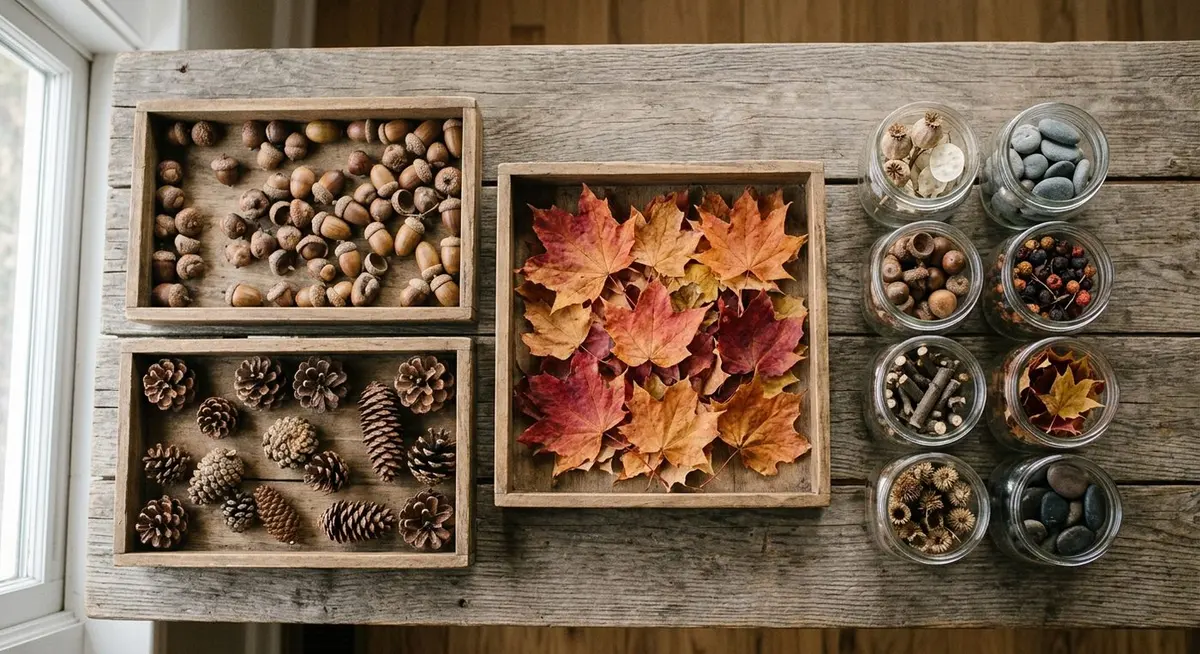
The sorting happens at home, with shoes off. Give it its own half hour and it doubles the value of the whole outing.
Age, task and what to carry
Age
What to give them
What to ask for
Realistic time out
Under 2
A single basket and no list
Nothing. They walk, they pick up, they put down.
20 to 30 minutes
2 to 3
Basket plus one colour to hunt
“Can you find a red one?” One instruction at a time, repeated.
30 to 45 minutes
4 to 5
Basket plus the full twelve-item list
One item at a time. Let them tick it rather than you.
45 to 60 minutes
6 to 8
List plus the magnifying glass
Count, compare and choose the best. Superlatives land well at this age.
60 to 90 minutes
9 to 12
List plus a notebook and pencil
One drawing of the best find, and one thing they noticed that was not on the list.
90 minutes and up
Mixed ages
The same list at two difficulty levels
Pair an older child with a younger one and make the older one the finder’s assistant.
Set by the youngest
Mixed ages are easier than they look. Give everyone the same basket and the same walk, but ask the older children for the superlatives and the younger ones for the colours. Nobody is doing a different activity, so nobody feels demoted. For the youngest end of the range, the shorter toddler version of the hunt is the one to print.
Eight Variations for Different Days
The same walk on the same route will get stale by the third time. Change one rule, not the place, and it feels new. Four of these change what you are hunting for; four change the conditions.
Change the goal
Colour walk. Everyone picks one colour and collects only that. It is the only version that works with a two-year-old and a ten-year-old on the same path.
Size walk. The smallest thing you can see, then the biggest. Bring the magnifying glass for the first half.
Sound walk. Five sounds in ten minutes, no collecting at all. Excellent for a day when hands are cold.
Texture walk. Something rough, smooth, soft, prickly, wet. A touching walk rather than a gathering walk.
Change the conditions
Torchlight walk. The same route after dark, in October, with one torch each. It is a completely different walk and children ask for it again for weeks.
Rain walk. Waterproofs, wellies, and a hunt for what the rain brought out. Puddles become a legitimate find.
Backwards walk. Walk the route in reverse. Everything looks unfamiliar, which resets the noticing.
Photograph walk. Nothing is collected. One photograph of each find, and the album gets looked at afterwards more than a basket ever does.
Change one thing at a time. A new route and a new rule at once is a new activity, and a new activity on a tired afternoon is a gamble. Keep the route and change the rule, or keep the rule and change the route, never both.
Weather, Light and Timing
Autumn gives you a narrow window each day when the light is good and the ground is dry enough. Knowing which window you are in turns a marginal afternoon into the good one.
Conditions and what to do about them
Condition
Verdict
Adjustment
Bright sun, still air
The best possible conditions
Go mid-morning. The low autumn sun through the leaves is the whole reason the photographs work.
Overcast, dry
Excellent, and underrated
Go whenever suits. Flat light means no squinting and no shadows, and colours look richer than you expect.
Light drizzle
Go anyway
Waterproofs and wellies, and add “something the rain brought out” to the list. Do not take paper.
Heavy rain
Postpone
Wet paper, wet lists, cold hands. Swap for an indoor version and walk tomorrow.
Windy, cold
Shorten it
Halve the list to six items and keep close to shelter. Wind is what ends walks, not cold.
After the first hard frost
Go now
Leaf fall accelerates fast after a frost. The best single day of the season is usually the one right after it.
The golden hour is real and it is early. In late September and October the last hour before sunset is when the amber light through the trees is at its best. If you only manage one walk this month, make it that one. If the weather is against you entirely, the fall activities sorted by the kind of day you have will give you a wet-afternoon alternative.
Safety and Etiquette Checklist
A nature walk is a very low-risk activity, and almost all of that risk sits in three places: roads, water and hands. Thirty seconds of checking covers all three.
The boundary was said out loud before anyone moved, and every child repeated it back.
Every child knows to stop and wait, not to run, when an adult calls.
The route has no road along any side, or the road side is walked holding hands.
Water, if there is any, is approached no closer than an adult’s arm’s length.
Nothing goes in a mouth. This is the rule for berries, seeds, fungi and anything unknown, with no exceptions.
Hands are washed, or wiped with a wipe, before the snack, not after.
Every child is wearing one layer more than the adult, and has spare socks in the bag.
One adult is watching the back of the group as well as the front.
Nothing is picked from a growing plant, and nothing is taken from private land.
Anything an animal made or left behind is looked at and left exactly where it is.
The one hard rule. Nothing found on a walk is ever tasted. These fruits and berries come back every year whether they are picked or not, so there is no cost to leaving them, and a berry-heavy branch is one of the most common sources of poisoning calls with small children.
What to Do With Everything You Bring Home
The basket on the kitchen table is the second half of the activity, and it is the half most people skip. Half an hour of sorting turns a pile of leaves into something worth keeping, and it is where the actual learning happens.
What to do with each thing
Bring home
What to do
How long it lasts
Leaves, fresh
Press them flat between sheets of newspaper under a couple of books for a week, then glue onto card.
Years, pressed
Acorns and conifers
Soak briefly in a dilute vinegar solution and dry thoroughly, or they will bring tiny insects out of the shell.
Months, dry
Pinecones
Twenty minutes in a low oven to close them and drive out anything living inside.
Months
Feathers
Photograph and return them to the garden. Do not keep them indoors.
Do not keep
Berries and fungi
Photograph only. Leave outside.
Do not keep
Stones and shells
Wash, dry and keep in a jar. These are the only finds with no shelf life at all.
Indefinitely
Three sorting projects that are worth the table space
A colour row. Arrange pressed leaves from yellow to brown on a strip of card. It takes ten minutes and it teaches more about autumn than a worksheet does.
A jar of the season. One clear jar, filled in layers with what you found, sealed and dated. The following year’s jar beside it is the whole point.
A tray of drawings. One drawing per walk, dated, on the same size card every time. By November you have a small book, and nobody had to be told to write anything.
If the collecting goes well and you have a good haul of leaves, the same afternoon energy carries nicely into no-carve pumpkin decorating or a session of painted monster pumpkins, both of which use the same table and the same tolerance for mess.
A Four-Week Rhythm That Does Not Get Old
The walks that survive the season are the ones on a rhythm rather than on a whim. One walk a week, four weeks, one changing element each time. Give the fourth week to a buffer, because October will hand you a wet Saturday.
One walk a week, four weeks
Week
Walk
The one change
Week 1
The nearest familiar route
Nothing. Establish the boundary and the basket habits first.
Week 2
The same route
Colour walk. Everyone picks one colour; nothing else changes.
Week 3
A new route
Full twelve-item list, with the magnifying glass and the notebook.
Week 4
The same route after dark
Torchlight. If the weather has beaten you twice, this is the buffer week, and it costs you nothing.
Keep a list of the walks, not of the finds. A note of the date and the one thing anyone noticed is enough, and it is the thing you will actually read again. If you want a wider menu to draw from, the family fall bucket list and its longer cousin, the hundred-idea version, both slot a weekly walk in without crowding out the rest of the season.
When It Goes Sideways
Almost every walk that fails fails for one of a handful of reasons, and all of them are fixable in the moment.
The usual failures and the fix
What happened
The real cause
The fix
Bored after ten minutes
The list is longer than the walk, or the first item is too hard
Swap the opening item for the biggest-leaf hunt so the first find arrives in seconds
Cold and complaining
Not enough layers, or the hands are wet
Spare socks and a second thin layer in the bag solve this ninety percent of the time
Nobody can find anything
The list was written for a different kind of woodland
Walk the route first and rewrite the list for the ground you have
The four-year-old will not walk
Too long, and the snack came too late
Halve the list, hand out the water at the halfway point, and end early
The older one is bored
The task is too easy
Add the superlatives and the notebook. Ask for the smallest, the smoothest, the one they cannot name
Everything ends in a squabble over a single acorn
One find, two children
Give every child their own basket before you leave the car. Never one basket between two
The rescue move. When a walk starts to fall apart, stop and change the goal rather than pushing on. “Now find the smallest thing you have ever seen” costs nothing, resets every child on the path, and does not require turning around. A fuller menu of rescues sits in the preschool fall activity ideas if you want options ready before you go.
Questions and the Printable
These come up most weeks in October. Almost all of them trace back to the same three things: a list written for the wrong patch of woodland, a basket that is too deep, or a walk that ran past the point where everyone was still enjoying it.
How long should a fall nature walk be?
Twenty to thirty minutes for a toddler, forty-five to sixty minutes for a four- or five-year-old, and ninety minutes or more for a child of eight and up. The reliable rule is to turn back while everyone still wants more rather than after they have stopped enjoying it. Ending early is what makes them ask to go again.
What if there is nothing to find on our route?
There is always something to find, but it may not be what your list asks for. Rewrite the list for the ground you actually have: if there are no oaks, take the acorn hunt off. The best preparation is to walk the route yourself first for ten minutes and note what is really there in quantity.
Is a nature walk suitable for a two-year-old?
Yes, with a basket and no list. At that age the activity is picking things up and putting them down, which is exactly what the walk is for. Give one instruction at a time, keep it under half an hour, and put the spare socks in the bag.
What should we not collect?
Berries, fungi and anything unknown, and never anything that goes in a mouth. Feathers are best photographed and left rather than kept indoors. Nothing should be picked from a growing plant, and nothing at all should be taken from private land.
How long do leaves and acorns last once we get them home?
Pressed leaves keep for years if you dry them flat between newspaper for a week. Dry acorns and pinecones keep for months, though both benefit from a quick treatment to drive out anything living inside. Stones and shells last indefinitely, and berries and fungi should not come indoors at all.
Can we do a nature walk in the rain?
Light drizzle is one of the best conditions there is, as long as you take waterproofs, wellies and no paper. Add something the rain brought out to the list and the walk becomes its own activity. Heavy rain is the only weather worth postponing for, because wet hands and wet lists end the outing early.
What is the best time of day for an autumn walk?
The last hour before sunset in late September and October, when the low amber light comes through the trees. Mid-morning on a bright still day runs it a close second. Overcast days are genuinely underrated, because flat light means no squinting and the colours read richer.
How do I stop the walk turning into a squabble?
Give every child their own basket before you leave the car, never one basket between two. That single change removes most of the conflict, because the shared-basket fight is almost always about ownership rather than about the acorn.
Free Printable: The Fall Nature Walk Kit
A printable companion to this guide, and nothing in it repeats the article. The twelve-item hunt sheet, a blank version for building your own route, picture cards for the toddler version, the age guide, the variation tick-sheet, the sorting project instructions, a finds log, a four-week rhythm planner and a ten-second pre-departure check.
PDF · 4 pages · prints on letter or A4 · subscribe to unlock the download
Savory Discovery · By Elowen Thorn · Last updated September 2026. Always check local guidance before foraging, and never taste anything found outdoors.
Elowen Thorn I cook, photograph and re-test every recipe in an ordinary home kitchen before it goes up, so what you make matches what you see. Savory Discovery is where simple weeknight cooking, seasonal ideas and the odd bit of kitchen craft sit side by side — written plainly, and worth cooking twice.