By Elowen Thorn · Slow-Cooker Chicken · Weeknight Dinners
Marry Me Chicken earned its name on the stovetop, where a skillet of cream, garlic and sun-dried tomatoes comes together in twenty minutes. The slow-cooker version is better in one way and fussier in two, and nearly every disappointing pot of it traces back to the same three mistakes: the cream went in too early, the chicken cooked past 165°F, and the sauce was thickened after the fact instead of before. This is the version that fixes all three — the ratio, the temperatures, and the rescues.
The stovetop original is a pan sauce. You sear, you deglaze, you finish with cream in the last two minutes, and you serve it straight away. A slow cooker does something almost opposite: it holds a wet environment at a low temperature for hours.
That is genuinely good news for two of the three components. Chicken breast is a lean muscle that turns tender and sliceable when it is held gently at temperature, and a covered crock is the gentlest tool in the kitchen for the job. The garlic, the parmesan and the sun-dried tomatoes all steep and mellow in that environment and come out better than they started. The cream does not. Cream is an emulsion of butterfat in water, held together by milk proteins, and hours of heat slowly dismantle it. If that stovetop finish is what you actually want, a stovetop-minded approach to ratios and temperatures is a better starting point than a slow cooker.
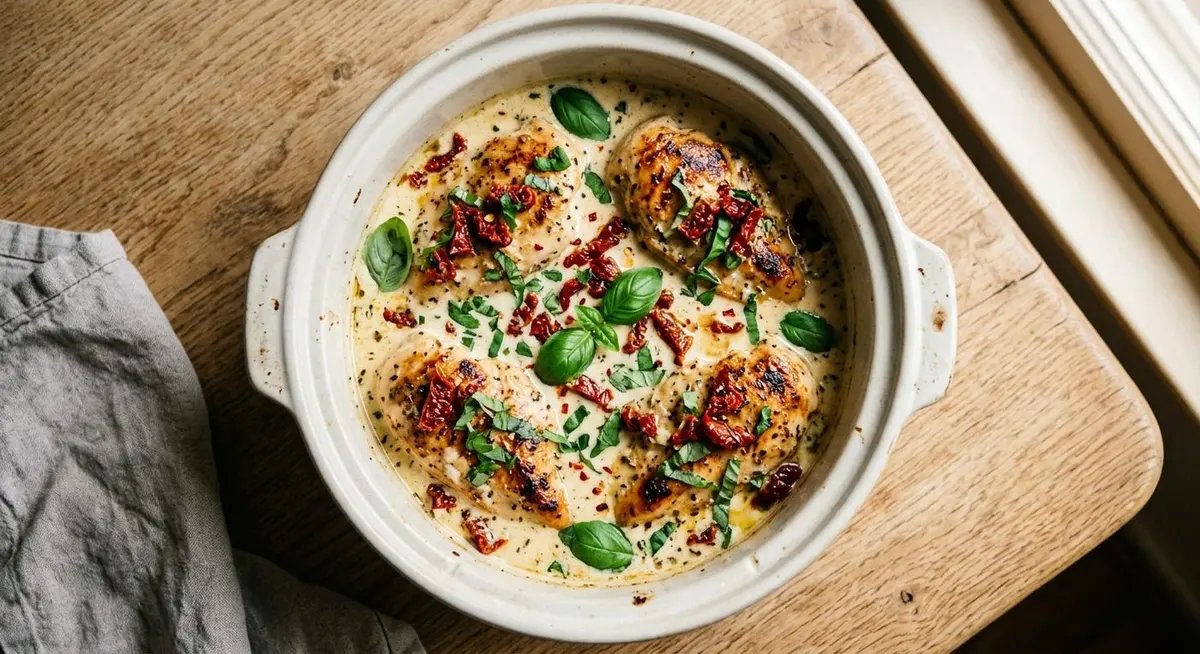
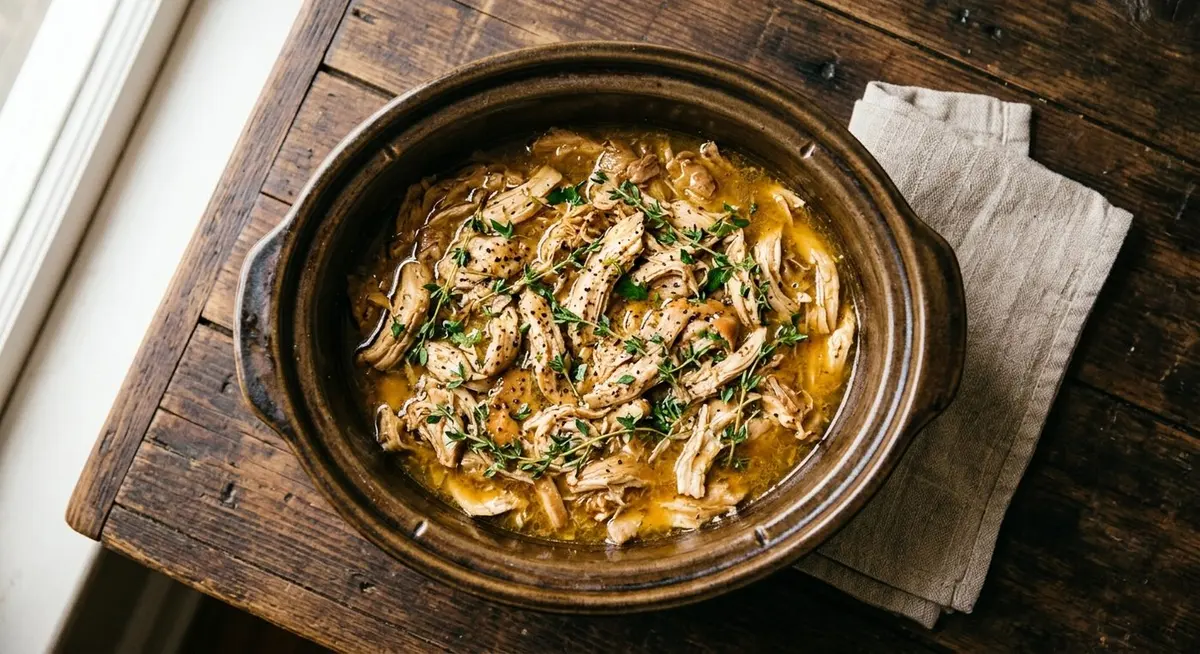
The finished pot: a glossy cream sauce that holds because the cream went in at the end, not the beginning.
So the fix is not a different ingredient list. It is moving one ingredient to the end. Almost every other decision in this guide follows from that single change, and once you have made it the dish becomes remarkably hard to ruin.
If you remember one thing from this page, make it this: add the heavy cream in the last 30 minutes. Not at the start, and not because a list told you to. That one move is the difference between a sauce that is glossy at hour six and a sauce that is grainy at hour two.
The Sauce Ratio That Holds Up for Six Hours
The sauce is a broth base thickened with cornstarch, enriched with parmesan at the end, and finished with cream. That order matters, because each ingredient needs a different amount of heat. Cornstarch must hydrate and gelatinize while the pot is genuinely hot. Parmesan needs a sauce that is already thick enough to carry it without the cheese sinking and clumping. Cream needs the least heat of the three, which is exactly why it goes last.
Once you see the sauce as a ratio rather than a list, scaling the dish stops being guesswork. Here it is per pound of chicken, and doubled for the pot most people own.
Sauce components, scaled by how much chicken you are cooking
Component
Per 1 lb chicken
For 4 servings (1.5 to 2 lb)
For 8 servings (3 to 4 lb)
Chicken broth
3/4 cup
1 1/2 cups
3 cups
Cornstarch
1 1/2 tbsp
3 tbsp
6 tbsp
Heavy cream
1/2 cup
1 cup
2 cups
Parmesan, finely grated
1/4 cup
1/2 cup
1 cup
Sun-dried tomatoes, drained and chopped
3 tbsp
1/3 cup
2/3 cup
Garlic, minced
2 cloves
4 cloves
8 cloves
Italian seasoning
3/4 tsp
1 1/2 tsp
1 tbsp
Red pepper flakes
1/4 tsp
1/2 tsp
1 tsp
Salt
1/4 tsp
1/2 tsp
1 tsp
Black pepper
1/4 tsp
1/2 tsp
1 tsp
Sweet paprika
1/4 tsp
1/2 tsp
1 tsp
Fresh basil, chopped
3 to 4 leaves
6 to 8 leaves
12 to 16 leaves
Two details in that table are doing more work than they look. Cornstarch is not a preference you can eyeball: the useful range is about one and a half tablespoons per cup of liquid, and below that the sauce simply never tightens no matter how long it sits. And the parmesan is structural as well as flavourful. Its proteins and fat help the sauce cling to the chicken and to whatever you serve underneath, which is why a block grated finely on a Microplane behaves so much better than the pre-shredded bag.
Watch the paprika and the salt together. Sweet paprika is mild, but it is the one spice here that turns bitter if it sits against a scorched pot bottom. Stir the sauce once at the halfway mark and you will never meet that problem.
To Sear, or Not to Sear
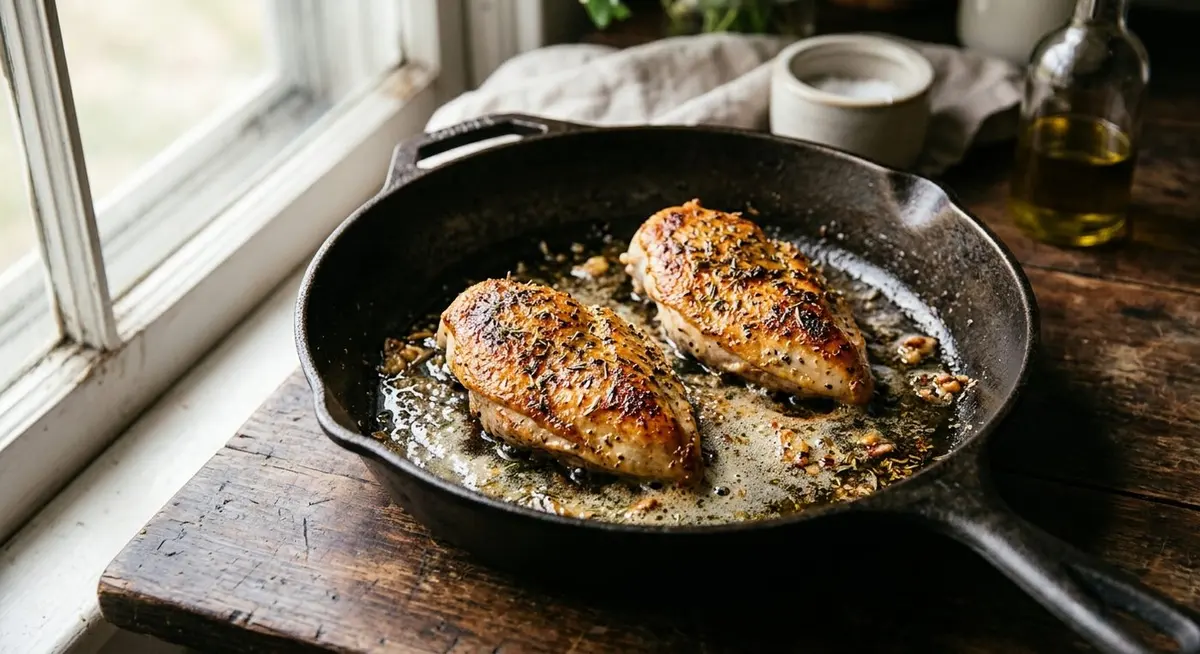
Searing is optional, and it is the step people drop on a weeknight. It buys you a deeper, browner flavour in the finished sauce and a better-looking piece of chicken. It costs ten minutes and one pan. What it also does, quietly, is add four tablespoons of fat to the pot, and that fat is part of the sauce rather than a byproduct of it.
Colour on the surface is the goal, not doneness. The pot finishes the cooking, so pull the chicken while the centre is still raw.
Sear it if you have ten minutes, if you want the deepest flavour, or if you are cooking for company.
Skip the sear on a busy night, but then add 4 tablespoons of melted and slightly cooled butter straight to the broth so the sauce still has body.
Never sear the chicken all the way through. You are looking for colour on both sides and nothing more, roughly two to three minutes per side over medium-high heat.
Keep the pan fat. Those juices carry the seasoning you put on the chicken, and pouring them over the pieces in the crock is free flavour.
There is one more reason to sear that rarely gets mentioned. Browning the surface firms up the outer layer of the meat, and a firmer surface holds up better to six hours of moisture. A pale, unseared breast goes soft and starts to shed into the sauce by hour five. The same logic is why a casserole built on the right ratios survives a long bake without turning to mush.
Doneness: The One Number That Decides Everything
Chicken breast is lean and unforgiving. It is juicy and sliceable at 160 to 165°F, and it is dry, chalky and shredding by 180°F. In a slow cooker, the gap between those two states is about forty-five minutes on low. That is a narrow window for something you are supposedly ignoring all afternoon.
The reason the window exists at all is that a six-quart slow cooker on low holds somewhere between 190 and 210°F. That is comfortably above what chicken needs to be safe, which means the pot has no way to tell you when to stop. Only a probe can, which is why a twelve-dollar thermometer is the single best upgrade you can make to this recipe.
Pull temperatures for this dish
What you are checking
Pull it at
Why that number
Chicken breast, boneless
165°F
Safe and still juicy; carryover adds a degree or two while it rests
Chicken thigh, boneless
175 to 185°F
Thighs need the extra heat to break down connective tissue, and they forgive it
Pork chops, 1 inch
145°F
They overcook faster than chicken in a slow cooker, so probe early
The sauce, before the cream goes in
190°F or above
Cornstarch needs near-boiling liquid to gelatinize and thicken
Start probing at hour five on low, not hour six. Slow cookers vary by twenty degrees or more from one another, and the ones that run hot will hit 165°F well before a recipe’s printed window closes. Then drop the pot to warm, lid on, and it will hold for up to two hours.
Low, High, or Oven: Pick Your Window
Low is the default and the setting I would choose every time. High works, but it is harder on the cream and it saves less time than people expect, because the pot still has to come all the way up to temperature first. The oven is worth knowing about because it lands closest to the stovetop original.
Timing by method
Method
Setting
Total time
What to watch
Slow cooker
Low
5 to 7 hours
Best texture by a distance; add the cream in the last 30 minutes
Slow cooker
High
2 1/2 to 3 1/2 hours
Check at two hours; add the cream in the last 20 minutes
Slow cooker
Warm, after cooking
Up to 2 hours
Holds beautifully; stir once just before serving
Dutch oven
325°F, covered
1 1/2 to 2 hours
The closest thing to a stovetop result without a skillet
Skillet, stovetop
Medium
25 to 30 minutes
The original method, if you are not reaching for a slow cooker at all
The warm setting is the underrated one. If you are feeding a crowd and the pot finishes early, drop it to warm, leave the lid on, and leave it alone. It will hold for a couple of hours without turning the chicken to string. What it will not do is thicken the sauce further, so make sure the sauce is where you want it before you step the heat down.
One caveat on high: a cooker that runs hot can push cream past a simmer and split it. If your machine is one of those, stay on low, or hold the cream back until the very end and stir it in with the pot switched off.
Thickening, Fixing and Rescuing the Sauce
Three things go wrong with this sauce, and each one has a specific fix. Knowing them in advance is most of what separates a cook who panics from a cook who does not.
It is too thin
Either the cornstarch ratio was low, or the slurry went in cold and never reached a full simmer. Make a fresh slurry of one tablespoon of cornstarch to two tablespoons of cold water, whisk it in with the pot turned to high, and give it ten minutes. It will tighten. If it does not, your cooker runs cool and you should keep it on high a little longer rather than adding more starch blindly.
It is grainy or curdled
This is the cream breaking, and it happens for one of exactly two reasons: the cream went in at the start, or the sauce boiled hard after the cream went in. You can sometimes bring it back by lifting the chicken out and whisking in a tablespoon of cold cream or a knob of cold butter with the pot off the heat. If it has split completely, strain the sauce, rebuild it with fresh cream, and pour it back over the chicken. The chicken itself is fine either way.
It is greasy
There is more fat in the pot than the sauce can hold. That usually comes from skipping the sear and adding the butter anyway, or from a fattier cut of meat than the recipe assumes. Skim the surface with a wide spoon, then whisk in a tablespoon of cornstarch slurry to bind what remains.
The three failures and their repairs at a glance
What you see
What caused it
What to do
Thin, watery sauce
Too little cornstarch, or the slurry never simmered
Fresh slurry, 1 tbsp to 2 tbsp cold water, high for 10 minutes
Grainy or curdled
Cream added early, or the sauce boiled after it went in
Whisk cold cream or butter in off the heat; strain and rebuild if fully split
Slick and greasy
More fat than the sauce can emulsify
Skim the surface, then bind with a cornstarch slurry
The single rule that prevents most of this: never let the sauce come to a rolling boil once the cream is in. A bare simmer with the lid on is all it needs, and it is all it should get.
Swaps That Actually Work
Some substitutions are invisible in the finished dish. Others change it enough that you should know what you are giving up before you reach for the alternative.
Substitutions and what they cost you
Instead of
Use
What changes
Boneless chicken breasts
Boneless skinless thighs
More forgiving and more flavourful; add 30 to 45 minutes on low
Heavy cream
Whole milk plus 1 tbsp butter per cup
Thinner sauce, far less curdle risk, less rich
Heavy cream
Full-fat coconut milk
A noticeably different flavour; works in a pinch, not a match
Cornstarch
Arrowroot
Thickens at a lower temperature; add it at the very end
Cornstarch
All-purpose flour
Needs to cook out, and it goes lumpy in a slow cooker
Oil-packed sun-dried tomatoes
Dry-packed, rehydrated
Same flavour with less oil landing in the sauce
Sun-dried tomatoes
Roasted red peppers
Sweeter and milder; you lose the signature tang
Fresh basil
1 tsp dried basil
Duller but acceptable; add it with the parmesan
Parmesan
Finely grated mozzarella
Stringier melt and less salt; season a little more
Fresh garlic
Jarred minced garlic
Sharper with fresh, flatter with jarred, but it works
A 6-quart cooker
A 4-quart cooker
Halve the recipe; do not crowd the pot
The one swap I would genuinely avoid is flour for cornstarch. Flour needs a real boil to lose its raw taste, and a slow cooker full of cream is the last place you want to find out whether it managed one. Cornstarch is more forgiving, thickens clear rather than cloudy, and behaves predictably at the temperatures a crock actually reaches.
What to Serve It With
The sauce is the point of the dish, so whatever sits under it has to be able to carry liquid without going to paste. Ranked by how well each one does that job:
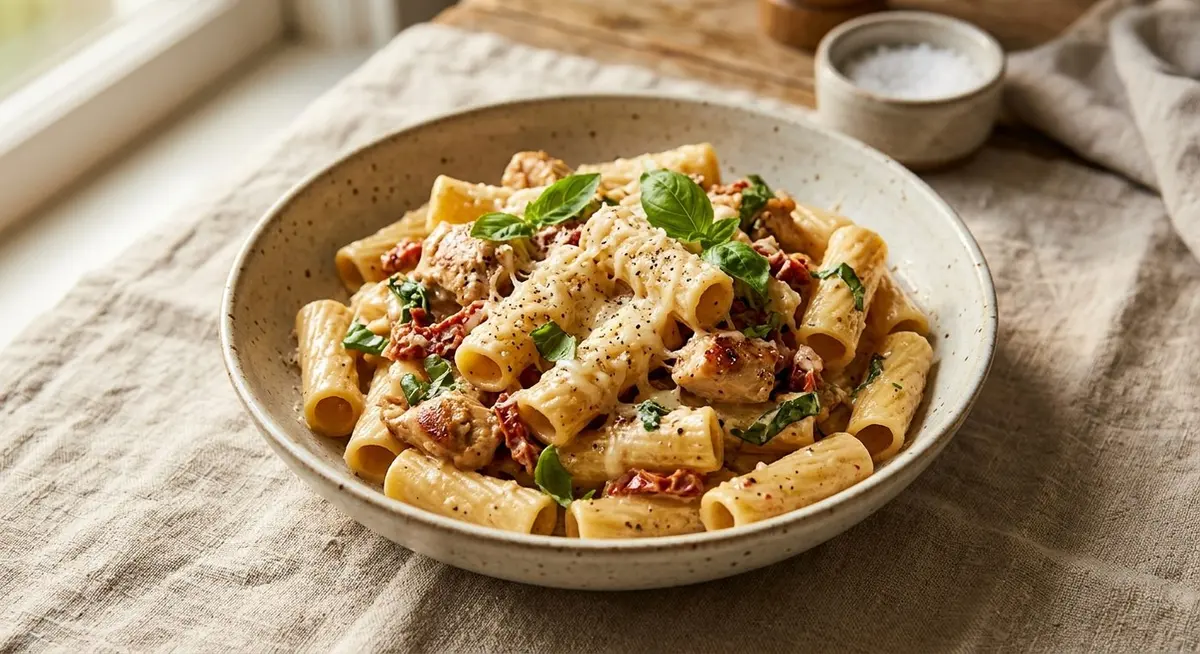
Rigatoni is the safest choice: the tubes trap sauce instead of letting it pool in the bottom of the bowl.
Rigatoni, rotini or penne. Tubes and spirals hold sauce best. Cook them a minute under the box time so they finish in the sauce on the plate.
Mashed potatoes. The classic pairing. Leave them a little looser than usual so they soak rather than sit.
Polenta or stone-ground grits. Silkier than potatoes and they absorb more, which is good news when the pot is generous.
Rice. Works, but serve it in a shallow bowl and spoon the sauce over the top rather than stirring it through.
Crusty bread. Not really a side, more of a delivery method, and honestly the best way to finish the last of the pot.
Egg noodles. Fast, cheap, and they hold sauce better than their reputation suggests.
Do not toss the pasta into the pot. The starch clouds the sauce, the leftovers stiffen into glue overnight, and you lose the ability to keep the chicken and the sauce at their own best textures. Sauce the portions on the plate and keep the two apart until the moment you eat.
Make-Ahead, Freezing and Reheating
This is a good dish to cook once and eat twice, provided you reheat it with some care. Cream sauces separate when they are reheated hard, and that is chemistry rather than a mistake you made. The two things that help most are gentleness and a splash of fresh liquid to give the sauce something to re-emulsify into.
Storage and reheating at a glance
Method
How to do it
How long it keeps
Refrigerator
Airtight, chicken and sauce together
3 to 4 days
Freezer
Cooled, portioned, sauce covering the chicken
Up to 3 months
Reheat, stovetop
Low heat, splash of broth or cream, stir constantly
Best method
Reheat, microwave
50 percent power, covered, in 30-second bursts
Acceptable
Reheat, slow cooker
Warm setting, 30 to 45 minutes, splash of cream
Good for a crowd
If you are freezing, portion the chicken into shallow containers and pour the sauce over it rather than beside it. The sauce is what protects the meat from freezer burn, and packing the chicken in a layer of sauce means it thaws evenly instead of drying out at the edges while the middle is still solid.
Cool it fast before you chill it. Spread the pot contents into a wide container so the depth stays shallow, and get it into the refrigerator within about an hour. A deep pot of sauce takes far too long to come down through the range where bacteria are happiest.
When It Goes Wrong
Slow cookers are individual machines, and most of the trouble people hit with this dish comes from a cooker behaving differently than the recipe assumed. Here is the list I keep in the front of my own notebook.
Symptom, likely cause, and the fix
Symptom
Likely cause
The fix
Chicken dry and shredding
Cooked past 175°F
Shred it and call it sandwiches; the sauce is still excellent
Sauce still thin after six hours
Cornstarch under-measured, or the slurry never simmered
Fresh slurry, 1 tbsp to 2 tbsp cold water, high for 10 minutes
Sauce grainy
Cream added early, or the pot boiled
Whisk cold cream or butter in off the heat
Sauce split completely
A hard boil with the cream in the pot
Strain it and rebuild the sauce with fresh cream
Greasy surface
More fat than the sauce can hold
Skim, then bind with a cornstarch slurry
Sauce tastes flat
Under-salted, or the parmesan was light
Parmesan, salt, and a squeeze of lemon
Chicken rubbery
Overcooked in a cooker that runs hot
Slice it thin across the grain and let the sauce do the work
Tomatoes taste harsh
They caught the pot bottom
Do not scrape the base; lift the contents out gently
Pot scorched
A hot-running cooker on high
Use low from now on, or line the pot next time
None of these are fatal, and that is worth saying plainly. The chicken in a broken-sauce pot is still perfectly good chicken, and the sauce can almost always be rebuilt. The dish is far more forgiving than its reputation suggests, provided you taste as you go and keep a thermometer within reach. If you would rather have a pumpkin dessert waiting for afterwards, these pumpkin dessert ratios are built on the same principle of measuring rather than guessing.
The Recipe, Condensed
Here is everything above reduced to what you actually need standing at the counter with a slow cooker in front of you.
Slow-Cooker Marry Me Chicken
Yield
4 servings
Prep
15 minutes
Cook
5 to 7 hours on low
Total
5 hours 15 minutes to 7 hours 15 minutes
Ingredients
4 boneless, skinless chicken breasts, about 1 1/2 to 2 lb
1/2 tsp salt, plus 1/2 tsp for the sauce
1/2 tsp garlic powder
1/2 tsp onion powder
1/4 tsp freshly ground black pepper
2 tbsp olive oil
2 tbsp salted butter
1 1/2 cups chicken broth
3 tbsp cornstarch
1 cup heavy cream
4 cloves garlic, minced
1 1/2 tsp Italian seasoning
1/2 tsp black pepper, for the sauce
1/2 tsp red pepper flakes
1/2 tsp sweet paprika
1/3 cup oil-packed sun-dried tomatoes, drained and chopped
1/2 cup freshly grated parmesan
6 to 8 fresh basil leaves, chopped
Instructions
Mix the 1/2 tsp salt, garlic powder, onion powder and 1/4 tsp black pepper, and season the chicken on both sides.
Heat a large skillet over medium-high. Add the olive oil and butter, let the butter melt, and sear the chicken until golden on both sides, about 2 to 3 minutes per side. You are colouring it, not cooking it through. Take the pan off the heat and keep the fat in it.
Whisk the broth and cornstarch together until completely smooth, then pour the mixture into the bottom of a 6-quart slow cooker.
Whisk in the minced garlic, Italian seasoning, 1/2 tsp salt, 1/2 tsp black pepper, red pepper flakes and paprika. Do not add the cream yet.
Lay the seared chicken in the pot and pour the reserved pan fat and juices over the top. Spoon the chopped sun-dried tomatoes over each piece.
Cover and cook on low for 5 to 7 hours, or on high for 2 1/2 to 3 1/2 hours, until the chicken reads 165°F at its thickest point.
In the last 30 minutes, lift the lid, stir in the heavy cream, and re-cover to finish the cooking time. Keep it at a bare simmer, never a boil.
Lift the chicken out to a plate. Whisk the parmesan into the sauce until it melts, then taste and adjust the salt.
Return the chicken to the pot, spoon sauce over each piece, scatter the basil on top, and serve.
Notes
Add the cream in the last 30 minutes. This is the single most important step in the whole recipe.
If you skip the sear, add 4 tablespoons of melted and slightly cooled butter to the broth so the sauce still has body.
A slow cooker on low runs 190 to 210°F, so the pot cannot tell you when the chicken is done. Start probing at hour five.
Never let the sauce reach a rolling boil once the cream is in, or it will grain and eventually split.
Leftovers keep 3 to 4 days refrigerated and up to 3 months frozen. Reheat gently with a splash of cream.
Parmesan goes in at the end, off the heat, so it melts into the sauce instead of clumping.
Questions I Get Asked
Can I cook this on high?
Yes, but check it at two hours and add the cream earlier, in the last 20 minutes rather than the last 30. High heat is harder on cream, and a slow cooker on high can push the sauce past a simmer, which is the beginning of the end for the emulsion.
Can I use frozen chicken breasts?
No. Frozen chicken keeps the pot in the unsafe range for far too long during the come-up, and it releases water as it thaws that thins the sauce. Thaw it fully in the refrigerator first.
Do I have to sear the chicken?
No, but you have to replace the fat. The sear puts two tablespoons of butter and two tablespoons of olive oil into the pot, and that fat is part of the sauce. If you skip the sear, add four tablespoons of melted butter to the broth.
Can I use chicken thighs instead?
Yes, and they are more forgiving. Boneless skinless thighs want 30 to 45 minutes longer on low, and they are happiest at 175 to 185°F rather than 165°F.
Why did my sauce curdle?
Either the cream went in at the start, or the sauce boiled after it went in. Cream is an emulsion, and heat breaks emulsions. Add it late and keep the pot at a bare simmer.
My sauce is still thin after six hours. What now?
Whisk one tablespoon of cornstarch into two tablespoons of cold water, stir it in, and run the pot on high for ten minutes. Cornstarch needs near-boiling liquid to gelatinize, so if your cooker runs cool, that is the missing piece.
Can I make this ahead?
Yes. Cook it fully, cool it quickly in a shallow container, and refrigerate for up to four days. Reheat gently on the stovetop with a splash of broth or cream, stirring constantly.
How do I reheat it without the sauce breaking?
Low and slow, with fresh liquid. The stovetop over low heat with a tablespoon or two of cream works best. The microwave at 50 percent power, covered, in short bursts, is a solid second choice.
What if I do not like sun-dried tomatoes?
Leave them out. The dish still works, but you lose the tang that gives it its character. Roasted red peppers are the closest substitute, sweeter and milder.
Can I double the recipe?
Only if the pot is big enough. A 6-quart cooker handles 3 to 4 pounds of chicken comfortably. Past that, use two pots, or halve the chicken and keep the sauce ratio intact so the sauce stays thick enough to matter.
Get the printable slow-cooker planner
One printable sheet set for this dish: the printable recipe card, the scaled sauce ratio card, the timing-and-temperature chart, the sauce rescue card, a make-ahead timeline and a storage tracker. Print it once and keep it in the drawer next to the cooker.
PDF · 7 pages · prints on letter or A4 · subscribe to unlock the download
By Elowen Thorn · savorydiscovery.com · Updated September 2026. Ratios and temperatures were tested in a 6-quart slow cooker; adjust your window to your own machine.
Elowen Thorn I cook, photograph and re-test every recipe in an ordinary home kitchen before it goes up, so what you make matches what you see. Savory Discovery is where simple weeknight cooking, seasonal ideas and the odd bit of kitchen craft sit side by side — written plainly, and worth cooking twice.