The 5-Minute Baked Yogurt That Eats Like Cheesecake (41g Protein)
One bowl, one ramekin, no crust, no water bath, no stand mixer. This is the version of baked yogurt that sets firm enough to slice, tastes like a baked cheesecake, and clears 40 grams of protein without a shred of chalkiness.
By Elowen Thorn · Updated 22 September 2026 · 12 test bakes to nail the set
Most baked yogurt recipes have the same problem: they promise cheesecake and deliver scrambled eggs with fruit in it. You follow the steps, cut a slice, and it slumps into a puddle of whey while the texture goes rubbery at the edges and grainy in the middle. The recipe gets blamed. The technique is what failed.
Baked yogurt is simply yogurt, eggs and a starch baked into a sliceable custard. It is not yogurt that has been heated — it is a set custard that happens to use yogurt as its base. Once you understand that, every variable stops being a mystery. The starch is what makes it sliceable. The acidity of the yogurt is what makes it fragile. The protein powder is what turns a 21-gram dessert into a 41-gram one, and it is also the single most common reason a batch goes chalky.
So this is not just a recipe. It is the working version: the 41-gram formula, a full nutrition table, six flavours off one base batter, a troubleshooting chart for every way it can go wrong, and a storage guide that tells you honestly what happens in the freezer. Five minutes of prep, one bake, and you have breakfast or dessert sorted for days.
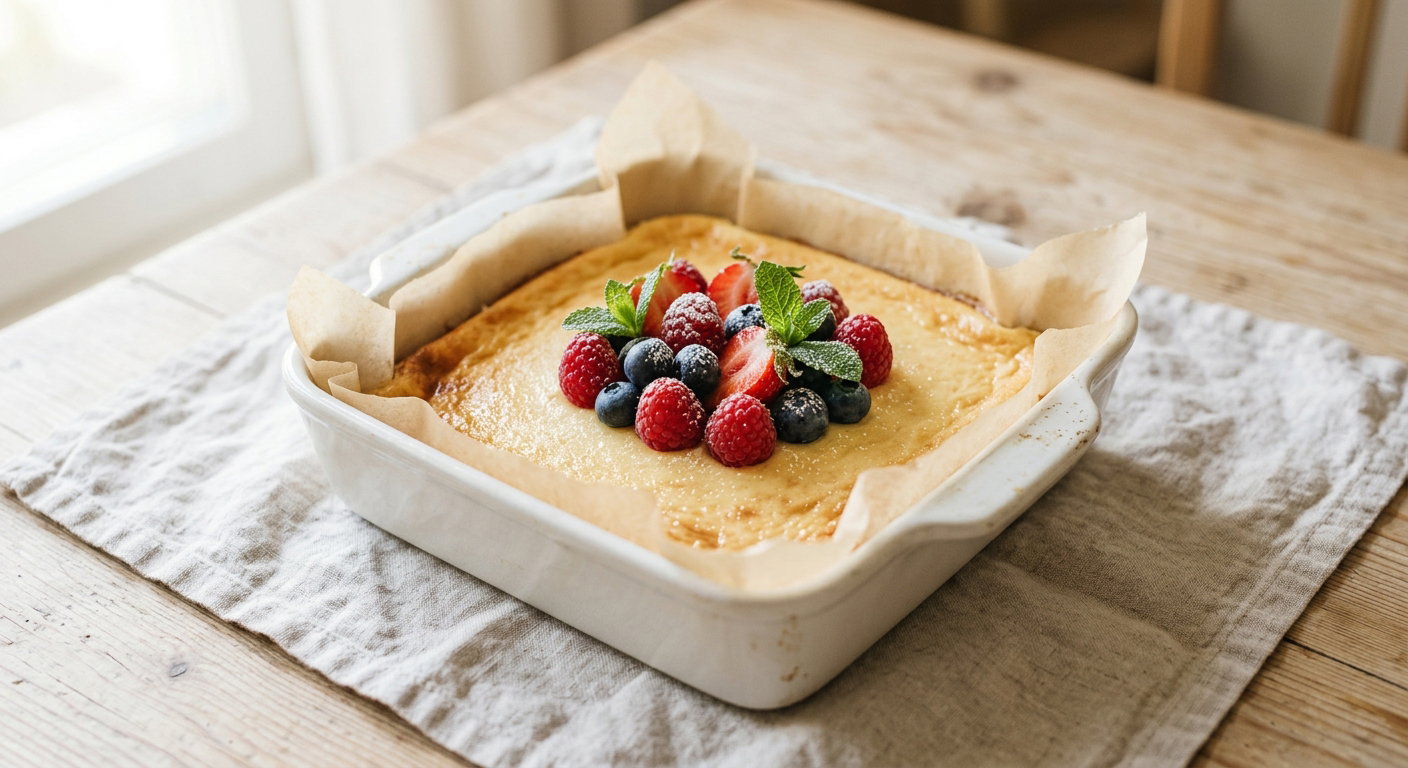
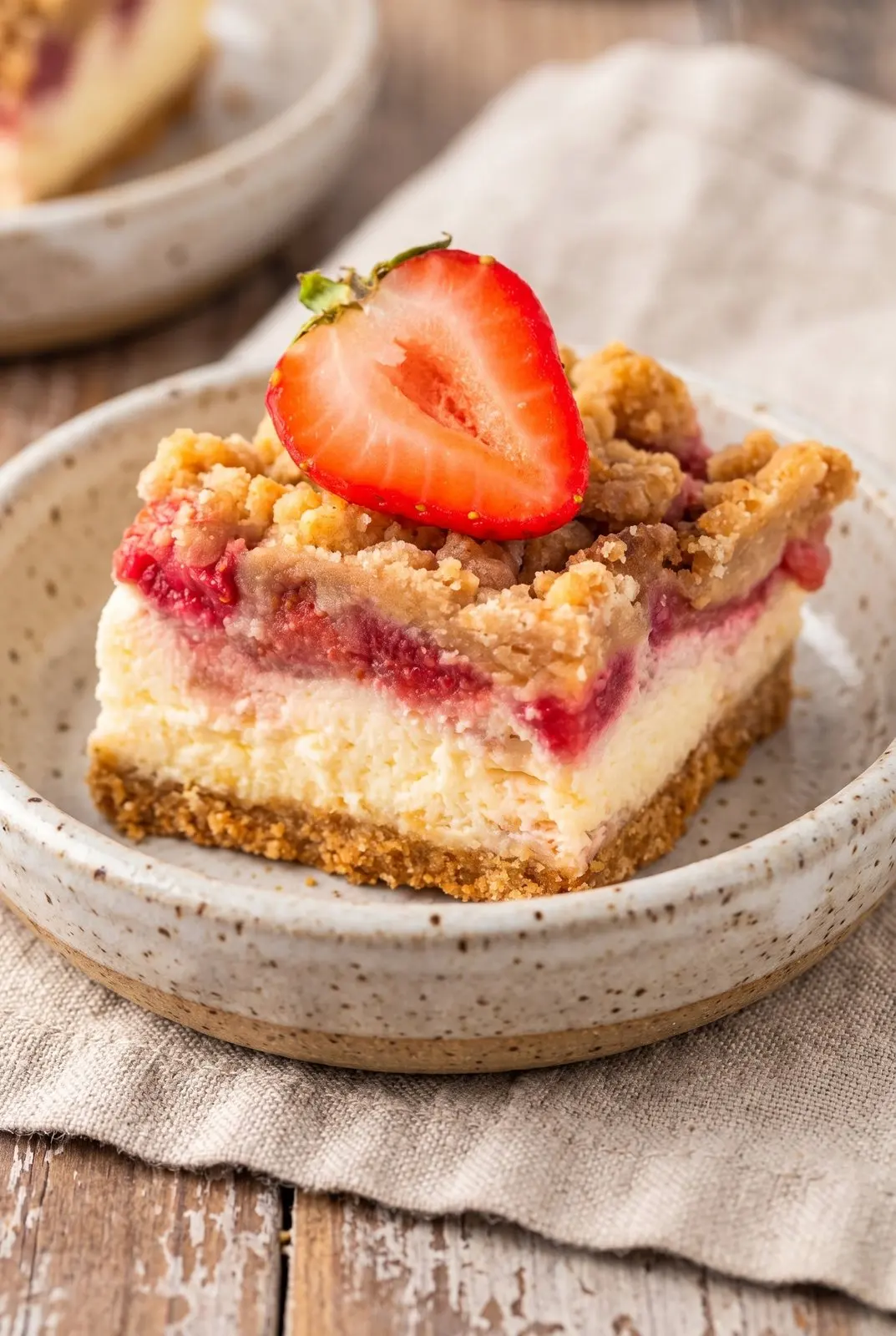
Baked yogurt straight from the oven: set, sliceable and topped with fresh berries. The single-serve ramekin version takes 25 minutes; the same batter scaled up makes six servings in one dish.
Why this works: the science of a set custard
Three things happen in the oven, and knowing them is the difference between a silky slice and a leaking mess. None of it requires special equipment — it just requires you to stop treating this like a cake.
Yogurt is already a gel. Greek yogurt is milk protein (mostly casein) that has been acid-set and then strained, which is why it is thick and low in whey. That strain is the point: the less free liquid you start with, the less there is to weep out later. This is the entire reason Greek yogurt works and thin regular yogurt turns into pudding. If you only take one thing from this article, take this one.
Cornstarch is the structure, not a thickener. Starch granules absorb water and swell as they pass roughly 62–80°C, then set into a network that traps the liquid inside the custard. Without it you get a soft, spoonable flan; with it you get a slice that holds its edges on a plate. It also physically separates the egg proteins so they cannot knit into tight, rubbery clumps — which is why a starch-thickened custard is so much more forgiving than a plain one.
The acidity is why it can go grainy. Yogurt is acidic, and acid lowers the temperature at which egg proteins coagulate. That sounds like a problem, and at high heat it is: push a yogurt custard past roughly 85°C and the proteins overcook and squeeze out water. This is the real reason overbaked baked yogurt turns watery and rubbery at the same time. Starch and sugar both raise the coagulation temperature and buy you margin, which is why you should not skip the sweetener entirely if you care about texture.
Why this works
Why it will not curdle
Curdling is heat plus acid, arriving too fast. You avoid it three ways: the starch buffers the proteins, the sweetener raises the coagulation point, and a moderate oven with a gentle, gradual temperature rise gets the middle set before the outside overcooks. That is why 175°C / 350°F for the ramekin, and 160°C / 325°C with a water bath if you want the silkiest possible texture. It is also why lemon juice goes on top at the end rather than into the batter — zest in, juice out.
Does baking kill the probiotics? Yes, the live cultures do not survive a 25-minute bake. You keep the protein, the calcium and the tang; you lose the live cultures. If probiotics are your goal, eat plain yogurt straight from the tub and bake this for the protein and the pleasure.
Why the protein number actually matters
A dessert that keeps you full is worth more than one that does not, and 41 grams is roughly what you get from two and a half eggs plus a chicken breast. Protein is also the macronutrient that makes a sweet thing behave like a meal: it slows gastric emptying, blunts the blood-sugar spike that comes from the maple syrup, and repays you at the next meal because you are simply less hungry. That is the practical case for a high-protein dessert — not that it is virtuous, but that it does the job of a snack and a treat at the same time.
The recipe
The single-serve version below hits 41 g of protein and bakes in a 250 ml ramekin. The batch version makes six identical servings in one dish, which is what I actually do on a Sunday. Both use the same ratio, so you can scale either direction without thinking about it.
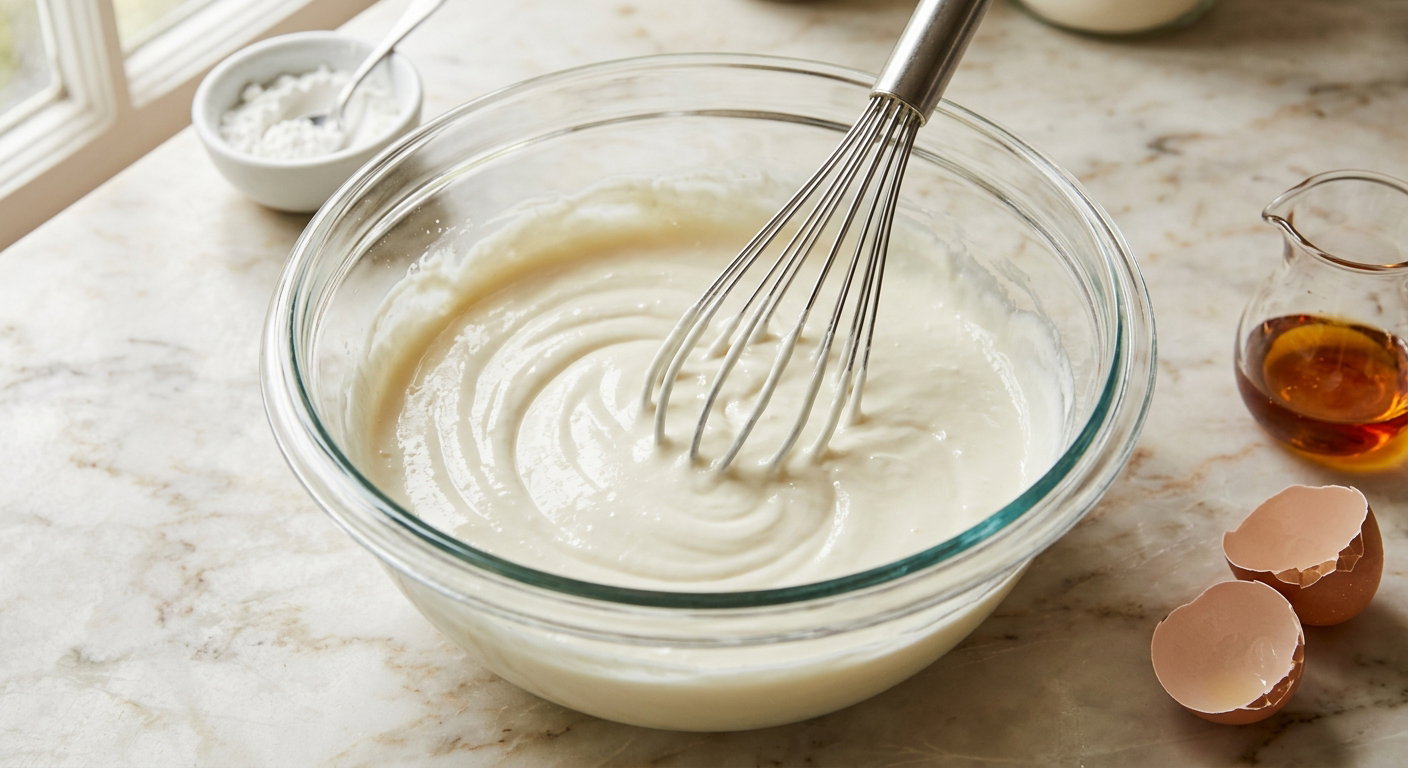
Everything goes into one bowl. Whisk the yogurt, egg and sweetener smooth first, then add the cornstarch — that order is what keeps the custard silky instead of lumpy.
Protein Baked Yogurt
Set, sliceable yogurt custard that eats like baked cheesecake — 41 g protein per serving, 5 minutes of prep, one bowl.
25 g (about 2 tablespoons) vanilla whey protein isolate
8 g (1 tablespoon) cornstarch
15 ml (1 tablespoon) maple syrup or honey
¼ teaspoon vanilla extract
40 g (⅓ cup) berries, fresh or frozen
Pinch fine salt
Instructions
Heat the oven and prep the dish175°C / 350°F, rack in the middle. Lightly grease a 250 ml (1 cup) ramekin, or line a small dish with parchment. A greased dish gives you a cleaner release than parchment in a ramekin, which is fiddly at this size.
Whisk the wet ingredients smoothIn a bowl, whisk the Greek yogurt, egg, maple syrup, vanilla and salt until completely uniform and slightly glossy — about 30 seconds. No streaks of egg white, no lumps of yogurt.
Sift in the protein powder and cornstarchSift both over the bowl to break up any clumps, then whisk gently until just combined. Whisking hard here whips in air, and air is what makes the custard puff and then collapse into a rubbery layer.
Fold in the berriesStir through three-quarters of the berries with a spatula, then pour the batter into the ramekin and scatter the rest on top.
Bake until barely setBake 22–28 minutes. The centre should be set with a faint, deliberate wobble when you nudge the ramekin, and the surface should look matte rather than wet and shiny. A skewer inserted 2 cm from the edge should come out clean; in the very middle it may still be slightly moist. That is correct — it finishes setting as it cools.
Cool, then chill for a clean sliceLeave it on a rack for 30 minutes, then refrigerate at least 30 minutes before eating. Warm, it is a soft spoonable custard; chilled, it slices cleanly and the texture firms into something genuinely cheesecake-like. Both are good. They are just different desserts.
Batch version (makes 6)
Multiply every ingredient by six: 900 g Greek yogurt, 6 eggs, 150 g whey isolate, 48 g cornstarch, 90 ml maple syrup, 1½ tablespoons vanilla, 240 g berries. Whisk in the same order, pour into a parchment-lined 20×20 cm (8×8 inch) dish at least 5 cm deep — or two 23×13 cm loaf pans if that is what you have — and bake at 175°C / 350°F for 40–50 minutes, until the centre is just set. Cool 45 minutes, then chill at least 2 hours before cutting into six. Same 41 g of protein per serving.
One bowl
No crust
Gluten-free
No refined sugar
Freezer-friendly
Scales to 6
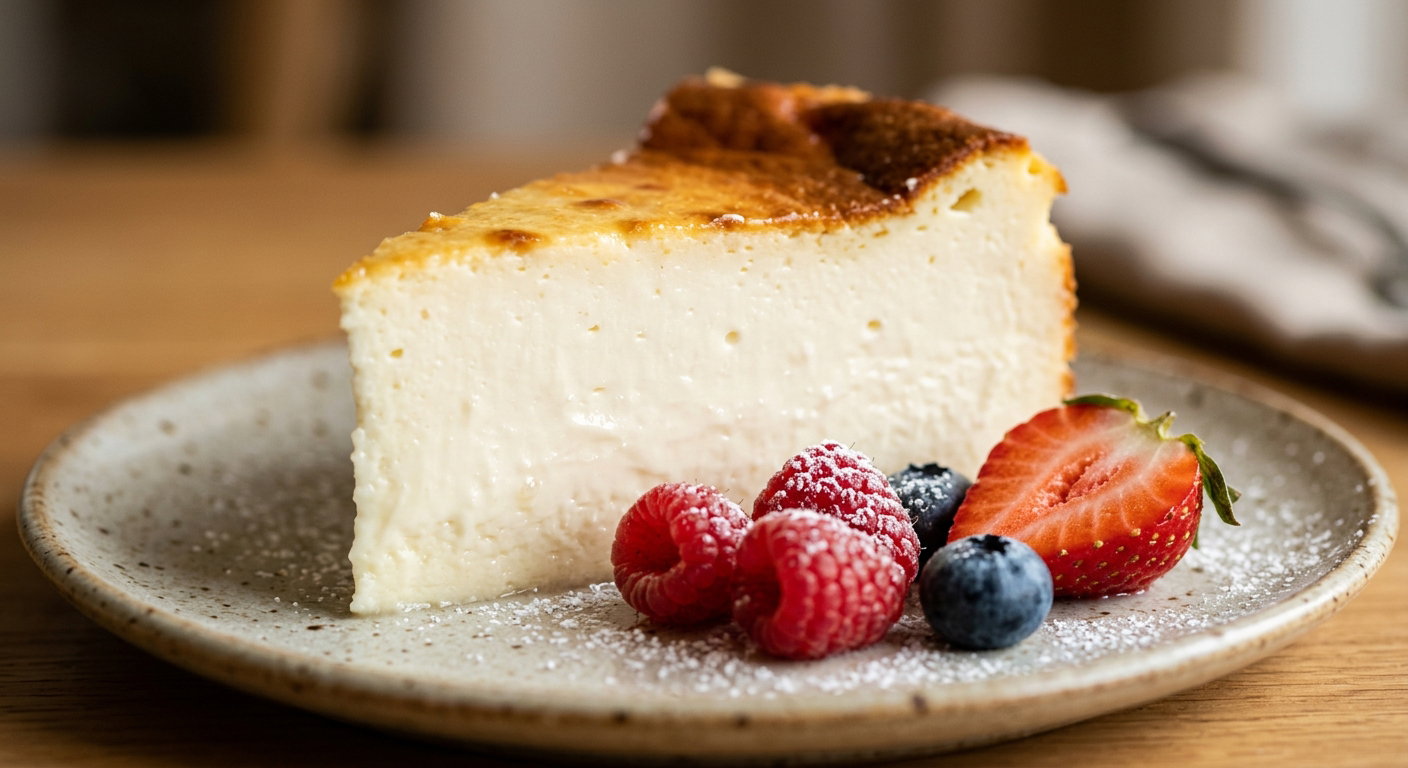
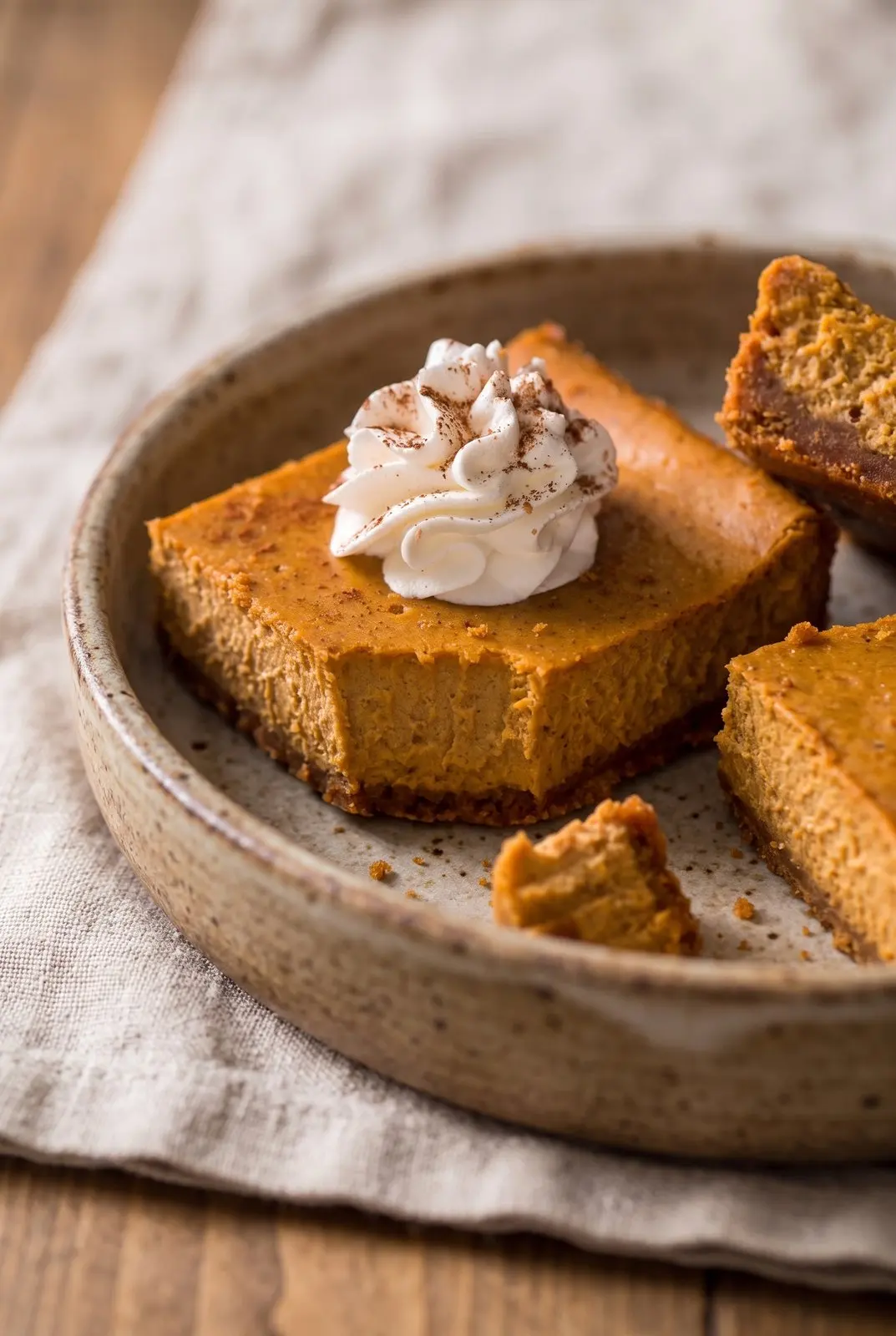
The cut face is the test: dense, smooth and creamy, with no weeping liquid pooling at the base and no spongy holes. A faintly golden top edge is exactly right.
Full nutrition breakdown
Calculated from the single-serve ingredient list above, with 0% fat plain Greek yogurt and a standard whey isolate at roughly 80 g protein per 100 g. Berry type barely moves the numbers, so use whichever you like.
Calories
364 kcal
Protein
41 g
Carbohydrate
31 g
Fat
6.6 g
Sugar
20 g
Fibre
4 g
Nutrition per serving (one 250 ml ramekin, 41 g protein)
Nutrient
Amount
Notes
Calories
364 kcal
About 40% of the energy comes from protein
Protein
41 g
From yogurt, egg and whey isolate
Carbohydrates
31 g
Mostly lactose and the sweetener
of which sugar
20 g
12 g of that is the added maple syrup
Fat
6.6 g
Almost entirely from the egg
of which saturated
2.3 g
—
Fibre
4 g
From the berries
Sodium
~200 mg
Yogurt, egg and whey all contribute
Cholesterol
~195 mg
One whole egg, kept for structure
Calcium
~250 mg
Roughly a quarter of a daily target
The swaps that change the numbers. Drop the maple syrup and you save 52 calories and 12 g of sugar, landing at about 312 kcal and 8 g of sugar — but you also lose some curdle protection, so keep the starch as written. Go up to 2% Greek yogurt for a creamier mouthfeel and add roughly 25 calories and 2 g of fat. Skip the protein powder and you are back at 264 kcal with 21 g of protein, which is a perfectly good custard but no longer a high-protein one.
The protein ladder: 21 g to 56 g
This is where most recipes hand-wave. Here is exactly how to move the protein number up, and what each step costs you in texture. Choose your level, then stop — stacking all three makes a dense, dry brick.
Pick one level. Level 1 is the recipe as written.
Level
What changes
Protein
Calories
Texture
0 — No powder
Omit the whey, keep everything else
21 g
264 kcal
Softest, most custardy
1 — Signature
Exactly as written: 25 g whey isolate
41 g
364 kcal
Firm, sliceable, cheesecake-like
2 — Max
Add 125 g blended 0% cottage cheese and cut cornstarch to 5 g
56 g
464 kcal
Denser, slightly savoury edge
Two rules for Level 1 and above. Use isolate, not concentrate — concentrate carries more lactose and fat and tastes noticeably chalkier when baked. And sift it. Clumped protein powder is the number one cause of a grainy bake, and sifting takes four seconds. If your powder is heavily flavoured or sweetened, cut the maple syrup to 1 teaspoon; you will not miss it.
How to use it this week
One bake, one dish, six breakfasts or snacks that are already portioned and already have 41 g of protein in them. Make the batch version on Sunday and it carries you to Saturday.
The 7-day plan from one 40-minute bake
When
What you do
Why
Sunday, 20 min
Bake the batch. Cool 45 min, chill 2 h, cut into 6 squares. Wrap individually.
Chilling is what makes the slices clean and the texture firm.
Mon – Fri breakfast
One square + coffee. Add 150 g extra yogurt if you want a lighter protein load.
41 g of protein before 9am kills the mid-morning snack entirely.
Wed, mid-afternoon
One square, cold, straight from the fridge.
The 3pm slump is a protein problem more often than a caffeine one.
Fri, post-workout
One square within an hour of training, with a banana.
Fast, cold, easy to eat when you are not hungry yet.
Sat, treat night
Warm one square for 45 seconds, top with a spoon of nut butter and dark chocolate.
Warming turns it back into a spoonable dessert.
Sun, refresh
Bake the next batch. Rotate flavours so you do not get bored.
Variety is the only reason meal prep survives week three.
What it costs. Priced at ordinary supermarket rates, one serving lands at roughly $2.70–$3.00 — about 85 cents of Greek yogurt, 30 cents of egg, a dollar of whey isolate and the rest in sweetener and berries. A comparable protein slice from a cafe is $7–$9. The batch is 40 minutes of oven time for six servings, so about seven minutes of hands-on work per day of eating.
Six flavour variations off one base batter
Every version below uses the same base ingredients. Only the add-ins change, and each add-in is sized for one serving. If you are making the batch of six, multiply the add-ins by six.
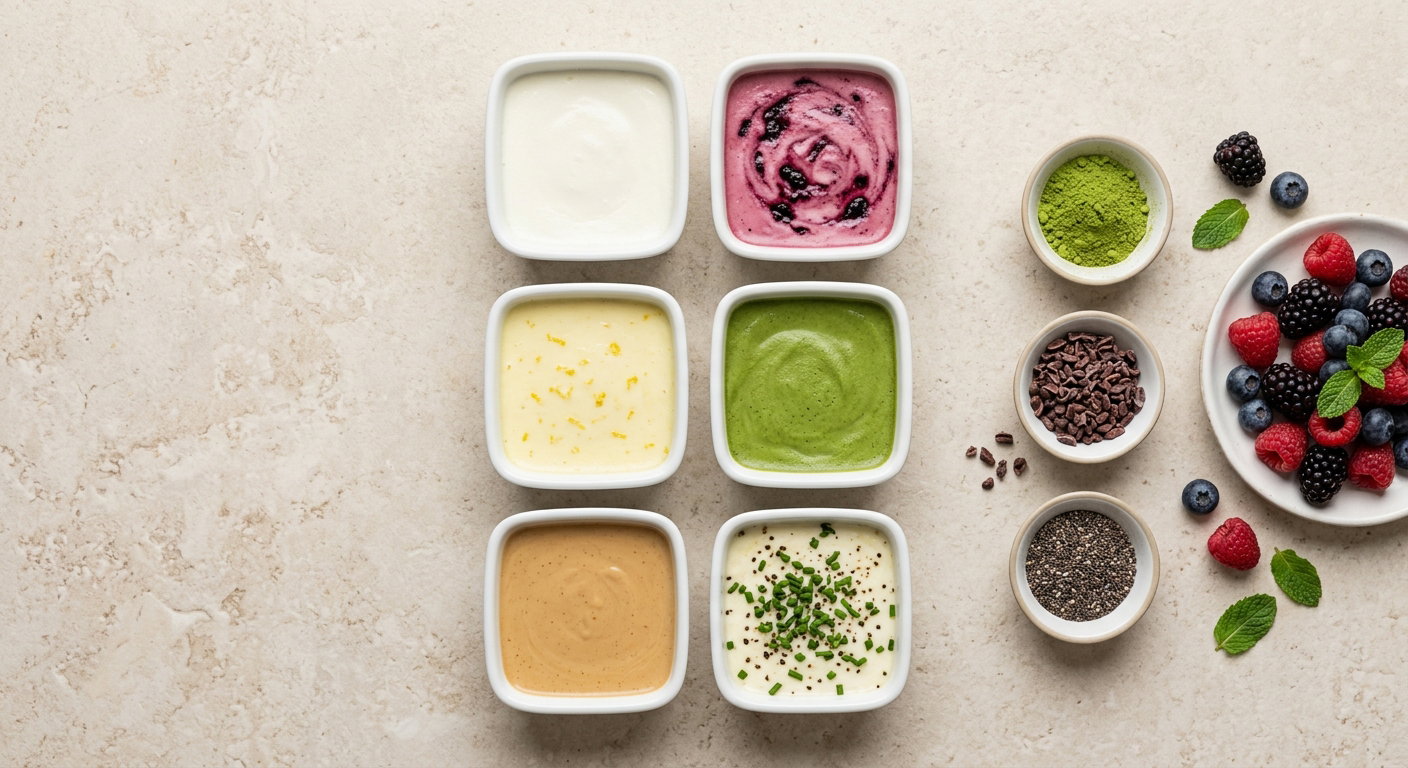
One base batter, six finishes. Clockwise from top left: vanilla bean, berry swirl, lemon, matcha, peanut butter, and a savoury herbed version for a high-protein lunch instead of a dessert.
Crowd pleaser
Vanilla berry swirl
The version in the photos. Mash 30 g of raspberries with a fork, swirl them through the batter with a knife in two or three strokes, and top with whole berries.
Add-in: 40 g berries, split
42 g protein · 370 kcal
Dessert mode
Dark chocolate
Whisk 6 g of unsweetened cocoa into the dry ingredients and add 1 extra teaspoon of sweetener to offset the bitterness. Scatter 5 g of dark chocolate chips on top before baking.
Add-in: 6 g cocoa, 5 g chocolate chips
43 g protein · 415 kcal
Bright and fresh
Lemon
Add the zest of half a lemon to the batter. Do not add the juice to the batter — acid plus heat is what makes it grainy. Spoon the juice over the top after baking instead.
Add-in: zest of ½ lemon
41 g protein · 368 kcal
Bright green
Matcha
Sift 4 g of culinary matcha in with the protein powder, then add an extra 15 ml of milk or water — matcha drinks liquid. Sweeten slightly more; matcha is bitter and it will taste flat otherwise.
Add-in: 4 g matcha, 15 ml milk
42 g protein · 375 kcal
Best on warm
Peanut butter
Swirl 15 g of smooth peanut butter through the batter in ribbons rather than mixing it in. Mixed fully, the fat weighs down the custard and it bakes denser and flatter.
Add-in: 15 g peanut butter
45 g protein · 455 kcal
Not a dessert
Savoury herbed
Drop the vanilla and sweetener, add a pinch more salt, and finish with chopped chives, cracked pepper and a thread of olive oil. Serve with a green salad for a genuine high-protein lunch.
Add-in: chives, pepper, olive oil
41 g protein · 350 kcal
Troubleshooting table
Baked yogurt is a custard, so it fails in predictable ways. Find your symptom, apply the fix, and note the cause so the next bake is easier. Nine times out of ten it is one of the first three rows.
Every way baked yogurt goes wrong, and the fix
What happened
Why
The fix
Did not set / still liquid
Thin yogurt with too much whey, or too little starch, or an under-heated oven
Switch to strained Greek yogurt and keep cornstarch as written. Give it 8–10 more minutes. Check your oven with a thermometer — a 15°C under-read is common and invisible.
Watery pool at the base
The custard was overbaked and the egg proteins squeezed out liquid; or frozen berries released water
Pull it earlier next time — remove while the centre still has a faint wobble. Thaw and drain frozen berries, or use fresh. A pool that forms after chilling means overbaking, not a bad recipe.
Rubbery or spongy
Overbaked by 5–10 minutes, or too much egg for the amount of starch
Shave 5 minutes off the bake and go straight from oven to cooling rack. For maximum insurance, bake at 160°C / 325°F in a water bath and add 10 minutes — the classic custard method and the silkiest result.
Grainy or chalky
Protein powder added without sifting, or a concentrate rather than an isolate
Sift the powder with the starch. Use whey isolate. If it is already grainy, blend the cooled bake smooth and eat it as a mousse instead — nothing is wasted.
Cracked on top
Baked too hot or too fast, so the outside set before the middle expanded
Lower the oven to 160°C / 325°F and add 8–10 minutes. Cracks are cosmetic — the slice still tastes fine, and a topping of berries hides them completely.
Too tangy
Plain yogurt is genuinely tart, and the sweetener is doing more work than you think
Add 1 extra teaspoon of sweetener, or use 2% yogurt which tastes rounder than 0%. A pinch of salt also mutes sourness — do not skip it.
Puffed up then collapsed
Air whipped into the batter, usually from over-whisking after the starch goes in
Whisk the wet ingredients hard, then fold the dry ingredients in gently. Bubbles are the enemy of a dense custard.
Stuck to the ramekin
Ungreased dish, or eaten straight from the oven
Grease properly and chill for 30 minutes. Custard releases far more cleanly cold. To unmould, run a thin knife around the edge and invert onto a plate.
Tastes like eggs
Egg ratio too high for the dairy, or it was hot when you ate it
Keep the ratio at 150 g yogurt to 1 egg. Serve it cold — the eggy note fades almost completely once chilled. A little vanilla and salt helps too.
Make-ahead, fridge and freezer
This is one of the great meal-prep desserts because it genuinely improves overnight and it freezes without turning to rubber — as long as you thaw it the right way.
Room temperature: 2 hours maximum, and only for serving. A dairy and egg custard should not sit out longer than that.
Fridge: 5 days in an airtight container. That is the honest window — day six it is still safe by most guidance, but the texture starts to weep and the flavour flattens. If you bake the batch of six on Sunday, plan to finish it by Friday.
Freezer: up to 3 months, individually wrapped. Freeze the slices on a tray first so they do not stick together, then bag them.
Thawing: overnight in the fridge. This is not negotiable if you care about texture — thawing at room temperature leaves the custard grainy and separated.
Reheating: 30–45 seconds in the microwave on medium, or 8 minutes in a 150°C / 300°F oven covered with foil. Warm, it becomes soft and spoonable; it will not return to a sliceable set.
Make-ahead tip
Bake the batch on Sunday evening and let it chill overnight rather than for two hours. Overnight chilling gives the starch network time to fully firm, and Monday’s slice will be noticeably cleaner than the first one you cut on Sunday night. Bake it, sleep, cut it in the morning.
What to serve it with
Cold, it is a sliceable cheesecake stand-in. Warm, it is a spoonable custard. Both work, and the right accompaniment depends on which one you are eating.
As a cold dessert: a spoon of lightly whipped cream, a few extra berries and a shaving of dark chocolate. The contrast between cold dense custard and soft cream is the whole point.
As breakfast: crumble a square over plain Greek yogurt with granola and a drizzle of honey. Sounds redundant and is not — you get crunch and acid against the dense custard.
Warm and spoonable: 45 seconds in the microwave, then a spoon of warm nut butter and a pinch of flaky salt. This is the version that satisfies a real dessert craving.
Post-workout: cold, with a banana and an espresso. Fast, portable, no fork needed if you bake it in a paper-lined dish.
Savoury lunch: the herbed variation with a green salad, sliced tomatoes and olive oil. Nothing about this dish requires it to be sweet.
On the side of a coffee: honestly, this is how most of mine get eaten. Cold from the fridge, standing up, before the kettle finishes.
Seven mistakes to avoid
Overbaking by five minutes. This is the mistake that causes almost everything else on the troubleshooting table. Pull it when the centre has a faint wobble — it keeps cooking in the hot dish, and the middle sets during cooling.
Using thin regular yogurt without adjusting. If the only yogurt you have is pourable, strain it for 30 minutes through a coffee filter or muslin first. Fifteen minutes of straining is the difference between a slice and a soup.
Adding unsifted protein powder. Powder clumps invisibly in the scoop. Sift it with the cornstarch and you will never get a grainy bake again.
Whisking air in after the starch goes in. Vigorous whisking builds foam. Foam bakes into a sponge, then collapses. Fold gently at that stage.
Slicing while warm. Warm custard has no structure yet. If you want a cut slice that holds its shape on a plate, chill it for at least 30 minutes — two hours for a perfect edge.
Putting lemon juice in the batter. Acid plus heat makes egg proteins clump. Zest in the batter, juice on top of the finished bake.
Skipping the salt. A pinch of salt is what makes a sweet custard taste sweet rather than merely sour. It is the smallest change with the largest effect.
FAQ
What exactly is baked yogurt, and is it just heated yogurt?
Baked yogurt is a set custard made from yogurt, eggs and a starch, baked until it firms up. It is not yogurt that has been warmed and served warm — the egg and starch transform it into something closer to a crustless cheesecake or a baked flan. That distinction explains everything about the recipe: you are setting a custard, not heating a dairy product, which is why starch and egg ratios matter so much and why the result slices.
Is baked yogurt healthy?
It can be genuinely excellent, and it can also be a dessert wearing a health halo. The version here is 364 kcal with 41 g of protein, 6.6 g of fat and no refined sugar — that is a strong protein-to-calorie ratio, about 40% of its energy from protein. It also brings roughly 250 mg of calcium. Where it stops being “healthy food” is the added sweetener: 12 g of sugar comes from the maple syrup, and you can remove it entirely for 312 kcal and 8 g of sugar if you keep the starch for texture. As a high-protein snack or breakfast, it earns its place. As a replacement for vegetables at dinner, no.
How many calories are in baked yogurt?
It depends entirely on what you put in it, which is why published figures range from about 100 to over 400 calories per serving. This recipe is 364 kcal per serving with 41 g of protein, 31 g of carbohydrate, 6.6 g of fat, 20 g of sugar and 4 g of fibre. Without the protein powder it drops to 264 kcal and 21 g of protein. A typical 100-gram slice from a large 8-inch dish made with sweetened yogurt and no protein powder lands nearer 110–150 kcal — but it also has under 10 g of protein, which is a very different food.
Can I use regular yogurt instead of Greek yogurt?
You can, but expect a softer result and add safeguards. Regular yogurt carries far more whey, and whey is liquid that has to go somewhere — usually out the sides of your custard. Strain it for 30 minutes first, or increase the cornstarch by half. The texture will be closer to a spoonable pudding than a clean slice. If Greek yogurt is unavailable, skyr and labneh are both excellent substitutes because they are strained too. Note that dairy-free yogurt is a different problem entirely: it is lower in protein and often lower in the proteins that set, so add extra starch and expect a softer bake.
Can I make baked yogurt without eggs?
Yes, with a texture compromise. Replace each egg with 1 tablespoon of ground flaxseed mixed with 3 tablespoons of water and let it gel for 10 minutes, or use 3 tablespoons of aquafaba. Increase the cornstarch to 12 g per serving, because you lose the setting power the egg provided. The result is softer and more spoonable, and it will not hold a clean slice the way the egg version does. It also drops the protein by about 6 g per serving unless you add more protein powder or cottage cheese to compensate.
Why did my baked yogurt not set?
The three usual causes, in order of likelihood: your yogurt was too thin and carried too much whey, you used less starch than the recipe called for, or your oven runs cold. Fix the first by using strained Greek yogurt, the second by measuring cornstarch with a measuring spoon rather than eyeballing it, and the third by giving it 8–10 extra minutes and checking your oven with a thermometer. Remember that the centre should still have a faint wobble when it comes out — a fully firm centre in the oven means an overbaked, watery custard once it cools.
How long does baked yogurt last in the fridge?
Five days in an airtight container, and it is best in the first three. It must be refrigerated within two hours of baking, and it should never sit at room temperature for longer than two hours at a time. The texture peaks after an overnight chill. By day five it is still safe in most food-safety guidance but it will weep slightly and taste flatter, so if you bake the batch of six on a Sunday, aim to finish it by Friday. Freeze anything you will not reach in time.
Can you freeze baked yogurt, and how do you thaw it?
Yes — up to three months. Freeze individual slices on a tray until solid, then wrap and bag them so they do not fuse together. Thaw overnight in the fridge, never on the counter: a slow fridge thaw keeps the custard smooth, while a fast room-temperature thaw leaves it grainy and weeping. Once thawed, eat it cold or warm it gently for 30–45 seconds; it will be soft rather than sliceable, which is fine for spooning over yogurt or fruit.
Do I have to use protein powder?
No. Without it you get a lovely 264-calorie custard with 21 g of protein — from the yogurt and egg alone, which is a respectable high-protein snack. The powder is what lifts it to 41 g and firms the set, so if you skip it, keep the cornstarch as written or the texture will be softer than the photos. If you dislike protein powder’s flavour, whey isolate is far milder than concentrate, and blending the powder into the yogurt before adding the egg hides it almost completely.
Is baked yogurt good for meal prep, and can I bake it in advance?
It is one of the best meal-prep desserts there is. It improves overnight, holds five days in the fridge, freezes for three months and is eaten cold with no reheating required. Bake the batch version in one dish, chill it overnight, cut it into six and wrap the squares individually — that is six grab-and-go servings of 41 g of protein from about 15 minutes of hands-on work. Rotate the flavour each week so you do not burn out on the same one.
Your next step
Do not read this and move on. Bake it once this week and the technique stops being theory.
Check your yogurt. It needs to be thick and strained. If it pours, strain it first.
Make one single serve tonight. Five minutes, one ramekin, 41 g of protein.
Cut it cold. Chill for 30 minutes and you will understand why the chilling step exists.
Scale to the batch on Sunday. One dish, six breakfasts, your week sorted.
How the numbers were calculated. Nutrition is calculated from the ingredient list by hand using standard reference values for 0% fat plain Greek yogurt (10 g protein per 100 g), one large egg (50 g, 6.3 g protein) and a whey protein isolate at approximately 80 g protein per 100 g. Figures are rounded to the nearest whole gram or 0.1 g and should be treated as a close estimate rather than a laboratory analysis — your yogurt, egg size and protein powder brand will all shift them slightly. Baking temperatures were verified across 12 test bakes in a domestic fan oven and a conventional oven; if yours runs hot or cold, trust the visual cue over the clock.
Savory Discovery Disclaimer — tested recipes and honest numbers. This article is for general information only and is not medical or dietary advice. If you are pregnant, managing a medical condition such as diabetes or kidney disease, or following a prescribed diet, speak to a registered dietitian or your doctor before changing how you eat.
Nutrition figures are estimates calculated from standard ingredient reference values. Always check labels on your own ingredients, especially protein powders, which vary widely between brands.