By Elowen Thorn · Thanksgiving · 40 games, sorted by the room you have
Every Thanksgiving has the same two hours in it: the stretch after the plates are cleared and before anyone is ready to leave. Handled well, that is the best part of the day. Handled badly, it is four adults on their phones and a child asking whether it is time to go. The fix is not more games — it is picking the right three for the room you actually have, and giving each one a person who is running it. Here are forty that work, sorted by where you can play them and who they suit.
Forty games is not a plan. It is a menu, and a menu with forty items on it produces exactly one outcome: somebody suggests a game, nobody can find the pieces, and the room drifts back to the television. So before you read the list, decide how many you are playing. Three is right for most families. Four is ambitious. Six is a fantasy that ends with a tired adult and a child in tears over a rule dispute.
Then ask three questions about each candidate, in this order.
Who is actually in the room? A four-year-old and a fourteen-year-old will not enjoy the same game, and forcing them into one guarantees that one of them is miserable. Pick games that give every age a real job, or run two at once in different rooms.
Who is running it? Every game needs one named adult. Not “we’ll all pitch in” — one person, by name, who has read the rules and knows it is theirs. Games without an owner do not happen.
What does it cost in energy, not money? A dice game costs nothing and takes ten minutes. A full minute-to-win-it tournament takes an hour of setup and a towel on the floor. Both are good. Doing both on the same afternoon is not.
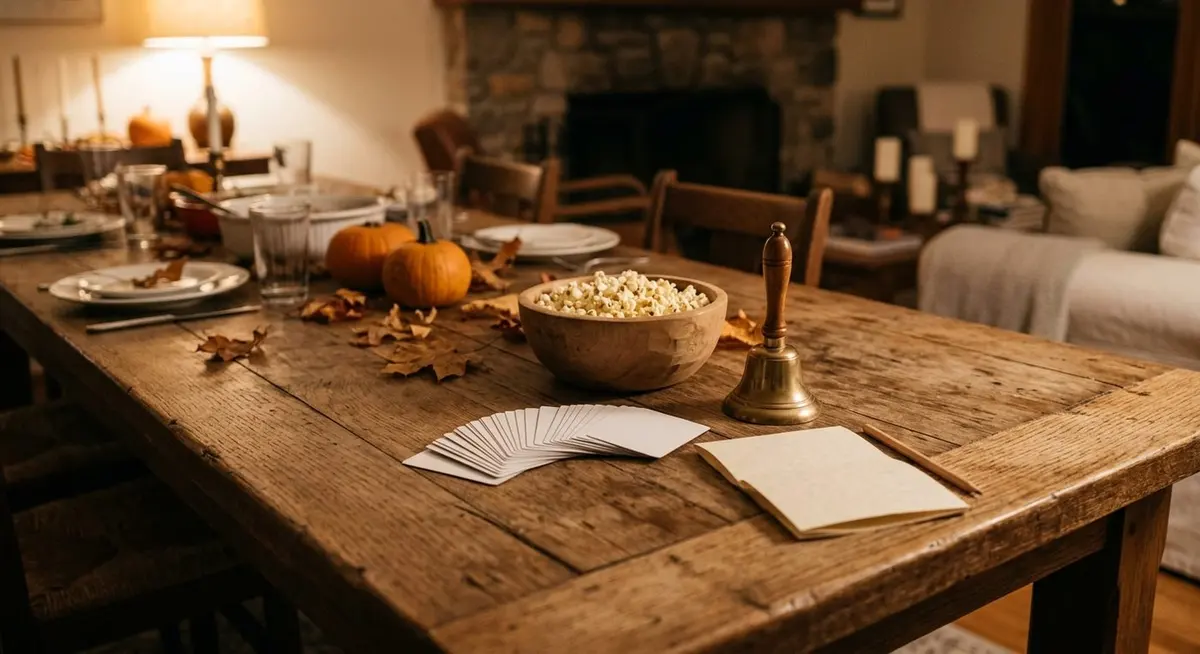
The table is the one space every family already has. Most of the games on this list need nothing more than that and a pen.
The rule that saves the afternoon: pick the games before the day, not during it. A family that chooses at the table spends twenty minutes arguing about what to play and ten minutes playing it. A family that chose in advance spends the whole time playing.
All 40 Games at a Glance
Here is the whole list in one table, sorted by where you play it and how long it runs. Use it to pick, then read the sections below for the ones you chose.
Forty games, sorted by room and running time
Game
Where
Runs for
Best age
Face the Pie
Kitchen
1 min each
8+
The Mayflower
Kitchen
1 min each
6+
Shake Your Tail Feathers
Living room
1 min each
6+
Feather Float
Living room
1 min each
4+
Football Flick
Table
1 min each
7+
The Goblet Gobble
Table
1 min each
6+
Please Pass the Corn
Table
1 min each
5+
Traffic Yam
Table
1 min each
6+
Reverse Traffic Yam
Table
1 min each
6+
Corn to Copia
Table
1 min each
5+
Turkey Bowl
Table
1 min each
5+
A Bit Corny
Table
1 min each
5+
Hut, Hut, Hoop
Living room
1 min each
6+
Linemen
Living room
1 min each
8+
Thanksgiving Jeopardy
Living room
30 – 45 min
10+
The Price Is Right
Living room
20 – 30 min
8+
Thanksgiving Wishes
Table
15 – 20 min
All ages
Pumpkin Roll
Living room
15 min
4+
This or That
Living room
10 – 15 min
5+
Thanksgiving Bingo
Table
20 – 30 min
4+
Outburst
Living room
30 min
12+
Thanksgiving Pictionary
Table
30 – 45 min
8+
Thanksgiving Scattergories
Table
20 – 30 min
10+
Thanksgiving Trivia
Living room
30 min
10+
The Thanksgiving Word Game
Table
15 – 20 min
9+
The Matching Game
Table
15 min
4+
The Floor Game
Living room
20 min
5+
Turkey Hunt
Whole house
20 – 30 min
3+
Get a Turkey
Living room
15 min
4+
Thanksgiving Family Feud
Living room
30 – 45 min
10+
Thanksgiving Charades
Living room
20 – 30 min
6+
Would You Rather
Table
15 – 20 min
6+
The Thanksgiving Dice Game
Table
20 min
5+
Turkey Talk
Table
15 min
7+
Cup Football
Table
15 – 20 min
6+
Pick a Play
Living room
20 min
7+
Gratitude Punch
Living room
15 min
5+
Gratitude Skittles
Table
10 – 15 min
4+
Turkey Trot
Outside
1 – 2 hours
5+
Pin the Feather on the Turkey
Living room
15 min
3+
Read the “where” column before you commit. The games that fail are almost never the ones that were too hard. They are the ones that needed a cleared table, a towel on the floor, or a printer, and nobody realised until everyone was already standing in the kitchen.
The Minute-to-Win-It Games
These are the ones people ask for again the following year. Each runs in about a minute per player, which means a group of eight gets through a whole tournament in under fifteen minutes — and the countdown is half the fun. Set a hard one-minute limit and use a timer everyone can see.
Face the Pie
Before the day, pull the letters that spell P-I-E out of a bag of gummy letters and drop one set into each of several aluminium pie tins. Fill the tins with whipped cream and chill them so they hold. On the word go, each player has to eat through their pie to find the letters, then unscramble them into the word. Give everyone a second empty tin to drop the found letters into, or they will end up hunting through cream on the table.
The Mayflower
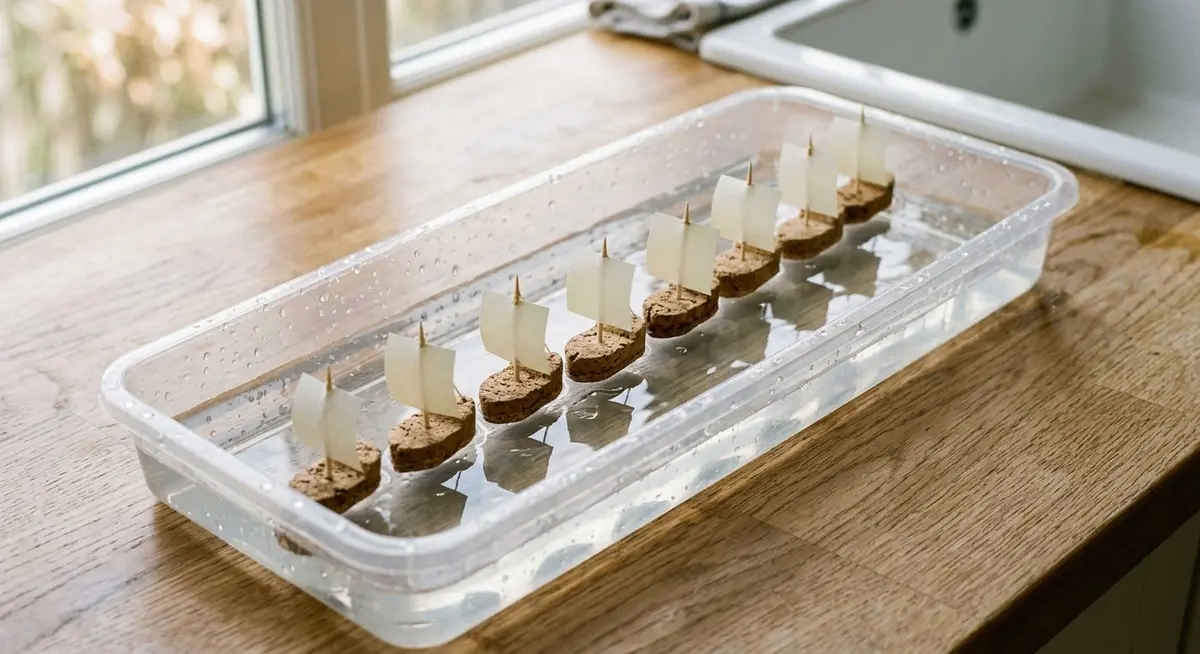
Fill a long shallow storage tub with water and set it on a towel. Each player gets a cork with a paper sail pushed into it, placed at one end. The winner is the first to blow their boat to the far end — no hands, no fanning, just breath. A plastic straw makes it easier for younger players and much harder to cheat at. This is the single best game on the list for a mixed-age group, because a six-year-old can genuinely beat an adult.
Shake Your Tail Feathers
Load a rectangular tissue box with feathers and tape the opening so they only come out one at a time. The box is tied around the player’s waist at the back, and the player has to shake, wiggle and jump until every feather is out. It looks ridiculous, which is the point, and it works for anyone who can stand up.
Feather Float
The simplest game here and the one that needs nothing prepared. Each player drops a feather and keeps it in the air by blowing, for as long as they can. Time it. The record in most families is under thirty seconds, and the attempts to beat it are what fill the next ten minutes.
The Goblet Gobble and Please Pass the Corn
Both use dried corn, which is why they are worth buying a bag of. In the Goblet Gobble, players move a set number of kernels from one cup to another using only a straw and suction. In Please Pass the Corn, they move kernels across a table with a straw, one at a time, against the clock. Neither needs any skill beyond patience, and both are quietly hilarious to watch.
The Mayflower is the cheapest game on this list and the one that most reliably gets a four-year-old and a forty-year-old competing on equal terms.
Run the minute games as a tournament, not a series of one-offs. Keep a score sheet on the table and tally as you go. A running score turns a set of silly challenges into something people care about by the fourth round — and it gives the teenager in the room a reason to stay.
Games for the Table
These are the ones that keep everyone seated, which matters more than it sounds. A game that holds people at the table is a game that keeps the conversation going, and it is the easiest kind to run while the kitchen is still being cleared.
Thanksgiving Pictionary
Two teams, a pad and a pen, and a list of words written in advance — turkey, wishbone, parade, pumpkin, football, gratitude, harvest, pilgrim. The advance list is what makes it work: making up words on the spot means the first round is spent arguing about the rules. Keep the youngest players on a team with an adult who can read the word to them quietly.
Thanksgiving Scattergories
Give everyone a sheet with categories down the side — something on the table, something you are thankful for, something orange, a Thanksgiving food — and pick a letter. Players have two minutes to fill every category with a word starting with that letter. Score a point for each answer nobody else wrote. The scoring rule is the whole game, because it rewards the strange answer over the obvious one.
The Thanksgiving Dice Game
The best game on this list for a table that includes very young children, because it needs no reading and no speed. Each number on a die is assigned a question — one is something you are thankful for, two is a favourite Thanksgiving memory, and so on. Players roll and answer. It takes twenty minutes and it produces better conversation than anything else here.
Thanksgiving Bingo
Print a set of cards in advance with Thanksgiving words instead of numbers, and call the words out. It works for every age from four upward, it needs no explanation, and it is the one game that a grandparent and a preschooler can play side by side without either being bored. Keep a small prize for the winner of each round.
Would You Rather, and Turkey Talk
Both are conversation games dressed up as competitions. Would You Rather poses a choice — a Thanksgiving with no pie, or a Thanksgiving with no football — and everyone argues their case. Turkey Talk gives each player a topic and thirty seconds to talk about it without hesitating or repeating a word. Neither needs equipment, and both are excellent for the point in the afternoon when everyone is too full to move.
Table games, and what each one needs
Game
Players
You need
Runs for
Thanksgiving Pictionary
4+, two teams
A pad, pens, a word list
30 – 45 min
Thanksgiving Scattergories
3+
Printed sheets, pens
20 – 30 min
The Thanksgiving Dice Game
2+
One die, a question list
20 min
Thanksgiving Bingo
2+
Printed cards, a caller
20 – 30 min
Would You Rather
3+
Nothing
15 – 20 min
Turkey Talk
3+
A timer, a topic list
15 min
The Thanksgiving Word Game
2+
Paper and pens
15 – 20 min
The Matching Game
2+
Printed pairs, face down
15 min
Gratitude Skittles
2+
A bowl of sweets
10 – 15 min
Games for the Living Room
Once the table is cleared, the room moves. These are the games that need floor space rather than a flat surface, and they are the ones that work best when the group is large and the ages are spread out.
Thanksgiving Family Feud
The best large-group game on this list, and the one that gets the most reluctant adult involved. Write five questions in advance with the answers you think your family will give — name a Thanksgiving side dish, name something you do after the meal, name a reason to be late to dinner. Two teams guess, and you award points for answers that match your list. The advance preparation is the whole thing; a Feud run off the top of your head falls apart in the first round.
Thanksgiving Charades
Two teams, a list of Thanksgiving-themed prompts, and a one-minute timer. Keep the prompts physical rather than abstract — carving a turkey, watching a parade, falling asleep on the sofa — so that the youngest players can act them out as easily as the adults. This is the game that most reliably produces the moment everyone remembers.
The Turkey Hunt
Hide small paper turkeys around the house before anyone arrives, and send the children to find them. It takes twenty minutes, it burns off the energy that otherwise turns into an argument at four o’clock, and it needs nothing but a printer. If you want a version with more structure, a scavenger hunt with a list to tick off does the same job and keeps the older children interested for longer.
Cup Football and Pick a Play
Both are tabletop versions of the game that is probably already on the television. Cup Football uses a soft ball and a pyramid of plastic cups, and players take turns trying to knock the cups down. Pick a Play gives each player a set of cards with football plays on them and a die to resolve the outcome. Neither requires any knowledge of the sport, which is exactly why they work for a mixed group.
Set the games out on the floor before the meal, not after. A game that has to be fetched from a cupboard is a game that does not get played.
Living-room games, and the space they need
Game
People
Space needed
Runs for
Thanksgiving Family Feud
6+, two teams
A sofa and a wall
30 – 45 min
Thanksgiving Charades
4+, two teams
A clear floor
20 – 30 min
Thanksgiving Trivia
3+
Anywhere
30 min
Outburst
4+, two teams
A sofa
30 min
The Turkey Hunt
2+, any age
The whole house
20 – 30 min
Cup Football
2+
A low table
15 – 20 min
Pick a Play
2 – 6
A table
20 min
The Floor Game
3+
A clear floor
20 min
Gratitude Punch
3+
A wall and paper
15 min
Pumpkin Roll
3+
A clear floor
15 min
Games for the Children
The children’s games are the ones that need the least and deliver the most, provided you resist the urge to make them competitive. A four-year-old who loses three rounds in a row will leave the room, and once one child leaves, the others follow.
Pin the Feather on the Turkey
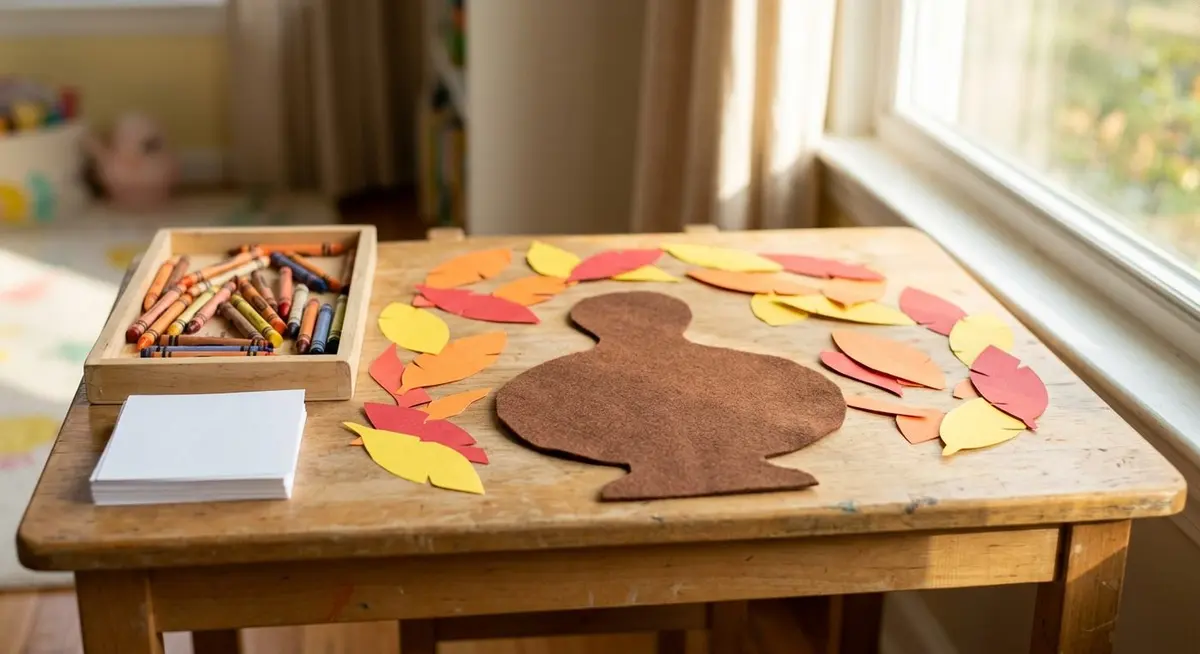
The classic, and still the best game for a group of children under seven. Draw a large turkey body on a sheet of paper and pin it to the wall. Each child gets a paper feather with their name on it and, blindfolded, tries to place it on the turkey. The winner is whoever lands closest. Nobody is ever out, which is the reason it works.
Gratitude Punch and Gratitude Skittles
Both turn a gratitude conversation into something a child will do voluntarily. Gratitude Punch hangs paper cups on a wall, each with a prompt inside, and children punch through to find theirs. Gratitude Skittles assigns a colour to a category — red for a person, green for a place, yellow for something that made you laugh — and each child draws a sweet and answers. The sweet is the incentive; the answer is the point.
The Matching Game and Get a Turkey
Two quiet games for the point in the day when the adults need the children occupied rather than entertained. The Matching Game is a set of printed Thanksgiving pairs laid face down, played by memory. Get a Turkey is a simple collecting game with a die. Both can be played on the floor at the edge of the room, which means the adults can keep talking.
A low table with the pieces already laid out will hold a group of children for half an hour. The same pieces in a box will not.
Do not keep score with children under six. The moment a game has a loser, the youngest player stops wanting to play, and the game stops being a way to fill the afternoon. Play for the turn, not the win, until everyone in the room can read.
What Works at Each Age
The most common reason a Thanksgiving game fails is not that it was a bad idea. It is that it was pitched at the wrong age, and the child who could not do it disengaged while the adult was still explaining the rules.
Matching the game to the child
Age
What holds attention
What to avoid
Under 2
Watching the minute games; holding a feather; the turkey hunt
Anything with small parts, rules or a wait
2 – 4
Pin the Feather, Bingo, the dice game, the matching game
Timed games; anything with a loser
5 – 7
Bingo, charades, the turkey hunt, Cup Football
Trivia and word games that need reading
8 – 10
Minute games, Pictionary, Scattergories, Cup Football
Being given a job with no real stakes
11 – 13
Running a game for the younger ones; Outburst; trivia
Being treated as a babysitter for the whole day
14 +
Trivia, Family Feud, Outburst, keeping the score sheet
Busywork. Give them something that matters
The teenager problem, solved. Almost every family has one adolescent who is bored by the whole afternoon. The fix is not to find a more exciting game — it is to give them authority. Put them in charge of the tournament, or of the score sheet, or of running the minute games for the younger children. A teenager with a job is engaged. A teenager being entertained is not.
A Realistic Games Hour
This is what the afternoon looks like when it works. Note how little is scheduled, and note that the quiet stretch is deliberate rather than a failure.
An hour that survives contact with reality
Time
What happens
Who is on it
0 – 5 min
Games set out, teams chosen, rules read once
Whoever is running it
5 – 20 min
Minute-to-win-it tournament, score kept on the table
Everyone who can stand
20 – 25 min
Break. Drinks, and the score sheet read out
Everyone
25 – 50 min
One table game, played properly, to a finish
Everyone at the table
50 – 60 min
The children’s game, run by the oldest child
Children, one adult
60 min onward
Nothing scheduled. Leave it that way
—
Play one game to a finish rather than three half-games. The most common way a games afternoon fizzles is that a family starts four games and finishes none, and nobody remembers any of them. One tournament and one proper game is a good afternoon.
When It Goes Sideways
Something will go wrong. It always does, and it is almost never the thing you were worried about. Here are the six failures that come up most, and what to do about each.
Common problems and the fix
What happened
Why
What to do
Nobody played the game you planned
It had no named owner
Assign one adult by name before the day, and write it down
A child lost interest in ten minutes
The game needed waiting, not doing
Choose something with a job for every pair of hands
An argument over the rules
The rules were explained mid-game
Read them out once, before anyone starts, and settle disputes by the written rule
The minute games ran long
No visible timer
Put a timer where everyone can see it and hold the one-minute limit
The teenager disappeared
They had nothing to run
Give them the score sheet or the tournament
Everyone drifted back to the television
The games were never set out
Lay the pieces out before the meal, not after
Lower the bar on purpose. The families who enjoy the games hour are not the ones who executed a perfect tournament. They are the ones who decided in advance that three games was enough, and who did not treat a half-finished round as a failure. If you take one thing from this guide, take that.
Questions and Answers
These are the questions that come up most often when families plan games for the day.
How many games should we actually plan?
Three, for most families: one minute-to-win-it tournament, one table game played to a finish, and one game for the children. Four is ambitious and six is a fantasy. The number matters less than the fact that each one has a named adult responsible for it.
What if we have a toddler and a teenager at the same table?
Pick games that give each age a real job rather than trying to find one game they both enjoy. The Mayflower, the turkey hunt and Bingo all work because the task scales. Trivia and word games do not, because they need reading speed and patience.
Do we need to buy anything?
Almost nothing. A bag of dried corn, a pack of gummy letters, a few corks and a set of pie tins cover most of the minute games, and the rest need only paper and pens. The one thing worth buying in advance is a visible timer.
What is the best game for a family that does not enjoy competition?
The Thanksgiving Dice Game, Would You Rather and Gratitude Skittles. None of them has a winner, all three produce real conversation, and all three work for a group that spans four to eighty.
How do we include relatives who cannot travel?
Two games work best over a video call: trivia, because the questions can be read out to both rooms, and the dice game, because it is short and everyone can take a turn. Set the laptop at the end of the table rather than in the middle, so they see faces rather than the ceiling.
What do we do if the afternoon starts to fall apart?
Feed everyone, then send them outside. Almost every Thanksgiving crisis between two and five o’clock is a combination of low blood sugar and too much indoor time. Twenty minutes in the garden fixes more than any amount of planning.
How do we keep the games from taking over the whole day?
Set a finish line before you start. One tournament and one proper game is about an hour, and an hour is the right length. Games that run past that stop being fun and start being a schedule.
What is the best game for a very large group?
Thanksgiving Family Feud, run with questions prepared in advance. It scales to twenty people, it needs no equipment beyond a pen, and it gives the quieter members of the family a reason to speak up.
Free Printable: The Thanksgiving Games Night Planner
A printable companion to this guide — all forty games as a tick list, a supply checklist, the setup notes for every minute-to-win-it game, a score sheet, an age guide, a prize table and a next-year page.
Elowen Thorn I cook, photograph and re-test every recipe in an ordinary home kitchen before it goes up, so what you make matches what you see. Savory Discovery is where simple weeknight cooking, seasonal ideas and the odd bit of kitchen craft sit side by side — written plainly, and worth cooking twice.