By Elowen Thorn · Fall Family Activities · 40 ideas, sorted by the day you have
Every autumn I make the same mistake: I save a list of a hundred fall activities, feel briefly wonderful about it, and then do about four of them before the leaves are gone. The problem was never the ideas. It was that the list had no shape. So this one does. Every activity below is filed by the kind of day it actually needs — a free afternoon, a rainy Tuesday, a whole Saturday — so you can open it on the morning you have and find something that fits instead of scrolling past forty things you will never get to.
Most fall activity lists are a hundred ideas in a single column, and that is exactly why they get saved and never used. A list with no shape asks you to do the sorting yourself, on a Saturday morning, with a child already asking what you are doing today. The sorting is the hard part, not the ideas.
So the forty ideas here are grouped by the kind of day each one needs. There is a group for the free afternoon when you want to be outside, a group for the wet day when nobody is leaving the house, a group for the evening when it is dark by six, and a group for the one big outing you plan a week ahead. Pick the group that matches today and you are done deciding in about thirty seconds.
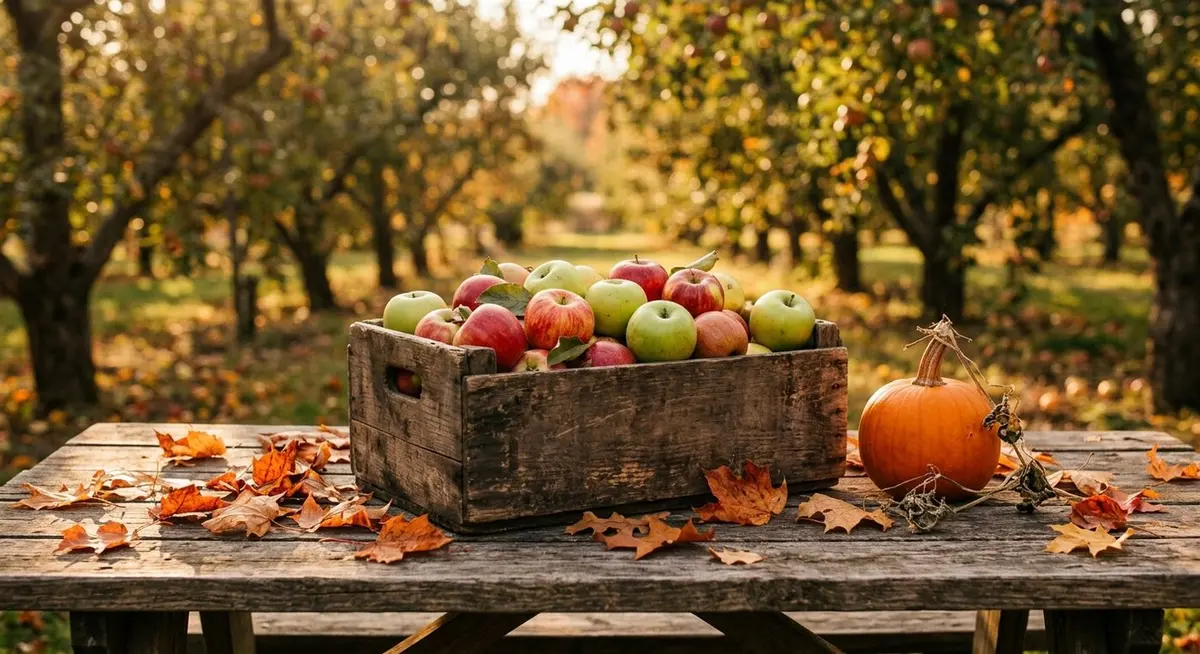
Apple picking is the one autumn activity that gets harder to do well the later you leave it — most u-pick orchards are picked out by mid-October.
The one rule that matters: pick three activities for the whole season, not thirty. Write them on the fridge. Everything else on this list is a bonus you can reach for on a day that turns out to have room in it. Families who plan three things do three things; families who plan thirty do none and feel bad about it.
How to Choose Without Overplanning
Before you look at a single idea, work out which of four kinds of day you are actually in. Almost every failed autumn plan comes from trying to fit a big-day activity into a small-day slot, or the reverse — saving the good stuff for a weekend that never quite arrives.
The four kinds of day, and what each one can hold
The day you have
Time it really takes
What fits
What to avoid
A free afternoon
1–2 hours, at home or nearby
Leaf play, a nature walk, a scavenger hunt, pumpkin decorating
Anything with a booking, a drive, or a queue
A wet, stuck-inside day
2–3 hours, indoors
Pumpkin science, nature crafts, baking, a food board, reading
Anything that needs dry ground or daylight
A dark evening
45–90 minutes after dinner
Campfire, moonlit walk, decorating the porch, a film and cocoa
Anything that needs a shop to be open
A whole planned Saturday
Half a day or more
Apple picking, a farm visit, a corn maze, a cider mill, a canopy walk
Adding a second big thing on the same day
The two-minute test. Before you commit to an activity, ask what has to be true for it to work: dry ground, daylight, a shop that is open, a child who is not already tired. If more than one of those is not true right now, pick something from a different row of the table. This single habit is what stops the mid-activity meltdown.
What Actually Works at Each Age
The same activity lands completely differently at three and at nine. A corn maze is a thrilling adventure for a seven-year-old and a terrifying dead end for a three-year-old. Use this as a filter before you read the ideas below, and remember that the age bands are about stamina and patience as much as they are about skill.
Matching the activity to the child
Age
What they can genuinely do
Best-fit activities
Watch out for
Under 2
Carry, touch, taste, watch
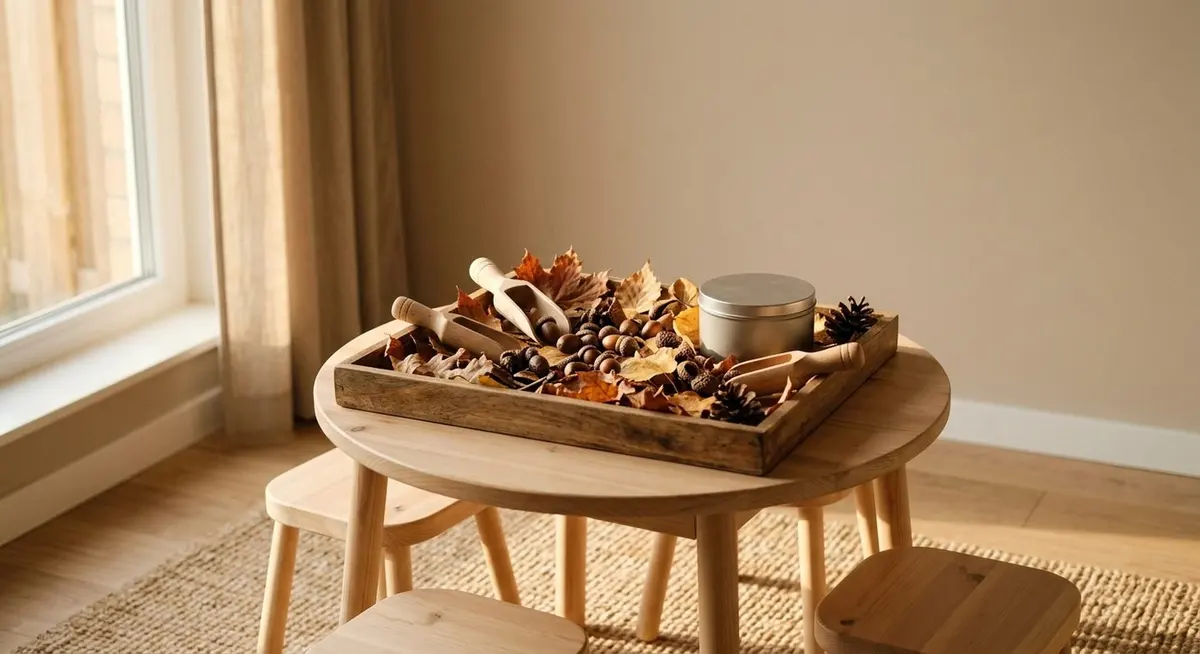
Leaf piles, a short walk in a carrier, sensory bins, pumpkin patting
Anything with small parts, and anything longer than 30 minutes
2–4
Collect, sort, glue, stomp, pour with help
Scavenger hunts, nature crafts, pumpkin science, decorating, leaf play
Carving tools, long queues, and mazes with dead ends
5–7
Follow multi-step instructions, use safe tools, plan ahead
Carving with supervision, corn mazes, baking, building a scarecrow
Losing interest in a craft that takes longer than an hour
8–11
Work independently, take on a role, handle a real task
Cider mill trips, campfire cooking, a full pumpkin project, a night walk
Being given a job that turns out to be busywork
12+
Own the plan, invite a friend, lead a younger sibling
Hosting a party, a moonlit hike, a photoshoot, a big bake
Being treated as a passenger on their own autumn
Mixed ages, one activity. Give the older child a real job — photographer, map reader, tool carrier, judge of the best leaf — rather than a harder version of the same task. A nine-year-old who is in charge of the camera will stay engaged for an hour on an activity designed for a four-year-old.
Outdoor Days Worth Leaving the House For
These are the ones that need dry ground and daylight, and they are the heart of the season. None of them needs a booking, a ticket or a long drive, which is exactly why they are the ones that actually happen.
Apple picking, early in the season
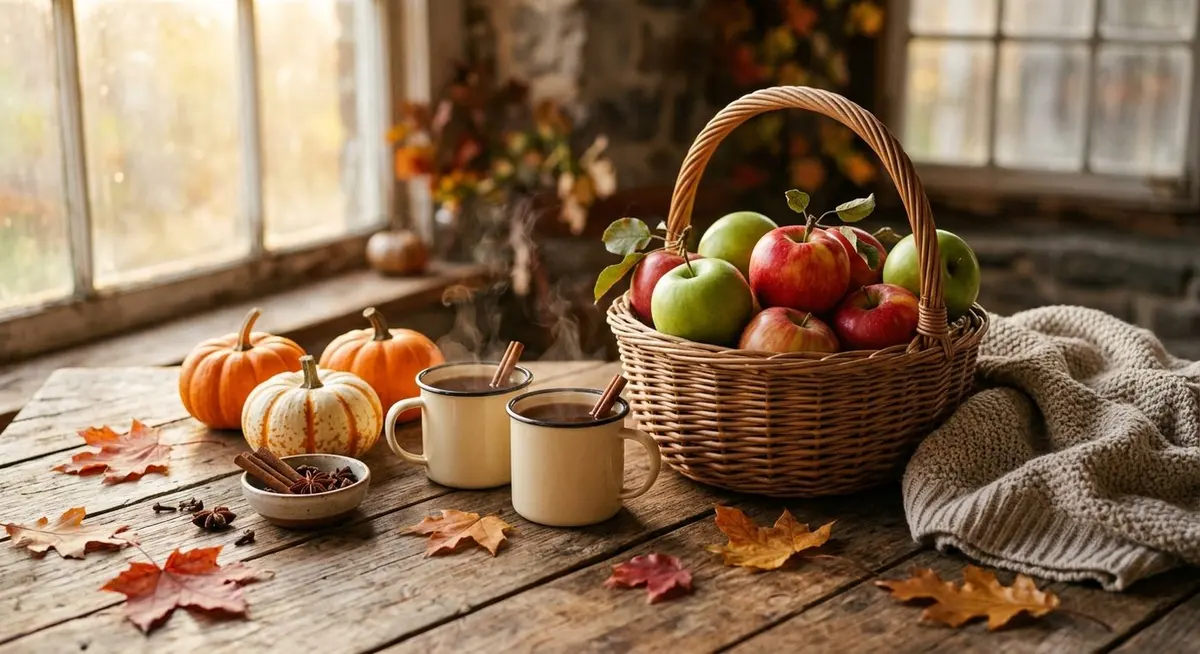
Apple picking is the one autumn activity with a real deadline. Most u-pick orchards are picked out by mid-October, and the good varieties go first. Go early in September if you can, take a wagon ride if the farm offers one, and pick more than you think you need — the whole point is to come home with enough to bake with. If you end up with a glut, an apple cider cake uses them up faster than a pie does.
Leaf play, which is free and always available
If you have trees, you have an activity. Raking is going to happen anyway, so make it the fun part rather than the chore you do after the fun part. Build a pile big enough to disappear into, then jump, bury, throw and repeat until someone is cold. The trick is to rake the pile onto grass rather than a path, so the landing is soft.
Leaf pile rules that prevent tears: no jumping into a pile that might hide a rake, a stone or a stick — rake it with your hands first.
Dress for the mess: waterproof trousers over normal clothes beat a change of clothes in the car.
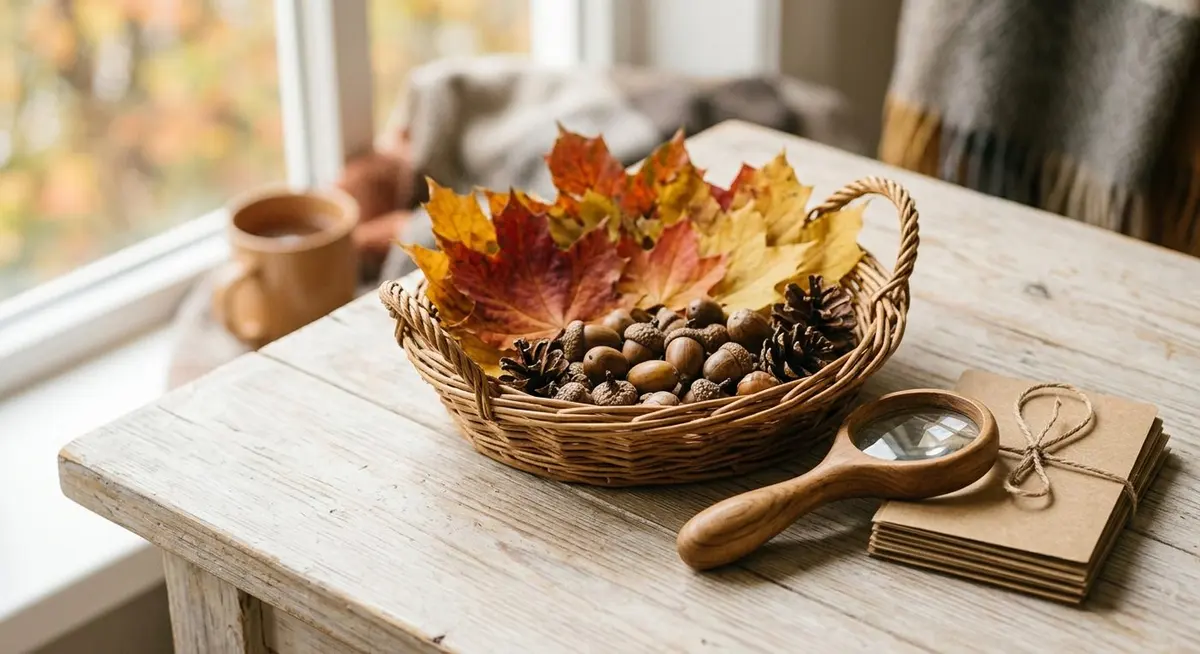
Bring a bag: the best leaves come home for the craft section below, and they keep for weeks pressed flat.
Set a finish line: “when the pile is this big we go in for cocoa” works far better than “five more minutes”.
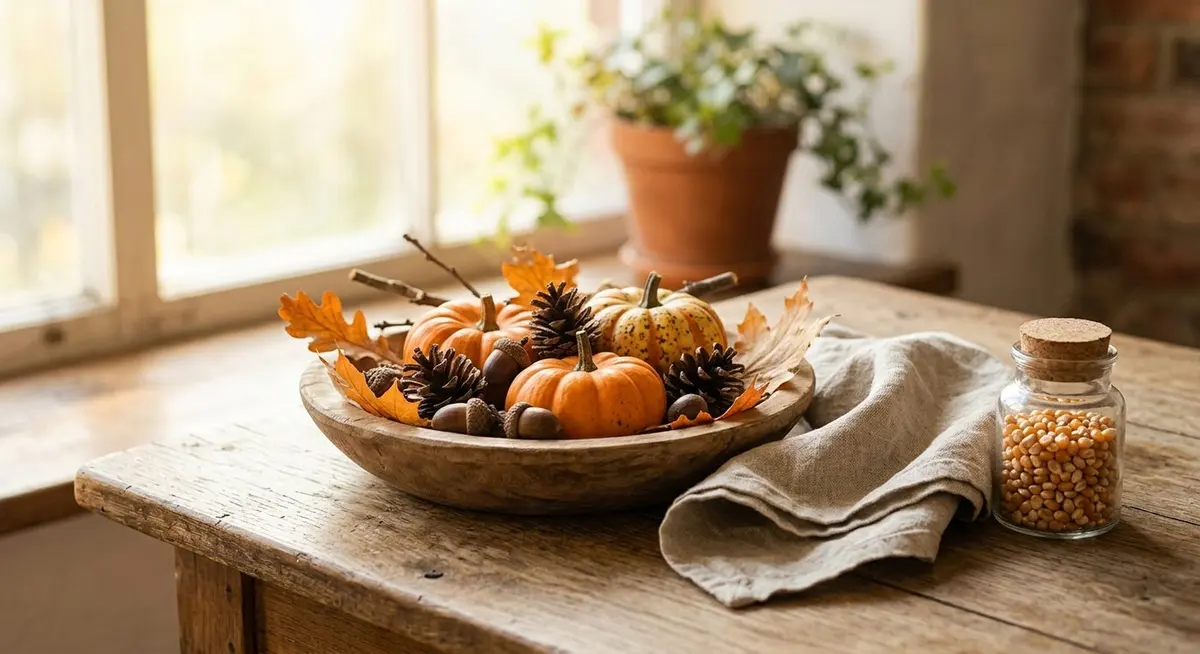
Everything a nature craft needs fits in one bag: leaves, twigs, acorns, pinecones, dried grass and a coil of twine.
The Pumpkin Science Experiment, Done Properly
This is the single best indoor autumn activity, and it is worth doing properly rather than as a one-off trick. The reaction is baking soda and vinegar, which produces carbon dioxide gas; the dish soap traps that gas into foam instead of letting it escape, and the food colouring makes the foam visible. Done as a real experiment, it holds a child’s attention for an hour.
Carve or hollow your pumpkin first, and keep the lid. A wide opening at the top works better than a narrow one — the foam needs room to climb.
Set the pumpkin on a tray with a lip, or on a baking sheet lined with a towel. This is not optional. The foam will overflow and it will be coloured.
Spoon three to four tablespoons of baking soda into the hollow, and add a good squeeze of dish soap. The soap is what turns a fizz into a foam.
In a jug, mix white vinegar with a few drops of food colouring. Two cups is plenty for a medium pumpkin.
Ask the child to predict what will happen before you pour. Write the prediction down if they are old enough — this is the step that turns a trick into science.
Pour the vinegar in and stand back. The foam will rise, spill over the carved face and keep going for a minute or more.
When it stops, rinse the tray and repeat. The reaction can be run four or five times before the baking soda is used up, and each run is a chance to change one thing and see what happens.
The dish soap is what turns a fizz into a foam — it traps the carbon dioxide into bubbles instead of letting the gas escape.
Turn it into a real experiment. Change one variable per run and ask what happened: warm vinegar instead of cold, more soap, less baking soda, a narrow opening instead of a wide one. A child who has run the same reaction four times with one thing changed each time has genuinely done the scientific method, and they will remember it far longer than they remember the foam.
Nature Crafts That Use What You Already Collected
The point of these is that the materials come from the walk you already took, which means the craft costs nothing and the collecting is half the activity. Everything here can be done at a kitchen table with glue, twine and a pair of scissors.
Nature wands and rustic brooms
Find a straight stick about the length of your forearm, then gather feathers, leaves, acorns, dried grasses and vines. Wrap the collected pieces around one end of the stick and bind them tightly with twine or ribbon. A wand takes ten minutes; a broom takes twenty and looks genuinely good propped by the front door.
Best sticks: straight, dry and about as thick as a finger. Green sticks shrink as they dry and the binding comes loose.
Best binding: garden twine, wrapped tight and tied off with a double knot. Ribbon looks prettier but slips.
Best glue for leaves: a glue stick for flat leaves, white craft glue for anything with weight. Hot glue is an adult job.
Best display: a jar by the door, or a hook on the porch. Crafts that get displayed get made again.
Preserving leaves in wax
Dipping leaves in melted beeswax is the trick that keeps autumn colour on the table until Christmas. Collect leaves of different shapes and colours, press them flat under a book for a day, then dip each one in melted wax and lay it on parchment to set. Thread them onto twine with a needle and you have a garland; hang them from a hoop and you have a mobile.
Wax safety: melt the beeswax in a bowl over a pan of simmering water, never directly on the hob, and keep the bowl well out of reach while it is hot.
Best leaves: maple, oak and beech hold their shape. Very dry leaves crumble as you dip them.
Drying time: about ten minutes on parchment. They will feel slightly tacky for an hour and then set hard.
Storage: layered between sheets of parchment in a box, they keep for years and can be reused next autumn.
If you only do one craft this autumn, do the wax leaves. It is the one that produces something you will still have on display in December, and it uses the leaves you were going to walk past anyway. If you want a bigger project to grow into, the preschool fall activities guide has a full set of step-by-step crafts sorted by skill.
Cozy Evenings: The Indoor Half of the Season
By late October it is dark before dinner, which rules out most of the outdoor list on a weeknight. That is not a problem to solve — it is the best part of the season, and it deserves its own set of activities rather than being treated as the fallback.
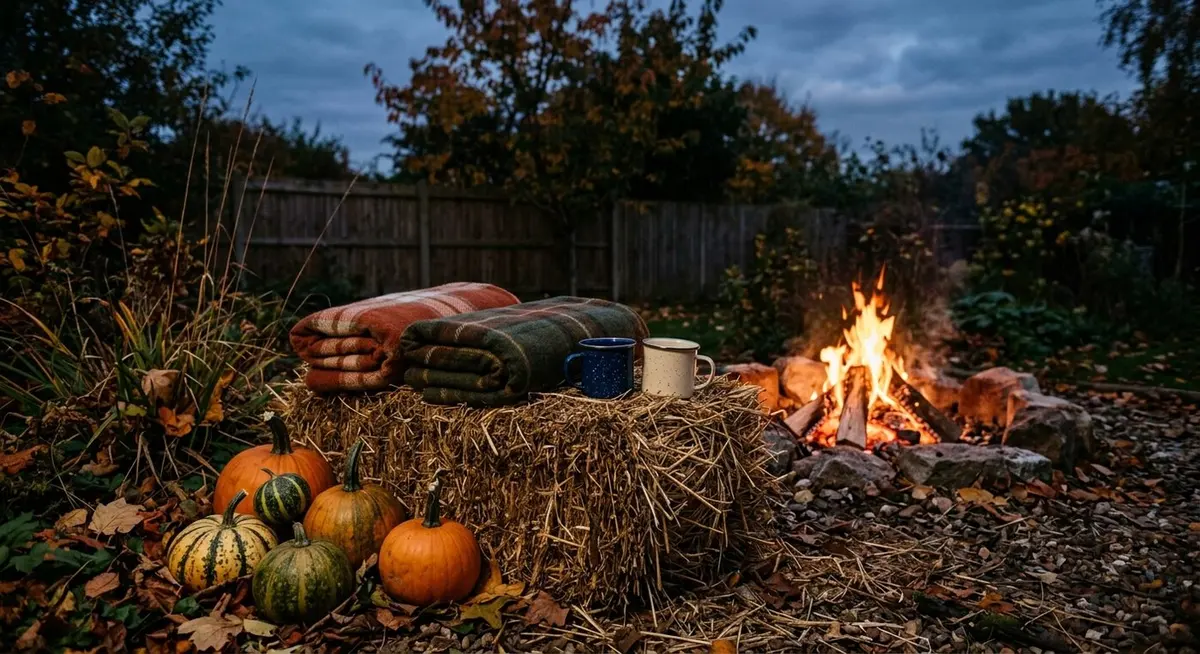
A backyard campfire. You do not need to go anywhere. A fire pit, blankets, hay bales and a flask of cocoa turns a Tuesday evening into something the children will talk about for a week. Check your local rules on open fires first.
A moonlit walk. A walk around the block after dark, with torches and a thermos, is a completely different experience from the same walk in daylight. Pick a clear night and go before the children are too tired to enjoy it.
A Halloween food board. A big board of cheese, crackers, grapes, salami and whatever else is in the fridge, arranged with a few spooky touches, is dinner and an activity at once. Let the children do the arranging.
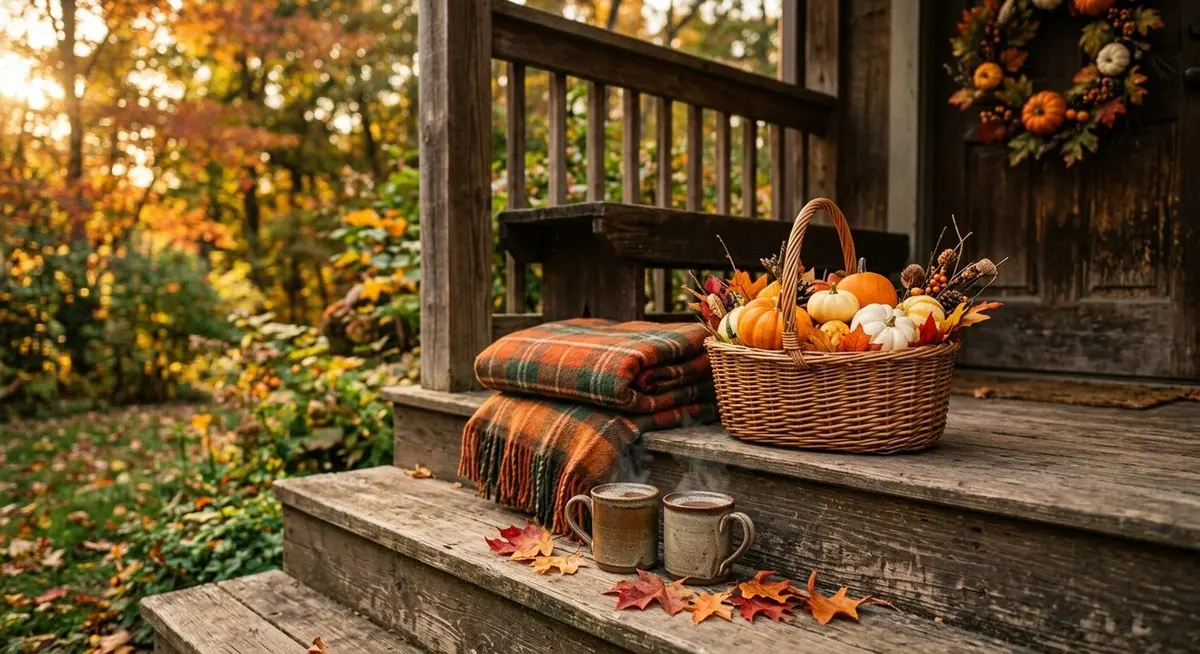
Decorating the porch together. Pumpkins, a wreath, a few lanterns. It takes an hour, it is genuinely fun, and you get to look at it every day for the next six weeks.
A film and cocoa night. The reliable one. Save it for the evening when everyone is tired and nothing else is going to work.
A backyard fire needs no planning, no booking and no drive — which is exactly why it happens more often than the big outings do.
The evening rule: start earlier than feels necessary. An activity that begins at 5:30 with a warm child is a success; the same activity at 7:00 with a tired one is a meltdown. If you only remember one thing from this section, remember the start time.
Outings Worth the Drive
These are the ones you plan a week ahead, and they are worth doing properly rather than squeezing two into one day. Pick one, give it the whole morning, and let it be the memory for that weekend.
The big outings, and how to get them right
Outing
Best for
Go when
Make it better
Apple picking
All ages
Early September, before the good varieties go
Take a wagon ride if the farm offers one; buy more than you need
A farm visit
Under 8
Any dry weekend in October
Go in the morning when the animals are active and the queues are short
A corn maze
5 and up
Late afternoon, or after dark for older children
Take a photo of the map before you go in; agree a meeting point
A cider mill
All ages
Any weekend, ideally before noon
Look for one with a playground and animals, not just a shop
A canopy walk
6 and up
Peak colour, usually mid to late October
Check the height restrictions before you drive there
A pumpkin patch
All ages
Early to mid October
Go to a farm field rather than a display; the search is the activity
One outing per weekend, maximum. The families who do the most in autumn are not the ones who fit in the most outings — they are the ones who give each outing enough time to be enjoyable. Two half-days beat one rushed day every time, and a child who is not being hurried will actually remember where they went.
Rainy-Day Swaps for Every Outdoor Plan
Autumn rain is not a reason to cancel the season, it is a reason to have a second plan ready. Every outdoor activity on this list has an indoor version that keeps the same spirit, so a wet Saturday does not become a screen-time Saturday by default.
If it rains, do this instead
You had planned
Do this instead
Why it works
Apple picking
Bake with the apples you already have, or make a food board
Same produce, same kitchen, no drive
Leaf play
Wax the leaves you collected last week, or make a leaf garland
Uses the same materials, indoors
A nature walk
A scavenger hunt around the house, or a window bird watch
Keeps the looking-and-finding habit going
A pumpkin patch
Decorate the pumpkins you have with leaves, acorns and paint
The decorating is the part children remember anyway
A campfire
A film and cocoa night, or a board game by lamplight
Same cosiness, no smoke
A corn maze
Build an indoor obstacle course from cushions and blankets
Same problem-solving, no mud
Keep a wet-day box. One plastic tub with the craft glue, the twine, the wax, the food colouring, the baking soda and a stack of parchment. When the rain starts, the box comes out and the decision is already made. The families who handle wet weekends well are not more organised — they just decided once, in September, instead of every time it rains.
The Safety Checklist Nobody Prints
Autumn activities come with a specific set of hazards that are easy to overlook because the activities feel gentle. None of these are reasons to stay inside — they are the two minutes of thought that let you relax once you are out.
Check the leaf pile with your hands before anyone jumps — rakes, stones and sticks hide under leaves.
Supervise all carving, and give children under eight a marker to draw the face while an adult does the cutting.
Keep melted wax in a bowl over simmering water, never on a direct hob, and well out of reach while hot.
Wash hands after handling pumpkins, gourds and outdoor produce, and after any craft with acorns or seeds.
Check for toxic plants before a foraging walk — berries and some fungi are genuinely dangerous, and small children put things in their mouths.
Dress for the temperature, not the photograph: waterproof layers and gloves beat a cute outfit on a cold afternoon.
Agree a meeting point before entering a maze, a farm or a crowded festival, and put your number in an older child’s pocket.
Check local rules before any open fire, and never leave a fire unattended, even for a minute.
The choking risk is the one people miss. Acorns, conkers, dried corn kernels and small pinecones are all the right size and shape to be a problem for a child under three. If you have a toddler in the house, do the nature crafts at the table with the small pieces in a bowl, and sweep the floor afterwards rather than leaving them for later.
A Four-Week Rhythm That Actually Fits
The reason autumn lists fail is that they assume every weekend is free and every child is willing. A rhythm works better than a plan, because it tells you what kind of thing to do without committing you to a specific day. Here is the one that has survived several autumns in our house.
One month, four weekends, one buffer
Week
The shape of it
What to do
Why it is here
Week 1
One outdoor afternoon
Apple picking, or a long leaf walk
Gets the season started while the weather is still kind
Week 2
One messy indoor session
Pumpkin science, or a full craft afternoon
Uses the energy on a day that might otherwise be rained out
Week 3
One big outing
A farm, a corn maze, a cider mill or a canopy walk
The one you plan ahead for, with the whole morning given to it
Week 4
One quiet evening
A campfire, a moonlit walk, or a film and cocoa night
Ends the month gently, and works even when everyone is tired
Buffer
Nothing at all
Whatever you did not get to, or nothing
The week that makes the other four possible
Build in the buffer week deliberately. A four-week plan with no slack is a plan that fails the first time someone gets a cold. The buffer is not laziness — it is the reason the other four weeks survive contact with real life. If you get to the end of the month and the buffer is still empty, that is a success, not a failure.
Questions Parents Actually Ask
These are the ones that come up every autumn, usually the night before. Most of them come down to timing, weather or age — and most of them have a simpler answer than expected.
How many fall activities should we actually plan?
Three. Pick three for the whole season, write them somewhere visible, and treat everything else as a bonus. Families who plan three do three; families who plan thirty do none and feel guilty about it. If you want a bigger list to draw from, the 100-idea fall bucket list is there for the days that turn out to have room in them.
What is the best fall activity for a toddler?
Leaf play, a short nature walk in a carrier, and a sensory bin. Toddlers learn texture by handling things, so the mess is the activity rather than a side effect of it. The toddler fall activities guide has twenty-five ideas that all take about twenty minutes, which is roughly the attention span you are working with.
When is the best time to go apple picking?
Early September, and earlier than you think. The good varieties are picked out by mid-October, and the orchards get busy from the second weekend. Go on a weekday if you possibly can, and buy more apples than you need — the baking is half the point.
Is the pumpkin science experiment safe for young children?
Yes, with supervision. Baking soda, vinegar, dish soap and food colouring are all safe to handle, but the mixture is not for drinking and the food colouring will stain clothes. Do it on a tray with a lip, keep the vinegar bottle out of reach, and wash hands afterwards.
What do we do when it rains on the day we planned something?
Have a wet-day box ready and swap to the indoor version of the same activity. Apple picking becomes baking, leaf play becomes waxing leaves, a campfire becomes a film and cocoa night. The activity changes; the spirit of the day does not.
How do we keep older children interested in family activities?
Give them a real job rather than a harder version of the same task. A nine-year-old in charge of the camera, the map or the fire will stay engaged for an hour on an activity designed for a four-year-old. Being needed is what keeps older children in the room.
What is the one autumn activity worth doing every single year?
A backyard campfire. It needs no booking, no drive and no good weather, it works for every age, and it is the one the children ask for again the following year. If you only protect one tradition, protect that one.
How do we stop the season feeling like a checklist?
Stop trying to do the whole list. Autumn is six weeks long and you have a life. Three planned activities, one buffer week and permission to do nothing is a better autumn than a perfectly executed schedule — and it is the one your children will actually remember.
Free Printable: The Fall Family Activity Planner
A printable companion to this guide — all forty activities as tick-sheets sorted by the kind of day each one needs, the four-week rhythm planner, the age-and-skills chart, the safety checklist, rainy-day swap cards to cut out and a memory log for the season.
PDF · 6 pages · prints on letter or A4 · subscribe to unlock the download
Savory Discovery · By Elowen Thorn · Last updated September 2026. Always check local rules before lighting an open fire, and supervise children around carving tools, hot wax and small natural materials.
Elowen Thorn I cook, photograph and re-test every recipe in an ordinary home kitchen before it goes up, so what you make matches what you see. Savory Discovery is where simple weeknight cooking, seasonal ideas and the odd bit of kitchen craft sit side by side — written plainly, and worth cooking twice.