By Elowen Thorn · Family Activities · Thanksgiving
Every November the same thing happens in my kitchen. Somebody says we should do something to mark the day, somebody else says we should not overcomplicate it, and nothing gets decided until the parade is already on. So I started writing the ideas down in October instead. Here are twelve that have survived contact with real children, real cousins, a real kitchen and a real clock — plus the bit the lists always leave out: how to choose the three you will actually finish.
Gratitude is not a feeling children are born with. It is a habit of noticing, and habits are built the same way all the way through childhood: by doing the same small thing often enough that it stops being an instruction and starts being a reflex. A single conversation on a Thursday afternoon will not do that. Twelve short conversations across a childhood will.
The second thing these activities do is quieter but just as useful. They give a child a role on a day that is otherwise run entirely by adults. On Thanksgiving, most children are moved around a table that was set by somebody else, fed food they did not choose, and told to wait. Handing a seven-year-old one real job that matters — getting the names on the right place cards, or reading the jar aloud — changes how the whole day feels to them. That is usually worth more than the activity itself.
Most of these activities need nothing you cannot find in a kitchen drawer. The tablecloths and the pens are the whole investment.
The rule that holds all twelve together: one real job per child, chosen by the child, announced before the day starts. Everything below is just a way of giving that job.
How to Choose the Three That Will Happen
Twelve ideas is a menu, not a plan. Choosing all twelve is the single most reliable way to have a miserable day, because you will spend it chasing your own agenda while everyone else is trying to enjoy themselves. Pick three, and pick them deliberately.
Ask three questions before you choose
Who will actually be in the room? An activity built for a four-year-old will be resented by a ten-year-old, and the reverse wastes the little one entirely. Start with the age spread and work backwards.
How much of your own attention does it need? Anything that needs you at the table is a genuine commitment of an hour, not fifteen minutes. Count the hour honestly or choose something else.
What happens if it goes badly? A ruined tablecloth is a story. A ruined meal is a crisis. Do not put an activity in the path of the food unless you have a second plan.
The twelve, sorted so you can pick fast
Activity
Best ages
Adult time
Prep ahead?
Gratitude tablecloth
4 and up
20 min
Buy the pens
Family interview
7 and up
30 min
Ask the relative
Gratitude jar
3 and up
10 min
Cut the slips
Goodness chain
4 and up
25 min
Cut the strips
Thankful tree
3 and up
20 min
Find the branch
Photo story of the year
6 and up
40 min
Gather the photos
Place-card workshop
5 and up
30 min
Blank the cards
Kitchen crew
6 and up
1 hour
Choose one dish each
Leaf-and-candle centrepiece
5 and up
25 min
Press the leaves
Thank-you assembly line
5 and up
30 min
Write the list
Neighbourhood delivery
6 and up
45 min
Address them
Game hour
5 and up
45 min
Learn the rules
Cutting the paper strips and blanking the cards a fortnight early is what turns a good intention into something that actually happens on the day.
The cut you will not want to make: drop the one you are most excited about. The activity you are personally invested in is the one you will push hardest, and pushing is what turns it into a chore for everyone else. Let it be next year’s.
The Gratitude Tablecloth
This is the one I would keep if I could only keep one, because it compounds. Buy a plain cream or white cotton tablecloth — nothing precious, nothing you will panic about — and a set of fabric pens. Each year, every person at the table adds their name, the date, and one thing they were thankful for. That is the entire activity.
The first year looks sparse and slightly disappointing. The fourth year, when the cloth comes out of the drawer and a nine-year-old finds their own four-year-old handwriting next to their grandmother’s, it stops being a craft and becomes a record. Give it ten years and it is the most valuable thing in the house.
Buy a plain cotton tablecloth a size larger than you need, and a set of fabric pens. Iron the cloth flat before anyone writes on it; wrinkles make the pen skip.
Write the year in one corner first, in a colour nobody else is using. That single line keeps ten years of entries in order.
Let each person add their name and one thing they are thankful for. Younger children draw a picture instead — a drawing from a five-year-old ages better than any sentence.
Fix the ink properly. Most fabric pens need heat setting: wait for the ink to dry completely, then press the cloth with a hot iron over a clean cloth for a minute or two, or tumble it on high for half an hour.
Wash it cold and separately the first time. Then keep it folded flat, not bundled, and store it with the Thanksgiving things so it is never lost in July.
The cloth does not need to be white. A warm cream or a soft oatmeal shows the ink just as well and hides the gravy better.
Test one pen on an inside hem before the day. Some fabric pens bleed badly on cotton and there is no fixing it afterwards.
Keep one corner permanently free. In eight years you will want the space.
Why this one lasts: it is the only activity on this list that gets better with age. Everything else is a good afternoon. This is an heirloom, and it costs about the same as a decent bottle of wine.
The Family Interview
Give a child a phone, a set of questions and one relative, and send them off for fifteen minutes. What comes back is usually the best part of the day, and nobody expects it.
The trick is the questions. “What was Thanksgiving like when you were little?” produces a polite sentence. Specific questions about objects, smells and small humiliations produce stories, because that is how memory actually works — it hangs on details.
Questions that get real answers
What did your kitchen smell like on Thanksgiving when you were my age? Smell unlocks memory faster than anything else you can ask.
Who was always at your table, and who is not there any more? Handle this one gently, and let the silence sit if it comes.
What was the worst dish anyone ever brought? Children love this question and relatives love answering it. It breaks the ice for everything after.
What did you have to do that you hated? Every generation had a chore. This is where the good stories live.
Was there a year the whole thing went wrong? Nobody remembers a Thanksgiving that went perfectly.
What do you want us to still be doing in twenty years? End on this. It is the one question that turns an interview into a message.
How to set it up so it works
Ask the relative a fortnight in advance. Springing an interview on someone mid-carving is how you get two polite minutes.
Write the questions on an index card in large letters. A child reading off a card looks prepared; a child reading off a phone looks distracted.
Record the audio, not the video. Audio is far less self-conscious for both people, and it is the part you will actually want in ten years.
Sit somewhere quieter than the kitchen. The living room with the door shut is fine; a good recording matters more than being in the middle of things.
Afterwards, write the person’s name, the date and one line about the interview on a slip of paper and add it to the gratitude jar.
Keep the audio files in one folder named by year. In five years you will have a small archive and no idea how you would have got it otherwise.
If the relative is not going to make it: do the interview by phone or video a week early and play it at the table. Nobody has ever regretted recording a grandparent’s voice. Plenty of people regret not doing it.
The Jar, the Chain and the Tree
These three are variations on the same idea — catch gratitude in something physical — and they suit different ages and different rooms. Pick one. Running all three is more paperwork than any household needs.
The gratitude jar: for the quietest household
Put a wide-mouthed jar, a stack of small slips and a pencil pot on the table in the first week of November. Everyone adds to it whenever they pass. On Thanksgiving Day, before the plates are cleared, somebody reads the slips aloud.
Use a wide-mouthed jar. Narrow-necked jars look better and are a nightmare to get slips out of.
One slip, one thing. A slip with four items on it reads as a list. A slip with one item reads as a moment.
Include the small and the silly. “The dog finally stopped barking at the postman” is a better slip than “family”, and children copy what they see you write.
Read them in a random order. Shuffle first, so the last slip is not always the most impressive one.
The goodness chain: for the children who need to move
Cut construction paper into strips. Everyone writes or draws one good thing on each strip, then the strips are looped and glued into a chain that grows across the week. Hang it somewhere it will be seen, not somewhere it will be tidy.
Cut the strips a fortnight early. Cutting paper on the day is what kills this activity before it starts.
Set a target that is reachable: one strip per person per day for the week before.
Loop each new strip through the last one and tape or glue it shut. Tape holds faster than glue, and speed matters with small children.
Date the first and last loop lightly in pencil so you know the year later.
Hang it low. A chain at adult eye level is decoration; a chain at child height is theirs.
The thankful tree: for a table centrepiece that does work
A branch, a stable base, a stack of blank tags and a hole punch. Everyone writes one thing on a tag, threads it with twine and hangs it on the branch. By dessert it is a small tree of the year’s better moments.
Find the branch a week early and let it dry out. Fresh branches drop leaves onto the plates.
Stand it in a pot of sand or gravel, or wire it to a heavy jar lid hidden under a cloth. Nothing ends a centrepiece faster than the fourth-grader knocking it over.
Punch the holes before people start writing, not after. Nobody wants to queue for a hole punch holding a finished tag.
Hang the tags in the order they arrive rather than rearranging them. It looks better and stops the comparing.
The Photo Story of the Year
Most families have several thousand photographs and almost no stories. This activity fixes that in about forty minutes, and it is one of the few that works just as well with teenagers, who will otherwise be on their phones anyway.
A week before, pull twenty or thirty photographs from the year into one folder or one album. Do not curate too hard; some ordinary ones make it better.
At the table, spread them out or cast them to a screen, and ask each person to choose the one that says the most about the year.
Each person explains their choice in a sentence or two. This is the part that matters. The choosing is just the excuse.
Write the year and the chosen moments on a single sheet and add it to the jar or the binder.
Photograph the sheet, not the screen. A sheet of paper survives a decade of phone upgrades.
The two-question version
If forty minutes is not realistic, ask two questions instead and answer them around the table. What was the best ordinary day of this year? What is the one thing you want to remember about it? The second question is what turns a nice chat into something worth writing down. Both work at a table of four or fourteen.
The Place-Card Workshop
Place cards are the single best job to give a child at Thanksgiving, because they are genuinely needed and genuinely visible. A child who wrote every name at the table has, in a small way, run the seating.
Skip the printed template. Blank folded card stock, a stack of coloured pencils, and one rule: name on the front, one sentence of thanks on the back. Then, before the meal, each person turns their card over and reads what is on it.
Who can do which bit
Age
Their job
What they need
3 to 4
Draw a picture on the front of each card
Chunky pencils, help with the names
5 to 6
Write the shorter names themselves
A list on a separate sheet to copy from
7 to 9
Write every name and fold the cards
Card stock, a ruler to fold straight
10 and up
Own the whole table: cards, seating and the reading
The guest list a week early
Write the guest list out by hand first, in capitals, on a separate sheet. Children copy what they can see, and a child copying from a phone screen will make three mistakes and lose interest. A hand-written list also lets you correct spellings without anyone feeling caught out.
The Kitchen Crew
Cooking together is the most obvious family activity there is, and the one most often reduced to handing a child a wooden spoon and telling them to stir. Done properly it is the activity that makes the biggest difference, because it ends in something everybody eats.
The structure that works is one dish per person, and it has to be a real dish. Not a garnish. A real component of the meal that the table will notice if it is missing.
Bread is the ideal first real dish: cheap enough to fail at, forgiving of an enthusiastic hand, and impressive when it works.
Real jobs by age, and what they teach
Age
Their dish
Why it is the right one
5 to 6
The butter dish and the bread basket
Assembly with a visible result; nothing can burn
7 to 8
Mashed potatoes, start to finish
Peeling, boiling and mashing; the whole arc in one job
9 to 10
A salad and its dressing
Measurement, tasting, adjusting; the first real seasoning job
11 to 12
A tray of rolls, from dough
Waiting, proving and timing; the best teacher of patience in a kitchen
13 and up
A side dish of their choosing, entirely alone
Ownership, planning and the risk of real failure
Name each person’s dish out loud at breakfast. Ownership starts with being announced.
Give one adult the role of helper, not overseer. An overseer turns the kitchen back into a classroom.
Let the small child who is not cooking be in charge of the timer. It is a real job and it keeps hands off the hob.
Accept the mess. A kitchen used properly by children is a kitchen that looks used properly by children.
Say the name of each cook when the dish goes on the table. This is the part they remember.
The one thing to get right: let them do the whole job, including the part you would rather do yourself. A nine-year-old who salted the potatoes too hard and heard about it is learning something a nine-year-old who watched you salt them is not.
The Leaf-and-Candle Centrepiece
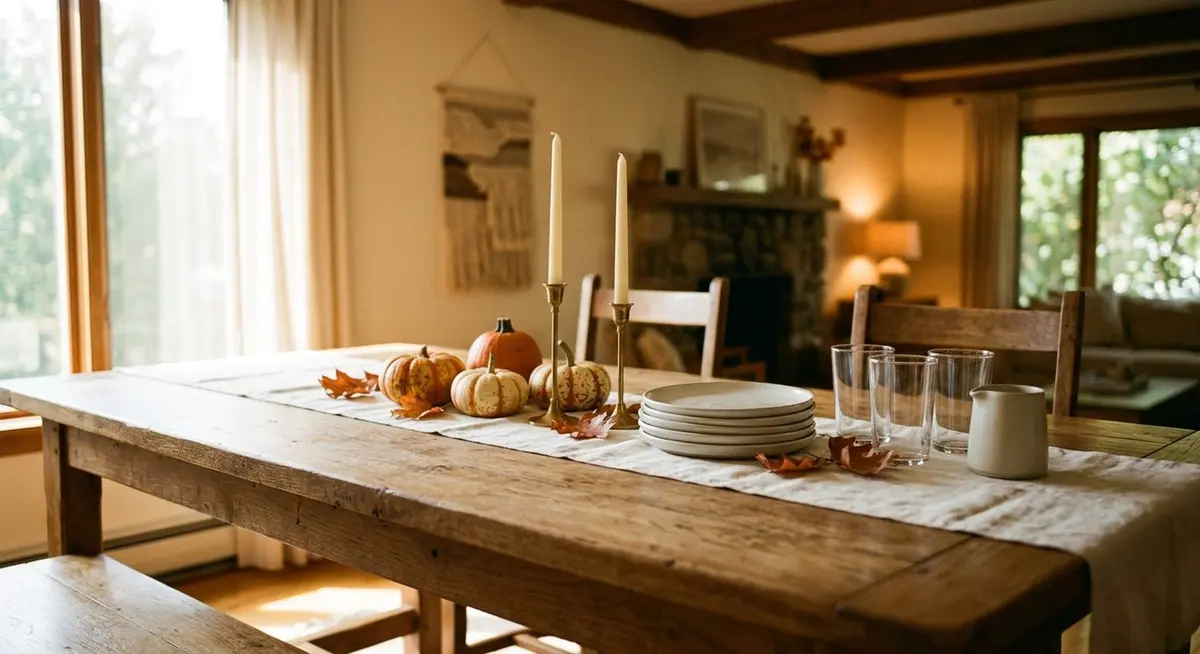
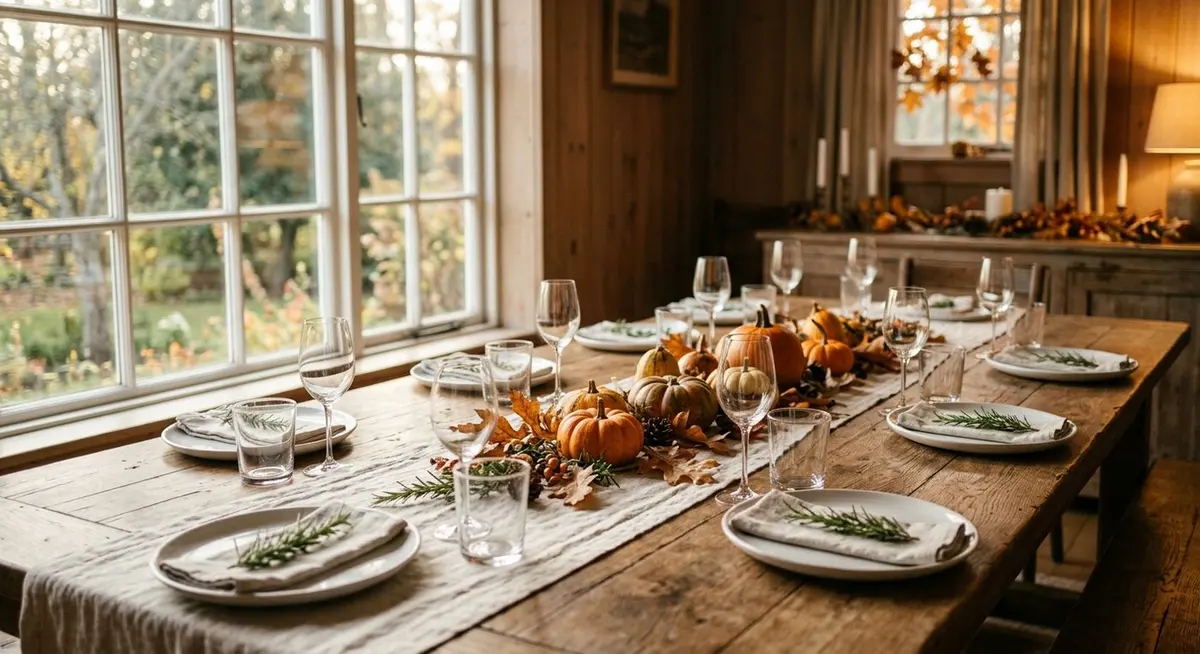
Twenty minutes, a walk, and the table is done. This is the activity that does double duty: it gets everybody outdoors on a day when the house is too full, and it means the table is decorated by the people sitting at it.
Go for a short walk and collect clean, dry leaves in rust, gold and deep green. Avoid anything damp or spotted, and avoid anything you cannot identify if there are toddlers in the house.
Press the leaves between two sheets of newspaper under a heavy book for a day or two. Flat leaves look deliberate; curled ones look like litter.
Arrange the leaves around two or three short pillar candles in glass holders on a shallow dish or a cake stand.
Add one sprig of something evergreen or a few small pinecones if you have them. Three textures is enough.
Keep the arrangement low. Anything taller than a candle becomes a thing to look around rather than at.
Nothing goes on a surface a candle can reach over. If it seems close, move it further out.
Battery candles are not a compromise here. With small children at the table they are simply the better choice, and modern ones look convincing in a glass holder.
Test the arrangement before the meal, when the table is still empty. Rearranging a centrepiece around hot serving dishes is how candles get knocked over.
Photograph it that evening. Leaves do not keep, and the photograph is what you will still have next November.
The Thank-You Assembly Line
Gratitude aimed at nobody in particular stays abstract. Pointed at an actual person, it becomes a skill, and one that a child will use for the rest of their life. This activity has two halves and both of them matter: writing the card, and delivering it.
The writing
Make a list of eight to twelve people who have helped the family this year. Include the ones children forget: a coach, a bus driver, a neighbour, a teacher, a grandparent’s carer.
Write each name on an envelope and put the envelopes in a bowl. Draw the number your family can realistically finish this week — four is a good number.
Each person writes one or two sentences and signs their own name. Younger children draw instead; a drawing on a card is a complete contribution.
Seal them and write the addresses together. Handwriting the address matters more than you would think; it makes the delivery feel like an errand and not a formality.
The delivery
Delivering is the half most families skip, and it is the half that teaches the lesson. Walk them round on the Friday or the Saturday. Handing a card to a person who did not expect one is an experience no amount of explaining can substitute for, and it takes twenty minutes.
Bring the children who wrote them. Posting through a letterbox is fine; handing it over is the point.
Do not script the conversation. Let them be a bit awkward. The awkwardness is the lesson.
Include one person who is not expecting anything at all. A shopkeeper, a neighbour, the person who always waves. That is where the surprise lives.
A note on the delivery: do not test whether the card is still on the mantelpiece next time you visit. The point is the giving, not the receiving, and a child who learns to check will stop wanting to give.
The Game Hour
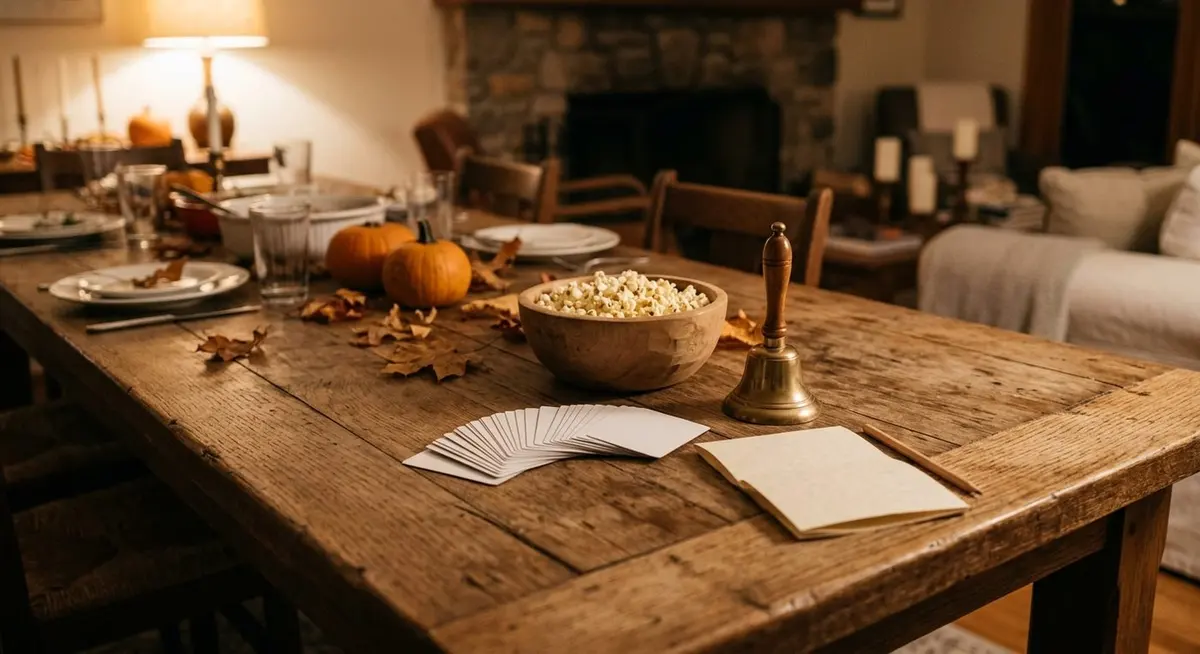
The hour between the plates being cleared and everybody finally leaving is the hardest hour of the day. The food is finished, the energy has nowhere to go, and the adults are too tired to do anything about it. That is what the game hour is for.
The rule that makes it work is one game, everybody plays, and it is chosen before the day rather than in the moment. A room that has already argued about what to play will not agree twice.
Picking your game by the room you have
The room
The game
Why it fits
Mixed ages, 4 to 70
Charades in two teams
No equipment, no reading, the youngest can mime
Everyone is competitive
A card game with a short hand
Under ten minutes a round, so nobody is stuck losing for an hour
Everybody is tired
Twenty questions
You can play it sitting down, half-asleep
A few really small children
A hunt for twelve hidden leaves
Movement, no rules to explain, over in ten minutes
A big crowd, 12 or more
Two parallel games, then winners play
Nobody waits long enough to get bored
Choose the game before the day, and say so at the table before the plates are cleared.
Pick something with a round shorter than fifteen minutes so players can rotate.
Put one teenager in charge of explaining the rules to the youngest. It gives them a job and it keeps the rules simple.
Have a second game ready in case the first one lands badly. Do not make anybody defend the choice.
Stop while it is still fun. The last round should be one people wanted, not one they endured.
Matching the Job to the Child
Most Thanksgiving-day disappointment comes from giving a child a job that does not match them. Too small and they wander off; too big and they freeze. Here is what actually holds attention at each stage.
What works at each age
Age
What holds their attention
What to avoid
Under 3
Tearing paper, dropping slips into the jar, handing things to people
Anything with scissors, glue or a waiting period
3 to 4
Drawing on cards and tags, collecting leaves, putting things in containers
Writing, and any job with a right answer
5 to 6
Writing short names, gluing chain loops, setting out the place cards
Long instructions with more than two steps
7 to 9
The whole interview from a written card, their own real dish, the table plan
Being watched while they work
10 to 12
Running something — the chain, the tree, the game hour — and reading aloud
Being given a job that is really busywork
13 and up
Owning one dish completely, recording the interview, driving the delivery round
Being treated as a helper rather than a person in charge
If you only remember one line from this article: teenagers are the most under-used people at a Thanksgiving table. They are capable of running almost everything here. Most of them are waiting to be asked.
A Realistic Timeline for the Day
The mistake almost everybody makes is trying to fit these into the afternoon, when the kitchen owns the afternoon. The activities that work best need the morning, and the ones that need people at a table need the hour after the meal.
What to do when
Time
What is happening
Who is free
The week before
Cut paper, blank cards, find the branch, print the questions
One adult, half an hour
The night before
Jar on the table, index cards written, phone charged for the interview
One adult, ten minutes
Morning, before the kitchen
The interview, the tablecloth, the centrepiece walk
Everyone
While the bird rests
Place cards finished and set, chain loops added
Children and one adult
After the meal
Jar read aloud, then the game hour
Everyone
The following weekend
Deliver the thank-you cards
Whoever wrote them
Read that table as a menu, not a schedule. The shape is the point: one activity that needs a calm room first thing, one that needs a table full of people, and one that needs a pair of shoes and a short walk. Fill those three slots and the day looks after itself.
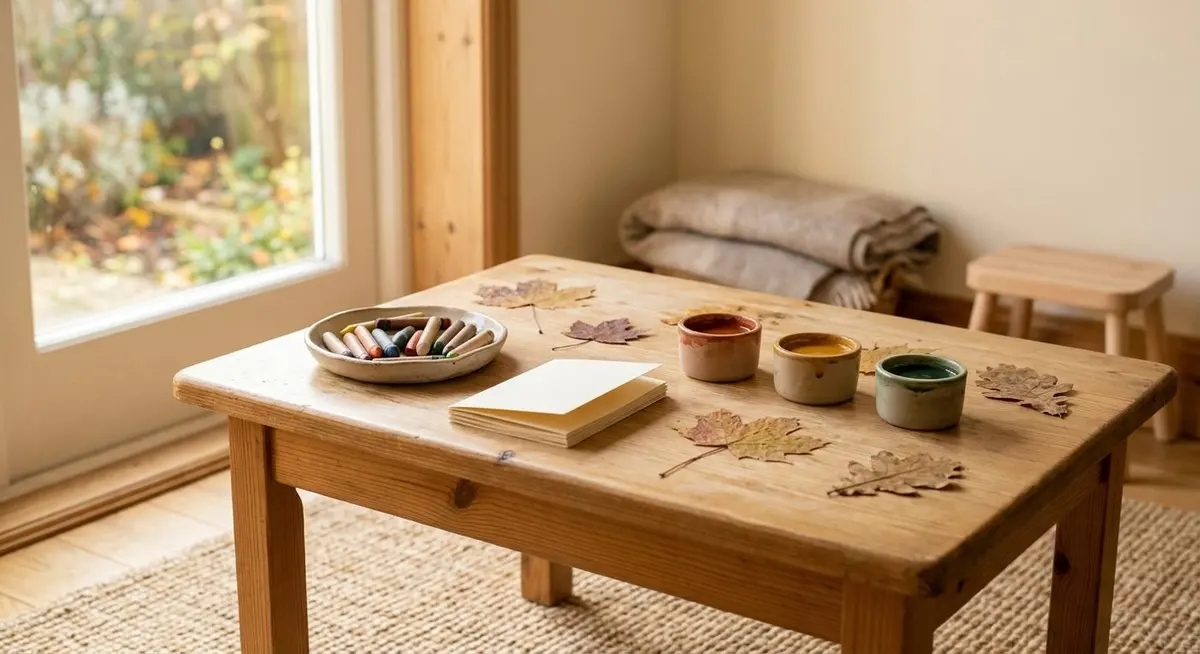
A low table by a window will keep a four-year-old occupied for twenty minutes with no adult sitting down. That is worth arranging in advance.
When It Starts Going Sideways
The day will not run to plan. Here is what usually goes wrong and the smallest fix that works.
Common problems, honest fixes
What happened
What to do
Nobody wants to stop and do an activity
Drop it. Do the one that needs no setup and no audience, usually the jar. Trying to force a mood is how you lose the room
One child is doing everything and another is watching
Give the watcher the job of photographing or timing. A real role always beats a consolation prize
The craft has turned into a mess and a fight
Stop it and put the table back. Running it out has never once worked
The food is late and the children are hungry
Feed them first, activity after. Hungry children do not want to be grateful
A relative is not interested in joining in
Let them watch. Participation cannot be mandated, and a spectator is not a problem
You are the only adult holding it all together
Do the tablecloth and nothing else. It is the one that survives being done badly
The activity is over in four minutes
That is a success, not a failure. Ten good minutes is what these are for
Troubleshooting and Questions
These come up every year, in roughly this order. Most of them are really the same question: how do I do this without turning a family day into a curriculum.
Do I really need to do all twelve?
No, and you should not try. Pick three. One that needs a calm room in the morning, one that needs the whole table, and one that gets everybody outside. Three finished activities leave everyone feeling good about the day; twelve attempted ones leave everyone tired and slightly resentful, and the children will remember the resentment rather than the gratitude.
What is the best activity if we only have twenty minutes?
The gratitude jar. It needs no setup beyond a jar and some slips, it works from age three upwards, it does not require anybody to be good at anything, and it produces something you will read aloud. If you have twenty minutes and one adult, that is the one to do.
Can we do these activities when it is not Thanksgiving?
All of them, and several work better on an ordinary weekend. The interview and the thank-you cards are excellent in the middle of a plain month, when nobody expects them. The tablecloth, the chain and the jar are the ones that gain their weight from being annual.
How do I include a teenager who would rather be somewhere else?
Give them a job with real responsibility and no supervision. Recording the interview, running the whole game hour, or cooking one dish completely on their own all work, because each of them is a real thing that would otherwise be an adult’s job. Being handed genuine responsibility is the one offer most teenagers will accept.
What if the relatives are not religious and we want to keep it that way?
Nothing here depends on faith. The gratitude jar, the chain, the tree, the interview and the thank-you cards are about noticing and thanking other people. If somebody wants to add a prayer or a reading at the table, that fits beside these activities perfectly well; if nobody does, the day still holds together.
Is it too late to start the week before Thanksgiving?
No. Cut the paper on a Tuesday and you are ahead. The only activity that genuinely needs warning is the interview, because you have to ask the relative, and the only one that needs two days is pressing the leaves. Everything else can be started on the morning itself.
How do we keep it from becoming a lot of extra work?
Do fewer things, and do them the same way every year. Year two of the tablecloth takes twenty minutes because the pens and the cloth are already in the drawer. The families who find this exhausting are usually the ones starting something new and elaborate each November instead of repeating three things they already know.
What do we do with everything afterwards?
Photograph it, then put it away together and in one place. The chain, the tree tags and this year’s place cards go in the same box as the tablecloth and the jar, so next November there is one box to open rather than a search through the house. Anything that cannot be stored, photograph and let go of.
Free Printable: The Thanksgiving Family Activity Planner
A printable companion to this article — all twelve activities at a glance, the supplies to gather, a four-week countdown, a gratitude journal page, place-card templates to cut out, a morning checklist and a reset list for after the meal.
PDF · 4 pages · prints on letter or A4 · subscribe to unlock the download
If you want the same care applied to the rest of the season, the fall bucket list is where we keep the ideas that work between now and the first frost, and the printable fall scavenger hunt is the one we reach for on any ordinary Saturday that needs rescuing. For the quieter family evenings that follow the holiday, these night routine cards do more for the week than any single day does. And when the table is finally quiet again, a loaf of pumpkin bread is the thing I bake to make the house feel like the day is not quite over.
Savory Discovery · By Elowen Thorn · Last updated September 2026. Ages and timings are a guide drawn from our own family holidays; adjust them for your own table.
Elowen Thorn I cook, photograph and re-test every recipe in an ordinary home kitchen before it goes up, so what you make matches what you see. Savory Discovery is where simple weeknight cooking, seasonal ideas and the odd bit of kitchen craft sit side by side — written plainly, and worth cooking twice.