By Elowen Thorn · Autumn Family Fun · Free printable inside
A scavenger hunt is the cheapest way I know to get children outside in autumn and keep them there. No booking, no equipment, no drive. You print one page, hand it over, and a walk that would have lasted nine minutes lasts an hour and a half. This is the version we have run every October for years, with the list, the rules and the age tweaks that make it work for a three-year-old and a ten-year-old on the same afternoon.
Ask a child to go for a walk and you get a negotiation. Hand them a list and you get a search. That is the whole trick, and it is not a small one. A list gives the walk a job, and a job gives a child a reason to look at the ground instead of at the distance to the car.
There is a second reason it works so well in autumn specifically. Fall is the one season when the things on the list are genuinely everywhere. You do not need a nature reserve or a good eye. A suburban pavement, a school field, a park with three trees and a hedge will produce almost everything on a well-written autumn list, and that means the hunt succeeds on the first try, which is what makes a child want to do it again.
It is also, and this matters more than it should, free. The only cost is one sheet of paper and a few minutes of printer ink. There is no booking to make, no kit to buy, no weather window to plan around. If the afternoon falls apart, you have lost nothing but a page. If you want more of these low-cost afternoons, our 100-idea fall bucket list is built entirely from them.
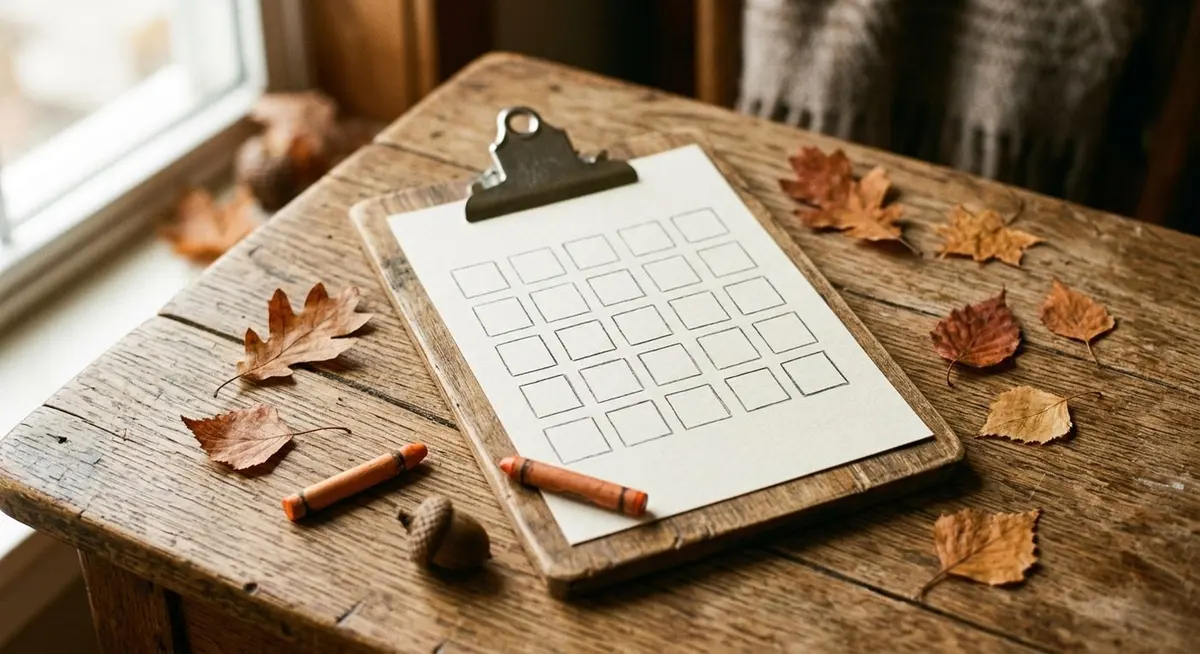
One page, one clipboard, one pencil. That is the entire setup for an afternoon outside.
The one rule that makes it work: the list has to be finishable. A hunt where a child finds nine of twelve items and gives up teaches them that the activity is frustrating. A hunt where they find all twelve teaches them that going outside is rewarding. Write the list for the place you are actually going, not for the place you wish you were going.
What to Put on the List, and What to Leave Off
Twelve items is the sweet spot. Fewer than ten and the hunt is over before anyone has warmed up; more than fifteen and the page becomes a chore. The twelve below are chosen because each one is findable in almost any autumn setting, and because each one gives you something to talk about once it is found.
The twelve items, and why each one earns its place
Item
Where to look
Why it is on the list
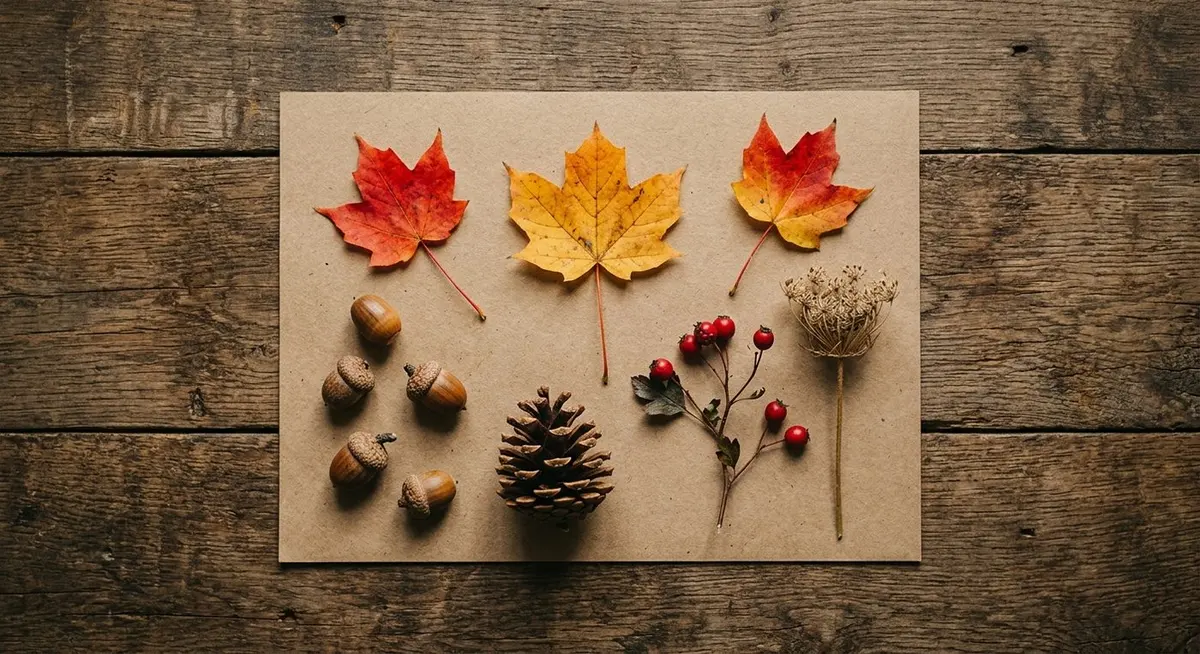
A red leaf
Under any maple, or on the pavement beneath one
The easiest win on the page, and the one that gets a reluctant child started
A yellow leaf
Birch, ash, poplar, or any street tree in October
Forces a colour comparison against the red leaf, which is the first real observation
An orange leaf
Beech, oak, or a mixed hedge
Completes the set and gives you a natural sorting activity for later
An acorn
Beneath any oak, in the grass at the trunk
A hunt with a container built in; children collect these without being asked
A pinecone
Under conifers, or on a park path after wind
Easy to spot, satisfying to hold, and it survives a pocket
A mushroom
Damp grass, tree stumps, shaded edges of a lawn
The item that makes children slow down and look properly at the ground
Berries
Hedgerows, ivy, rowan, holly
A colour pop that is easy to find and easy to spot from a distance
A wildflower
Verge, meadow edge, or a garden that has gone over
The last of the season, and a good prompt for counting petals
A feather
Anywhere, honestly; they are everywhere
The wildcard that keeps a hunt alive when the leaves have been raked
A squirrel
Any park with trees, especially mid-morning
The one moving item, which turns the hunt into a watching game
A bird
Sky, hedge, fence, feeder
Rewards looking up, which children almost never do unprompted
The seasonal anchor; almost every street has one by mid-October
Everything on the list fits in two cupped hands. That is deliberate — the hunt should end with a small pile of treasure, not a bag of rubbish.
What to leave off
Anything you have to touch to identify. Unknown mushrooms, unfamiliar berries and anything growing on a dead animal are look-only items. Put them on the list as things to spot, never as things to pick.
Anything rare. If an item needs a specific tree, a specific park or a lucky day, it will be the one that is missing, and it will be the one the child remembers.
Anything that requires trespassing. No items from behind fences, in other people’s gardens, or across a road you would not cross with a five-year-old.
Litter. It is tempting to add a tidy-up item, and it is a lovely idea, but it changes the game from finding to clearing. Keep the two separate and do the litter pick as its own five minutes at the end.
More than one moving animal. Squirrels and birds are enough. A list that depends on a fox, a deer or a hedgehog will fail, and a failed hunt is worse than a short one.
Write the list for your actual route. Before you print, walk the route in your head. If there is no oak on it, take the acorn off. If the park has no conifers, swap the pinecone for a second feather. A list that matches the ground under your feet is the difference between a hunt and a disappointment.
How to Run It, Step by Step
The order below is the one that has survived a lot of Octobers. The important parts are the second step and the last one: set the boundary before you start, and finish while everyone still wants more.
Print the hunt page. One per child is better than one between two, because sharing a pencil is the single most common cause of an argument. If you are printing in black and white, that is fine — just read the items aloud to anyone who cannot read yet.
Set the boundary out loud, before anyone moves. Point at the far end of the field, the gate, the corner of the street. Say it once, clearly, and make them repeat it back. This is the step people skip, and it is the step that keeps the hunt safe.
Hand over the page and the pencil, and let them go. Do not lead. The whole value of the activity is that the child is the one doing the looking, and a parent pointing at an acorn removes that entirely.
Walk behind, not in front. Stay close enough to see them, far enough that they forget you are there. This is the part of the afternoon you get to enjoy.
Tick the items off as they are found, not at the end. The tick is the reward, and a delayed tick is a delayed reward.
When the list is full, stop. Do not add items, do not extend the route, do not suggest one more loop. Ending on a full page is what makes them ask to do it again next week.
Empty the pockets at the door. Leaves and acorns go into a bowl on the windowsill, not into the washing machine. This is also the moment to check for anything that should not have been picked up.
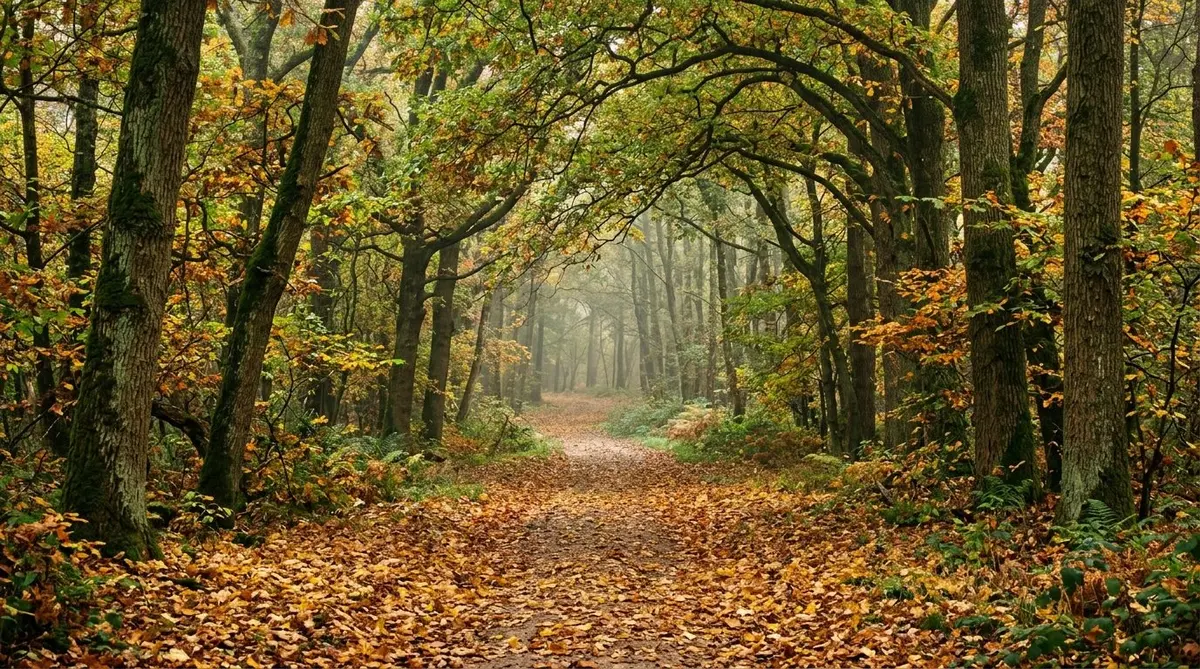
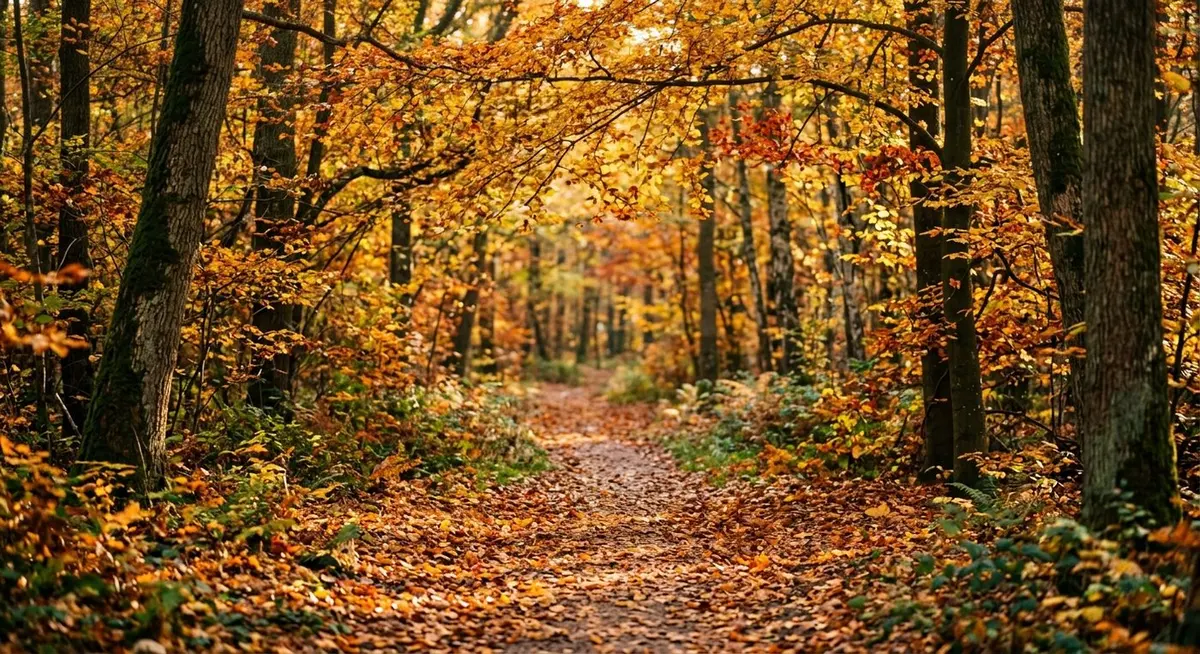
A path like this will fill a twelve-item list in twenty minutes. A bare pavement will take an hour. Both are fine — just write the list for the ground you have.
Bring a spare pencil. It sounds trivial. It is not. A hunt that stops because a pencil rolled into a drain is a hunt that ends in tears, and it takes ten seconds to prevent.
The Same Hunt, Four Different Ages
The list does not change with age. The rules around it do. Here is how the same twelve items work from toddler to ten-year-old, and what to change at each stage so nobody is bored and nobody is lost.
One list, four sets of rules
Age
How to run it
What to change
Under 2
Carry them, or push the buggy, and point at things
Nothing to tick. Name what you see and let them hold a leaf. The hunt is really for you.
2 to 3
Walk beside them and read each item aloud
Use pictures instead of words. Expect to find four or five items, not twelve, and count that as a win.
4 to 6
They hold the page and tick it themselves
Add a quantity to each item — two acorns, three red leaves — to stretch the hunt without making it harder to understand.
7 to 9
They run it, you follow
Add a timer, or split into two teams. This is the age where the competitive version becomes the fun version.
10 to 12
They design the list for a younger child
Writing the hunt is the activity now. Give them the page and let them choose the twelve items for a sibling.
If you have a wide age gap
The single best fix for a mixed-age group is to give the older child a job that is genuinely more interesting than finding. Make them the photographer, the official ticker, or the designer of the next hunt. A ten-year-old who is in charge of the camera will stay engaged for the whole walk, and the four-year-old gets to do the finding without being overtaken. If you are planning a whole season of these, the fall activities for kids guide sorts forty ideas by the kind of day each one needs.
If you have one child
Play against the clock rather than against a sibling. Time the first run, then try to beat it on a different route. Or play the reverse version: you find an item, they have to name it. Both keep a solo hunt from becoming a solo walk.
Eight Ways to Play It Again
The same twelve items will hold a child’s attention for about three outings. After that, change the rules rather than the list, because the list is what makes the hunt findable and the rules are what make it new.
Change the goal
Quantities. Write a number beside each item — three acorns, five red leaves. The hunt becomes a counting game and takes twice as long.
Teams and a timer. Two teams, same list, ten minutes. First team to fill the page wins. Works from about seven upward.
Photograph instead of collect. Nothing comes home. Every find is a photo, and the album at the end is the trophy. This is the version to use in a park that asks you not to take things.
Reverse hunt. You hide the twelve items around the garden and they find them. Best for a wet afternoon and a small space.
Change the conditions
Torchlight. The same list, after dark, with a torch each. Genuinely thrilling, and it works from about six upward. Keep the route short and the boundary tight.
Colour only. Ignore the names and hunt for colour: something red, something gold, something brown, something still green. Excellent for toddlers and for late October when the leaves are all one shade.
Texture hunt. Something smooth, something bumpy, something soft, something prickly. This one turns into a conversation without any effort from you.
Sound hunt. Stand still for one minute and tick off what you hear — a bird, wind in leaves, a dog, water. The perfect version for a child who is tired of walking.
Laminate the page. A laminated hunt card survives rain, pockets and a whole season of reuse, and it means you print once instead of every weekend. A dry-wipe pen wipes straight off.
The Questions That Turn It Into Learning
The hunt is already doing the hard part — it has a child’s attention on the natural world. A few questions at the moment of finding turn that attention into vocabulary, observation and memory, and they cost you nothing but a sentence.
Colour. “Is this red the same red as that one?” Comparing two finds is a far better colour lesson than naming one.
Texture. “Is it bumpy or smooth? What does it feel like on the back of your hand?”
Smell. “Does it smell of anything?” Crushed leaves and pinecones both do, and the answer is usually surprising.
Counting. “How many points does this leaf have? How many petals?” Counting real objects sticks better than counting on a page.
Size order. Line up the finds from smallest to largest. This is early maths, disguised as tidying up.
Sorting. “Which of these came from a tree and which from the ground?” Sorting by a rule is the beginning of classification.
Prediction. “Which one do you think we will find next?” Asking before the next find keeps the hunt moving.
Preference. “Which is your favourite, and why?” The “why” is the part that builds language.
Ask, then wait. The temptation is to answer your own question after two seconds of silence. Count to five in your head instead. Almost every child gets there, and the answer they reach themselves is the one they keep. For more of this kind of thing, the preschool fall activities guide is built around the same idea.
Safety, Weather and the Ten-Minute Rule
A scavenger hunt is about as low-risk as an outdoor activity gets, but the whole point is that the child is looking at the ground rather than at the road, so a few things are worth saying out loud before you start. If you are hunting with a very small child, the simple fall activities for toddlers guide covers the shorter version.
Boundary first, always. Say it, point at it, have them repeat it. This is the single most important line in this article.
Nothing goes in the mouth. Berries, mushrooms and seeds are look-only. Say it plainly, once, at the start.
Look, do not pick, for anything you cannot identify. Unknown mushrooms and unfamiliar berries stay where they are.
Wash hands when you get home. Especially after handling acorns, pinecones and anything from the ground.
Roads and driveways are out of bounds. If the route crosses one, the hunt pauses and hands are held.
Dress for the ground, not the air. Autumn afternoons are warm and autumn grass is wet. Waterproof shoes matter more than a coat.
Weather, and what to do about it
Conditions
Verdict
Adjustment
Dry and bright
Ideal
Run the full list as written
Light rain
Fine
Laminate the page, shorten the route, hunt for colour instead of specific items
Windy
Good
The best feather and leaf day of the season; keep to open ground away from old trees
Heavy rain
Indoors
Switch to the reverse hunt: hide the items around the house
Frost or ice
Careful
Short route, no running, and check the ground before you let them go ahead
Dark
Torchlight only
Short, familiar route, tight boundary, one adult per child
The ten-minute rule. If a child has lost interest for ten minutes, the hunt is over. Do not push it to the end of the list. A hunt that ends early and happily gets repeated; a hunt that is forced to the finish line does not.
Your Printable Hunt and Tracker
The printable below is the companion to this guide, and it is built to be used rather than admired. It carries the twelve-item hunt card in two sizes, a blank card so you can write your own list for your own route, a tick-sheet for the variations, a colour-and-texture hunt for the youngest children, a torchlight version, a find log and a set of questions to ask at the moment of finding.
Print the hunt card, take the walk, and use the log page to keep a record of what you found and when.
Print it on letter or A4, and print the hunt card twice if you have two children. If you want it to last the season, laminate the card and use a dry-wipe pen. Everything in the pack is designed for personal and classroom use, so a teacher can print a class set without asking. If the hunt goes well and you want the next project ready, our no-carve pumpkin decorating ideas and these night routine cards for kids both come with their own printables.
Free Printable: The Fall Scavenger Hunt Pack
The twelve-item hunt card in two sizes, a blank card for your own route, a colour-and-texture hunt for toddlers, a torchlight version, a find log and the question prompts — everything in this guide, ready to print.
PDF · 4 pages · prints on letter or A4 · subscribe to unlock the download
Questions and Troubleshooting
These are the questions that come up most often, usually about ten minutes before a walk. Almost every problem with a scavenger hunt traces back to one of three things: a list that does not match the ground, a boundary that was never set, or a hunt that was pushed past the point of fun.
What age is a fall scavenger hunt suitable for?
It works from about two upward, with the rules changed rather than the list. Toddlers do a picture version and find four or five items; four- to six-year-olds tick the page themselves; seven- to nine-year-olds add a timer or teams; ten- to twelve-year-olds design the next hunt for a younger child. The twelve items stay the same at every age.
What if we cannot find everything on the list?
Change the list, not the child. If an item is missing, it is almost always because the route does not have the tree or the habitat it needs. Walk the route in your head before you print and swap anything that is not genuinely there. A hunt that ends with a full page is the one that gets repeated.
How long should a scavenger hunt take?
Twenty minutes on a leafy woodland path, up to an hour on a bare pavement. If it is running longer than an hour, the list is too hard for the ground you are on. If it is over in ten minutes, add quantities to each item rather than adding new ones.
Can we do this in our own backyard?
Yes, and it is the best place to start. A garden with one tree, a hedge and a patch of grass will produce leaves, berries, a feather and usually a bird. For a wet day, hide the twelve items around the house and run it as a reverse hunt.
Is it safe to pick up acorns, pinecones and leaves?
Yes, with the usual hygiene. Nothing goes in the mouth, unknown mushrooms and berries are look-only, and hands get washed when you come home. Acorns and pinecones are fine to collect and keep.
What do we do with everything we collect?
Keep it small. A bowl on the windowsill, a jar of acorns, or a single pressed leaf is enough. Anything more becomes clutter, and the point of the hunt was the looking, not the hauling. If you would rather take nothing home, run the photograph version instead.
Can I use this with a class or a group?
Yes. Print one card per child, set the boundary as a group before anyone moves, and pair children up so nobody is hunting alone. The pack is designed for personal and classroom use, so a teacher can print a full set.
How do I keep it interesting the second time?
Change the rules, not the list. Add quantities, split into teams, run it after dark with torches, or switch to a colour, texture or sound hunt. The list is what makes the hunt findable; the rules are what make it new.
Savory Discovery · By Elowen Thorn · Last updated September 2026. Always supervise children outdoors and follow local guidance on foraging and picking.
Elowen Thorn I cook, photograph and re-test every recipe in an ordinary home kitchen before it goes up, so what you make matches what you see. Savory Discovery is where simple weeknight cooking, seasonal ideas and the odd bit of kitchen craft sit side by side — written plainly, and worth cooking twice.